The early voting blog, 2026 general

UPDATED, 10/26/26, 10 PM
Late Clark mail update, almost 3-to-1 Ds: 5,539 more mail ballots (D+2,940, R+1,073)
Totals:
D+24,395 (5.5 points), net D+3,943 so far today versus Sunday's final.
More tomorrow....
UPDATED, 10/26/26,9 PM
Greetings fellow data obsessives -- who else is reading this after 9 PM?
The Dems late day/evening surge has occurred again, giving the Ds a 2,000-ballot lead for the day and a 22,500 edge overall as of 9 PM. (I expect mail to come in after this post, but I will do a more extensive update in the AM.)
The Dems won big in in-person voting again in Clark and it was essentially tied in Washoe, so without big margins in the larger rurals, the Dems would have done even better.
The mail has been a blowout again, especially in Clark where the Dems are winning by 24 percentage points:

Almost 439,000 ballots have been cast, or 21 percent of active voters. If turnout is about 1.1 million, that means 40 percent of the vote is in.
2022 comparison does not look good for the Rs:
Democrats lead Republicans in Clark by 36,784 ballots (12.4 points), compared with 20,880 (7.9 points) in 2022. In-person it's D+4,643 versus R+14,932 in 2022, and in mail it's D+32,141 versus D+35,812.
Check out this chart (it uses returned mail not accepted but most will be accepted):

It's pretty stark.
Let's look ahead quickly to the end of in-person early voting:
A few days ago, I said the Ds would get to 25,000 or 30,000 lead statewide by Friday. 25,000 seems like a lock – it may get there by tomorrow.
In 2022, it was D+28,714 in Clark going into the weekend and it was D+39,000-plus by Election Day morning. The Election Day GOP domination by nearly 50,000 ballots saved Lombardo and a few other Republicans.
But if the D surge continues every day, those leads will be much larger by the end of the day Friday – it's already 36,000 in Clark. The question is whether the Ds can build up such a lead in urban Nevada – it's 41,000 now – that whatever happens on Election Day can't save them. (Remember Dems should build a bigger lead over the weekend because it's only mail being counted.)
Here's where things stand as of 9 PM:

It looks from a 2022 model of how Lombardo won that he would need almost 51 percent of the votes left and maybe close to 70 percent of those in the rurals to hold on. Give or take…
Until I post again...
UPDATED, 10/26/26, 4 PM
There are still several hours left in today's tallying, so it's time to start a biennial tradition: showing what's left and what could happen.
I want to focus on the governor's race, and what I show here will apply down the ballot, but even more so. My assumption is Joe Lombardo will run ahead of a generic Republican because A. He's the governor B. His numbers are not as bad as others C. Aaron Ford's base numbers may be a little soft
First, let's set the baseline from 2022:
Dem Gov. Steve Sisolak carried both urban counties, but not by enough. Together Clark and Washoe gave him D+41,421, short of Lombardo's R+56,807 in the rurals.
- Clark: Sisolak 347,397 (51.1%) to Lombardo 308,760 (45.4%), out of 680,355 votes. That's D+38,637 (5.7 points).
- Washoe: Sisolak 94,646 (48.8%) to Lombardo 91,862 (47.3%), out of 194,042 votes. That's D+2,784 (1.4 points).
Clark cast about two-thirds of the governor vote. Lombardo's statewide win of R+15,386 came down to holding Sisolak under 6 points in Clark and nearly even in Washoe.
So let's take a look at a few scenarios, including what it would take for Lombardo to get to the numbers he won with in 2022. Let's assume there are about 700,000 or so votes yet to come.
Short version: The governor would need to get about half of the votes that are left.
Longer version – take a look:


Lombardo cannot lose Clark by double digits and win. He needs to cut the Clark margin by a lot.
Look at it another way – there are probably about half a million votes left in Clark. The current numbers are Democrats by about 34,000, or 12 percent.. If Clark turnout is about 780,000 voters, and if we just talk about Dem ballot leads, to get it to 6 percent, Republicans would be behind by about 47,000 in Clark. That means they would need to lose Clark by only 3 points going forward out of the nearly half million left. Let's see what today brings.
Key data point to remember: Lombardo lost Clark by 5.7 points and the GOP ballot deficit was 4.9 points, so Sisolak ran slightly ahead of the ballot numbers. Will Ford match that? This is why nonpartisans are so important and why Team Lombardo knows they are key. Even if Ford is weaker with the base than Sisolak, and I am not sure he is, Lombardo can't let the ballot lead in Clark be much past 6 points to have any chance.
Which brings me to Washoe in 2022: Republicans led Washoe ballots by 7,388 (3.8 points): Democrats 68,443 (35.4%), Republicans 75,831 (39.2%), Other 49,325 (25.5%). Yet Sisolak won Washoe by 1.4 (2,784 votes), a swing of about 5 points his way, mostly because nonpartisans broke for him.
Washoe has become much more reliable for Dems in statewide races than registration would indicate. And right now:
Washoe is D+4,903 (5.8 points) on 84,064 ballots: Democrats 41.0%, Republicans 35.2%, Other 23.8%. That's nearly 10 points bluer than its 2022 final of R+3.8. This could be a big problem for Lombardo, who lost Washoe by 1.4 points four years ago. If Dems continue to expand their ballot lead there, I am not sure Election Day can save the governor.
Finally, the rurals:
In the rurals four years ago: Republicans led ballots by 53,908 (37.2 points): Democrats 28,727 (19.8%), Republicans 82,635 (57.1%), Other 33,451 (23.1%). Lombardo won them by 39.3 points (56,807 votes), running about 2 points ahead of the Republican ballot edge. NPs in the rurals always lean GOP.
Right now the rurals are R+18,111 (31.4 points) on 57,600 ballots: Democrats 23.4%, Republicans 54.8%, Other 21.8%. That's about 6 points less Republican than their 2022 final of R+37.2.
Bottom line: Lombardo needs to change the dynamic in. every region to hold on to his governorship. And time is running out.
If Lombardo loses, that means a whole lot of Republicans will lose down-ballot. He has a better chance than most because of his campaign and Ford's potential weakness with the base and NPs. But you know what can make up for any weakness? Lots of Dem ballots.
As I post this, the numbers today are about even, but there are several hours left for Clark mail dumps to give the Dems a solid lead. The Dems are holding their own so far in in-person and if they surge late, as they have previously done, the gap could widen again.
Right now, it looks as if every Republican on the ballot not in a R+double-digit district should be worried -- and even a few of those in heavy R districts should be, too.
After I know what the state of play is when early in-person closes Friday, I can model what Lombardo and Republicans would need on Election Day. They might just need a 50K win, as they got in 2022, but in a year with Trump instead of Biden in the White House.
More later…
UPDATED, 10/26/26, 6 :45 AM
Good morning, fellow blog travelers.
A dominant weekend for the Dems in Nevada, with the rurals being closed Sunday helping, too. It got a little worse for the Republicans in Nevada after I went to sleep last night. The Democratic lead went up another 1,000 with some Clark mail, which is now coming in at massive advantages for the Ds (last one yesterday was: D+1,476, R+428, O+719).
Let's see where we are:
Dem ballot lead: 20,432, or 5.2 percentage points out of 395,325 ballots. Dems have 40 percent of the vote, Republicans have 35 percent and others have 25 percent.
By region:
Clark: D+32,116 (the firewall I have talked about for almost two decades)
Washoe: D+4,801
Rural: R+16,465
So the urban combined D lead – almost 37,000 – easily overwhelms the rural R lead by more than 2-to-1.
Turnout: Statewide is 19 percent. Pretty close to 36 percent of what I expect the total electorate to be.
Regions: The Dem lead in Clark is 12 points and in Reno it is 8 points. The Rs lead in the rurals by 31 points, but it's not nearly enough to make up for the urban counties. Regional breakdowns relative to reg:
Clark: 66.5 percent (6 points lower than reg)
Washoe: 20.2 percent (4.5 points higher)
Rurals: 13.3 percent (1.5 points higher)
These numbers are not far from where 2022 eventually ended up: Clark was 66.8 percent, Washoe was 19 percent and the rurals were 14.1 percent.
So it's not as if the rurals are dramatically underperforming this cycle. They are doing about what they always do and Rs are winning them by a margin they usually do (30 points or so).
The problem for the Republicans is Democrats simply have more enthusiasm:

3.3 percent is significant. You can see even in the rurals, the Dem turnout lead is large; there are just so many more Republicans. Maybe the Rs plan to go door-to-door in Lyon and Douglas counties on Election Day to drag voters out of their homes because that is about what they will need. I kid, but not by much….
The mail/in-person splits and the margins in each also are telling:

What do all of these numbers mean?
With five days left in early voting, the Republicans are in trouble, and the smart ones are not in denial. In 2014, it was difficult for Democrats to get their folks to the polls, and a red wave came. The Republicans have plenty of voters left out there, but will they vote? I keep telling you that 2022 Election Day was huge for the GOP – R+50,000 – but it's not clear that will happen this cycle.
I will do some projections later to see if there are plausible scenarios that could save Republicans, including Gov. Joe Lombardo, who would probably lose if the election were held today.
The last five days, especially the final two, of early voting are usually the largest, especially in Clark. If the Dems continue to do well, they may have closer to a 35,000 or more ballot lead. The Republicans probably would be thrilled at this point to hold it down to 25,000.
I can keep telling you this looks a lot like 2022, but this weekend's Democratic wave has changed everything. More than ever, I think this year is going to be different.
Just look at what Week 2 of 2022 looked like, and the first two days this year already make this unlikely:

Republicans could start to make up ground in the final five days, but there is nothing out there in polling or atmospherics that show that will happen. But I will let the data speak for itself in the coming days.
Some charts to leave you with:
----Erik has a great glimpse at how bleak the congressional districts look for the Rs and how difficult CD2 still looks for the Dems:

----Here's how the races look generically:

----And the gov's race:

Let me put it this way: Unless Nonpartisans are breaking for the Rs -- and there is no evidence yet that they are -- the gov could be in trouble.
---For you data geeks, here's a county by county look at where we are:

More later and I'll keep a close eye on the numbers today to see if it's the beginning of a GOP comeback or more like this:
UPDATED, 10/25/26, 9 PM
Hello, fellow travelers on this very bloggable journey to Nov. 3 and beyond.
This was a bad weekend for Nevada Republicans. It's that simple.
Instead of a double-digit victory as they had four years ago on this weekend, they were crushed by the Dems in early in-person voting and mail. They started the weekend with a deficit just under 13,000 ballots and will end it with one of at least 19,400 ballots.
That is, the Dems increased their lead by about 50 percent in one weekend.
The Dems lead also is just under 5 percentage points, and every Republican, from Gov. Joe Lombardo on down, should be nervous going into the last five days of early voting. I showed you projections earlier that said the Dems could have a 25K to 30K lead by week's end. Now I think that may be a lowball estimate. This week will tell the tale, and if it's not redder, Rs will be blue.
Turnout is at just under 400,000 voters and just under 20 percent. That means we probably have about 36 percent of the vote in.
Monday will be pivotal to see if this trajectory continues or if Republicans can start cutting into the Dem lead. If the national atmospherics are affecting Nevada voters -- and there have been times in national wave cycles when the state rebuffed tsunamis -- not only will Republicans in contested races lose, including perhaps Lombardo, but Republicans who had no business losing (think Legislature) will be short their titles come Nov. 3.
Here's where we are as of 9 PM:

In-person voting was a wipeout for the Dems as I foretold -- not only were the rurals closed but the Dem enthusiasm in urban Nevada was really something:

The mail splits in Clark also have started to approach or at times exceed 2-to-1, which is accounting for much of the Dem surge. Will they continue or slow down?
One other data point before I leave you for the night -- I will post again in the AM -- is one Greg Bailor has been tracking. Greg has found that the voter mix could be quite problematic for the Rs as it shows some real Dem enthusiasm. Check out this page of his site and this chart:

The question is whether there will be enough GOP votes, much less enough GOP enthusiasm, to save some Republicans on Election Day IF this trend continues. No longer can we say it's too early to suggest what might be happening:
A blue wave is starting to form; the question is with what force it will come ashore Nov. 3 -- that is, will it peter out in the next 8 days or grow stronger?
But that, of course, is why you reading this blog.
Until I blog again, thanks for reading and please support The Indy. No better way to show you appreciate my work here.
UPDATED, 10/25/26, 12:30 PM
Quick post here, dearest blog mates -- hey, I like football, too!
Mail is still more than 60 percent while it ended up as half the vote in 2022 and Dems have a 10 percentage point lead in mail while the Rs have about a 4 point lead in in-person (thanks, rurals!)

So let's do a little projecting -- yes it's time!
Let's suppose there are 20 percent more votes coming in Week 2 than Week 1 -- here's what it would look like (Note that the chart shows even increases by day but the last two days generally have larger turnout.):

(The chart includes the mail ballots before Week 1.)
So D+34,000 ballots and 4.6 points.
If Week 2 is only 15 percent bigger than Week 1 and mail/in-person ratios stay the same, it doesn't change the dynamic a lot:

So what if you shrink the mail/in-person to 55-45, what happens?
This:


So unless there is a great turnround (it's possible, I suppose) a conservative expectation is that Ds could have a 25,000-ballot lead by next weekend, and it could be more than 30,000, which would put the Rs in real trouble without a dominant Election Day.
Back to football...
UPDATED, 10/25/26, 10:30 AM
Just a quick update to provide you with some down-ballot analysis courtesy of my bipartisan team of Erik Jimenez and Greg Bailor.
You can see on Greg's great new site (check it out!) just how much trouble the Rs are in the three D-held congressional districts right now, and also the uphill climb the Dems still have in the GOP open seat:

And Erik shows how it has changed since yesterday:

Erik also shows the split between Washoe and the rurals in CD2 -- my take is that Washoe is going to go even more D than these numbers indicate if history is a guide and it's more about Washoe's share and crossover votes/third-party votes for Dems to have any chance:

In the Legislature, Greg's numbers indicate it's close to panic button time for the Rs. Take a look at these pages and you can see the problem. He has taken all the supposedly contested state Senate races off the board because they have partisan margins now above 6 percent; in the Assembly, he continues to see a great chance for the Ds to pick up a comfortable supermajority.
Whether this is going to be that kind of Carson City bloodbath will become clearer in a few days, I think, if the trend continues.
The real issue for Rs, as I have alluded to, is that they may have to count on a massive Election Day turnout, which may prove elusive in a year with a Trump undertow.
More later...
UPDATED, 10/25/26, 8:30 AM
Welcome back, blog mates.
Saturday was an anomalous day as this weekend was a big one for the Rs in 2022, and I think smart Republicans thought this was the beginning of a comeback of sorts, or at least one designed to combat any building blue wave.
It was not.
The Dems went from a 3.8 percent lead going into the day to 4.5 percent by day's end, and the statewide ballot lead increased by nearly 4,000 to 16,864 total. This, on a day in which four years ago, Republicans had their biggest gain of the two-week period.
Turnout is 375,492, or about 18 percent of active voters. If turnout ends up being about 1.1 million voters, that means 35 percent of the vote is in. Yes, we can see some trends that look quite blue; but a cautionary note that about two-thirds of the vote still remains to be cast, so I am not quick to draw conclusions.
Would you rather be a D than an R right now? Of course. But Rs may be able to make up a lot of ground on Election Day to make races competitive and to still win some they are surely losing right now.
Even though the governor can still hold on with a late GOP surge or crossover voting, even his team has to be wondering if all of his money and ads are being Trumped.
Some basic numbers and the 2022 comparison again:
Turnout by party:
D – 25.9 percent
R – 23.2 percent
O – 10 percent
Share of vote:
D – 39.8 percent
R – 35.3 percent
O – 25 percent
DETAIL:

Turnout by region:
Clark – 66.4 percent (reg is 72.6 percent)
Washoe – 19.5 percent (reg is 15.7 percent)
Rurals – 14 percent (reg is 11.7 percent)
None of these trends are good for the Rs, who have turnout deficits in every region and are not doing well despite the rurals punching above their weight. The Dems are ahead of their pace in 2022, when they had a 3.1 percent statewide lead. And the turnout continues to be very similar to 2022:

The most important question for both parties, assuming nothing really strange happens in the next few days (and this year, that could happen) is this:
What will Election Day look like?
Dedicated blog mates already know Election Day 2022 was huge for the Repubs – they won by nearly 50,000 ballots. The numbers were essentially even after early voting concluded in 2022, and that 50,000-ballot win was enough to push Lombardo over the top but it did not save Adam Laxalt for the U.S. Senate or help the Rs in the congressional races or the Legislature.
So consider: The Republicans may have to count on a repeat of 2022, and even that may not be enough. There is no reason to believe it will be as overwhelming as 2022 considering that was Biden, this is Trump. Too early to say what is likely, but we will know more soon.
Here are the current situations for generic candidates and for the governor:

There is now only one scenario out of the 15 measured where a generic GOP candidate would win today.
Similar scenarios in the gov's race:

More later, and I'll dive into the down-ballot stuff, which will not look good for Rs, with a little help from my friends.
Until I blog again, I'll leave you with the details for the super-data-geeks:

Saturday was an anomalous day as this weekend was a big one for the Rs in 2022, and I think smart Republicans thought this was the beginning of a comeback of sorts, or at least one designed to combat any building blue wave.
It was not.
The Dems went from a 3.8 percent lead going into the day to 4.5 percent by day's end, and the statewide ballot lead increased by nearly 4,000 to 16,864 total. This, on a day in which four years ago, Republicans had their biggest gain of the two-week period.
Turnout is 375,492, or about 18 percent of active voters. If turnout ends up being about 1.1 million voters, that means 35 percent of the vote is in. Yes, we can see some trends that look quite blue; but a cautionary note that about two-thirds of the vote still remains to be cast, so I am not quick to draw conclusions.
Would you rather be a D than an R right now? Of course. But Rs may be able to make up a lot of ground on Election Day to make races competitive and to still win some they are surely losing right now.
Even though the governor can still hold on with a late GOP surge or crossover voting, even his team has to be wondering if all of his money and ads are being Trumped.
Some basic numbers and the 2022 comparison again:
Turnout by party:
D – 25.9 percent
R – 23.2 percent
O – 10 percent
Share of vote:
D – 39.8 percent
R – 35.3 percent
O – 25 percent
DETAIL:
Turnout by region:
Clark – 66.4 percent (reg is 72.6 percent)
Washoe – 19.5 percent (reg is 15.7 percent)
Rurals – 14 percent (reg is 11.7 percent)
None of these trends are good for the Rs, who have turnout deficits in every region and are not doing well despite the rurals punching above their weight. The Dems are ahead of their pace in 2022, when they had a 3.1 percent statewide lead. And the turnout continues to be very similar to 2022:
The most important question for both parties, assuming nothing really strange happens in the next few days (and this year, that could happen) is this:
What will Election Day look like?
Dedicated blog mates already know Election Day 2022 was huge for the Repubs – they won by nearly 50,000 ballots. The numbers were essentially even after early voting concluded in 2022, and that 50,000-ballot win was enough to push Lombardo over the top but it did not save Adam Laxalt for the U.S. Senate or help the Rs in the congressional races or the Legislature.
So consider: The Republicans may have to count on a repeat of 2022, and even that may not be enough. There is no reason to believe it will be as overwhelming as 2022 considering that was Biden, this is Trump. Too early to say what is likely, but we will know more soon.
Here are the current situations for generic candidates and for the governor:
There is now only one scenario out of the 15 measured where a generic GOP candidate would win today.
Similar scenarios in the gov's race:
More later, and I'll dive into the down-ballot stuff, which will not look good for Rs, with a little help from my friends.
Until I blog again, I'll leave you with the details for the super-data-geeks:
UPDATED, 10/24/26, 11:40 AM
Just a quick note on the composition of the electorate via Erik:
To see who is voting, I've applied a random sample of 100,000 early voters pulled from this morning, weighted to this morning's SOS counts by region, party and mail vs. in person. As always, voter ethnicity in these calculations are only for voters with high or medium level of confidence only.
- This remains a very old electorate. Voters under 45 are only 16.6% of ballots so far. In a typical midterm they end up around a third of the final electorate. Voters 65+ are 54% of ballots now. Most of what's left to come is younger, which is good news for Democrats if they show up.
- Latino voters are under-represented so far. About 34,000 Latino voters have voted, 11.9% of voters so far. The model's Latino benchmark for a normal midterm electorate is about 15.5%. If Latino turnout catches back up to that by the end, it's worth roughly 7,500 net votes for Democrats, or about 0.7 points statewide, enough on its own to move the governor's race into toss-up.
- Where Latinos fall so far: 56% Democratic, 18% Republican, 26% nonpartisan. They're much younger than everyone else (34% under 45, against 13% of non-Latino voters), far more likely to be presidential-year voters (26% voted in 2024 but skipped 2022, against 14%), and 80% live in Clark County.
Two ways to look at this: If Latinos don't get above 15 percent of the electorate, could be a problem for some Dems. But the other way is this: If Ds are doing this well without Latinos and they still will turn out, bad news for Rs.
Back to watching Michigan...
UPDATED, 10/24/26, 11 AM
A quick look, courtesy of data provided by Dem operative Erik Jimenez and GOP operative Greg Bailor, shows the Dems are looking strong in the three D-held congressional districts, still have an uphiil battle in the open GOP seat and are on track to pick up Assembly seats. The state Senate is looking like status quo.
Let me show you what Bailor, whose site is superb, has found:
Congress

The Ds have doublk-digit or near-double-digit leads in all of the districts they hold. As Erik has said repeatedly about CD2, the Dems would need significant crossover voting and/or votes going to the third-party candidates.
Legislature
Bailor found the three state Senate seats the GOP is hoping to flip are looking strong.

In the Assembly, Bailor's numbers show the Assembly could be headed for a supermajority.

There is a ton of info on Bailor's site. I highly recommend it!
More later...
UPDATED, 10/24/26, 7:30 AM
The second week of in-person voting begins today, and the headline is: Dems have a significant lead, but can they maintain it?
13,000 ballots ahead, 3.8 percent share lead.
Let me show you why Republicans would be in trouble IF THE ELECTION WERE HELD TODAY:

As you can see, unless Rs are winning indies by a significant margin -- and that seems unlikely -- even if an R is holding the base better than a Dem, the Dem will win. Of course every race is different, but Rs have to be worried from the top to the bottom.
Even in the best-case scenario for the governor, the AG has a real chance to win, as you can see:

If Ford can't hold his base to 90 percent, Lombardo probably will still win unless the indie split is wildly in the AG's favor. This is not impossible, if you have seen the polling that shows Trump way underwater with indies. The question is: Will voters separate Lombardo from Trump because he is at the top and has established his own reasons for re-election and destroyed Ford's image?
None of the trends after the first week are good for Republicans – mail continues to be more than 62 percent of the vote and Ds are winning it by almost double digits. (One smart guy I know also pointed out that the rejection rate for mail is way down in urban Nevada to only 1,5 percent, about a third of what it has been. Kudos to the election folks and better tech! That, too, helps Dems.)
The D lead in mail in Clark is 17 percentage points, and keep an eye on that number: If that holds and the Ds can keep in-person close (Rs lead by 5.5 percentage points right now), that is a real danger sign for Republicans.
Even though the mix is different, the numbers look a lot like 2022 and pay no attention, as I said, to 2024 comparisons, and I will include them to show you why they are not analogous. Let me show you the Clark comparison for Week 1:

Look how close those 2022 and 2026 lines are.
Clark turnout, a usual, is lagging well behind everywhere else, but Washoe is up, partly because it sent its mail later in 2022. You can see the details here:

So what can we expect this weekend and in the second week of in-person early voting, when turnout will be as much as 20 percent higher if past is prologue. In 2022, 40,000 more people turned out to vote in person during the second week than had in the first.
Take a look at this chart for Clark:

And this one, too, is a good historical comparison:

Keep an eye on this weekend to see if the Repubs bounce back. In 2022: Saturday and Sunday ran about R+13 points combined, slightly worse for Democrats than week 1. Saturday alone was about R+16, Republicans' best day of the cycle by margin.
One other data point to mention: Indies are only about 25 percent of the vote, slightly under my 27 percent early projection and well below some models that show closer to 30 percent. Will that matter? We'll see.
I'll post again later to see what's developing…
UPDATED, 10/24/26, 5:15 AM
Good morning, blog mates.
Headline for today: Don't sleep on Clark Mail. I did and I missed a big Dem gain late last night that -- again -- turned an apparent daily GOP victory into a small Dem win (+327). The Dem statewide lead is now just under 13,000,.
After one week of in--person early voting, the electorate is D+3.8. It's essentially 40 percent to 36 percent with rounding.
I'll have a detailed post up later this morning, but the pattern of GOP leads during the day and then Dems surge at night through accepted mail was pretty consistent during the first week.
Here are a couple of line graphs to show what happened during the first week -- the gradual building of the Dem lraw-ballot lead but the share peaking early and then dropping as each successive day was pretty close.


The latest numbers:

Man, I need sleep, but as the great Warren Zevon said:
UPDATED, 10/23/26, 9:15 PM
Good evening, fellow data devotees.
Editor's Note: PLEASE STOP MAKING COMPARSIONS TO 2024! I'm not even sure 2022 comparisons mean much this cycle, but 2024 tells us nothing.
By the way, it IS starting to look a lot like 2022. I'll try to do a more detailed post in the morning because only crazy people are reading this on a Friday evening. But let me show you where we are as we now have one week in the books, half of the in-person voting period done.
This was a good day for the Rs as they cut about 1,000 ballots off the Dem lead, thus reducing the Dem share lead by about a point.
Here are the current numbers in 2026, as of 9 PM (I will revisit in the AM to see if any more mail was accepted):
Statewide: D+11,531, or 3.5 percent of 333,341
Turnout: 16.2 percent (31 percent of what total vote will be if 1.1 million is final number)
Clark firewall: 23,537
Electorate share: D+3 (39-36)
Mail to in-person ratio: 62-38
So what was in-person and early voting in Clark at the end of week one in 2022? As I wrote:
The Democrats have a 41.0 percent to 36.4 percent lead in ballots (slightly smaller once we put in outstanding rurals), which is 4.6 points or almost 2 points above their statewide reg lead.
The raw ballot lead was about 13,000 for the Dems.
That's not so different from where it is now.
And look at what it was in Clark in 2022:
EV:
Total ballots:77,484
Percentages: Rs, 47-34
Lead: Rs by 10,000
Mail:
Total ballots: 123,324
Percentages: Ds, 49-25
Lead: Ds by 30,000
So in 2022, in Clark, the Ds led by 20,000 ballots in Clark. The turnout was about 15 percent.
Again, not so far from right now.
I didn't have great rural numbers four years ago, but here's what I said about Washoe:
In Washoe, where the Dems have a slight lead (1,500 ballots), the pattern is similar to Clark but not quite so dramatic. Dems are winning mail, 46-30, while Rs are winning EV by 49-34. The mix of the two methods is similar to Clark, 58-42. Dems have to be happy that they are winning in a county where the Rs have a 1.5 percent reg edge, but Washoe remains close and is the swing county.
The Washoe ballot lead now is about twice what it was in 2022, and the D strength there could be key to the election.
So yeah, folks, it looks a lot like 2022. The ballot mix is different -- Ds are doing much better in in-person early voting while the Rs have cut into the usual D lead on mail. But the numbers are pretty similar overall.
By the way, let me remind you what happened in 2022: Joe Lombardo won the governor's race, but Democrats retained the U.S. Senate seat, won three of the four congressional districts, swept the attorney general, secretary of state and treasurer races and kept control of both legislative chambers while adding to their majorities in both houses.
A big D year but a big loss at the top of the ticket in 2022. Hmm.
I'll show you what the models look like – still good for Ds right now – and how down-ballot is looking – no changes in congressional districts, trouble for Rs in some key races.
But it's late, I've just finished two days of IndyFest and you can all wait until the morning for a chartful post.
Here's the latest update:

Until we meet again…
UPDATED, 10/23/26, 7:30 AM
Just a quick note to let you know that the redoubtable Erik Jimenez has found what others have on both sides: Inveterate Dems are turning out in much greater numbers than inveterate Rs. By a lot.
Does that mean that Election Day could be big for the GOP, as it was in 2022? Possibly. Does it mean the early Dem turnout shows an enthusiasm that will trickle down to not-so-inveterate Ds? Maybe.
Remember the Rs won Election Day 2022 by 2-to-1. Of course a different guy was president then...
Here's some of what Erik found:
Among people who voted in all three of the last general elections, 27% of Democrats have already voted vs. 21% of Republicans. This appears to hold in every county/age group for the data I have on who has voted so far (there is a tiny bit of a lag, but there are enough votes in now, we can make these assumptions with relative confidence).
What the data shows. People who have early voted, and who also voted in all three of the 2020, 2022 and 2024 generals:
| Dem | Rep | Other | |
|---|---|---|---|
| Already voted this year | 26.6% | 20.8% | 19.2% |
| Estimated pool of these voters | ~238,000 | ~289,000 | ~153,000 |
| Not yet voted | ~175,000 | ~229,000 | ~123,000 |
- Democratic regulars are about 6 points ahead, with a margin of error of about ±0.5 points. It holds everywhere: Clark (25.8% vs 20.7%), Washoe (28.5% vs 20.8%), the rurals (29.9% vs 21.4%) and every age group. Among regulars aged 65+ it's 38.0% vs 29.4%.
- The gap isn't just Republicans waiting for Election Day. Republicans who voted on Election Day in 2022 have come in early at the same rate as Democrats who did (8.4% vs 8.5%). The Republican lag is among their usual early and mail voters: 24.1% vs 29.5% for 2022 early in-person voters and 24.8% vs 28.0% for 2022 mail voters. People who normally vote early are voting later this year.
Thanks again to Erik for the data share.
Off to IndyFest...
UPDATED, 10/23/26, 5 AM
Up early to prepare for Day 2 of IndyFest and i see Clark mail came in while I was sleeping (about 3,000 ballots and Dems won them by more than 2-to-1) and pushed the D statewide lead to 12,594 or 4.4 points.
Not much has changed from the analysis from last night, and the Clark mail gap is now at 20,000 ballots, or 17 percent.
We will have one week in the books after today, and I will look at the overall modelp and see if any adjustments need to be made. I am not so sure now that an R+3 electorate is coming unless something changes in Week 2.
Here are the numbers as we await the first votes Friday:

Back to you tonight...
UPDATED, 10/22/26, 7:45 PM
What's below:
Where we are, generic candidate model, past cycle comparisons, congressional district glimpse, legislative rumblings
WHERE WE ARE
More ballots may come in tonight, but this is where we are as of 7 PM:
Mail: D+16,675 (9.4 points)
Early in-person: R+5,022 (4.7 points)
Totals: D+11,653 (4.1 points)
Turnout: 284,836, or just under 14 percent
I think just over a quarter of the vote is in. Dems keep doing well enough to increase their ballot lead, but the volume of ballots has reduced their percentage point lead to 4.1 points.
Shares:
D – 40 percent
R – 35.5 percent
O – 24.5 percent
So the D share advantage was reduced by a half-point, but it's still a D+4.5 electorate, which is not insignificant. With any kind of party loyalty, an R would need significant indie advantages to win.
To wit:

Here's what the Lombardo-Ford race looks like:

Here's the detailed county-by-county:

Here's what happened today:

2022 AND 2024
I am not a fan of the day-by-day comparisons to past cycles, but almost a week in the book and trends might matter. I know some smart people are making comparisons to 2024, but I think that is mostly silly because it was a presidential year AND we had a Senate race. Turnout patterns and percentages bound to be different.
I can tell you that after six days in 2024, if you care, the GOP had a 24,000-ballot statewide lead, or 5 percent.
But 2022 provides a much better lens. Here's what I wrote after six days:
Six days in the books, and it's beginning to look a lot like 2018…
---Clark: The pattern has settled in here with GOP winning in-person by 1.5 to 1 every day. (It was 5,427—3,593 on Thursday.) The Repubs now have a 47 percent to 34 percent lead in in-person in the South, or 8,200 ballots.
NOTE: This is not close to what is happening this cycle. The Dems won Clark early voting today by 350 votes and lead in-person early voting in the South, 40-38.
On the mail front, Dems in Clark now have a 26,200 ballot lead, or 49-25. There are 108,000 mail ballots compared to 65,000 in-person…
NOTE: The Dem percentage is down from 2022 on 113,000 mail ballots (not far from 2022 total) at 44-27. That's 7 percentage points under their 2022 lead.
Raw votes matter, too. And the Dems now have built a 18,000-plus firewall in Clark, which compares favorably to the 15,000 at the same time in 2018…
NOTE: The raw Clark lead is nearly 21,000, so 3,000 more than 2022.
---Washoe: The Dems continue to do well in the other urban county, winning every day in the overall vote where the Republicans have a slight reg lead — GOP wins early in-person, Dems win mail…The lead there is now 1,300 ballots, or 41-38.
NOTE: The lead there now is 3,300, so two and a half times 2022.
Even though the Dem mail lead in Clark is not as big this year, they are holding their own in in-person. I am sure many Republicans are close to hitting the panic button, but I don't see all blue people -- at least not yet.
CONGRESSIONAL DISTRICTS
Here's the latest snapshot of the 4 CDs, via Erik Jimenez's great data extraction:

So the three Ds seem relatively safe right now, and TBT's path is still mathematically difficult.
LEGISLATIVE SNAPSHOT
Some folks I know, including Greg Bailor, are tracking leg races, and there is worry in GOP land, especially in Assembly races. I'll try to do a deeper dive this weekend, but no promises.
Enough for now. More when I have it, maybe not until tomorrow…
UPDATED, 7 AM, 10/22/26
A quick note to remind you I will be at IndyFest all day, but will update tonight.
Clark and Washoe accepted 4,600 new mail ballots this morning, pushing the Dem overall lead to 11,300, or 4.5 percent. About 12 percent of active voters have cast ballots.
I have pointed out – as have others – that the Clark County mail has been key for the Dems. We can't say anything for certain about the size of any blue wave, but with a quarter or so of the vote in, a trend has been established, so let's see if it continues or starts to reverse.
Keep an eye on the turnout numbers for urban and rural Nevada – as you can see, the Dems are turning out in greater percentage numbers in all regions:

The real questions to consider are these:
- Will the GOP be able to make up these gaps either by Election Day and/or on Election Day? (I have pointed out that the GOP crushed the Dems by 2-to-1 in 2022's Election Day. There is some evidence there is voter cannibalization going on, but we need more data to be sure.)
- What will overall turnout be? My original model said 1.1 million, and it still seems as if that might be close. I may adjust after the first week's numbers are in.
Just under a quarter of a million voters are in the bank – I continue to focus on accepted mail only and there are a few thousand more returned and waiting to be accepted, which would change the numbers only marginally in Dems favor.
Clark is, as usual, punching below its weight despite having most of the votes. Here are the numbers:
Out of 244,767 votes cast (accepted mail plus in-person), Clark has 161,501 (66 percent), Washoe 48,079 (20 percent) and the rurals 35,187 (14 percent).
To remind you:, Clark is 73 percent of active voters, Washoe 16 percent and the rurals just under 12 percent. So far Washoe (plus-4 percent) and the rurals (plus 3 percent) are voting above their share and Clark is about 7 points under.
Dems have about a 2 percentage point turnout advantage over Repubs right now. The voter shares are:
D -- 40 percent
R -- 35 percent
O -- 25 percent
That has stayed pretty consistent. Keep an eye on those numbers. They could be very important by the end.
More tonight…
UPDATED, 10/21/26, 8:30 PM
Good evening, as Alfred Hitchcock used to say.
The pattern has become pretty settled for the first five days – Repubs turn out for the first half of the day in person, then Dems come out later and cut into the in-person margin while Dem mail ballots overwhelm whatever small lead the GOP has.
Here's what we have as of 8 PM:
Dems have a 10,168 ballot lead over the GOP, with 244,767 ballots cast. That's a 4 percent lead for the Dems and turnout is now just under 12 percent of active voters. I'd guess we are close to having a quarter of the total vote in now.
As the D ballot lead grows slightly every day – and it may increase more later as mail ballots are accepted tonight – their percentage lead shrinks a bit because of how close each day is and the volume of ballots.
Here are the details for you super-data geeks:

Today's numbers as of 8 PM:

Mail remains just under two-thirds of the vote, which accounts for the Dem advantage. If that percentage does not come down, that could spell trouble for the GOP, which is winning in-person early voting by much smaller margins in Clark than in the past, although it won by a wide margin (11 percent) in Washoe today.
You'd definitely rather be a D than an R right now, but there is still three-quarters of the vote to come so no wavy conclusions yet.
Here are the updated models for generic candidates and the one for the governor's race:


If you are wondering about 2022, here's what I wrote after Day 5:
What I find most interesting – and this has been holding – is that the Democratic ballot lead in urban Nevada, which represents at least 85 percent of the total vote, is at 43.2 percent to 34.6 percent, or 8.6 percent. That is very close to – or slightly above – what it has been in when all is said and done in the last two cycles, too:
2020: 40-33
2018: 42-34
If Dems have a 7 percent or 8 percent ballot lead in urban Nevada going into Election Day, that is very bad news for the GOP. It means they will need extraordinarily high rural turnout and a big Election Day win. It also depends on how much of the vote is in by Nov. 8, and we will know more as the voting continues. And, of course, how the indies vote.
The urban Nevada lead right now is just under 10 percentage points, so 1.4 points ahead of 2022. In 2022, the Democrats did quite well except for one place in particular: the governor's race. (The Rs won a few other races, too, but Joe Lombardo won by 1.5 percentage points with that 8.6 percentage point lead after five days. Take that for what it is worth.)
Stat reminder: Republicans won Election Day in 2022 by 2-to-1 and almost 50,000 ballots. They may need that this time, but that margin seems unlikely. Election Day was a fifth of the total vote. Election Day, for those who care, was less than 17 percent of the vote in 2024 and the Rs and Ds were essentially tied.
By the way, Greg Bailor sees the down-ballot races looking a bit wavy.
I'll do another post in the AM before our public policy conference, but then I will be out of touch for much of the day before doing a concluding post tomorrow evening. Thanks for reading, welcome your feedback and please recognize my hard work by donating to our 501c3 nonprofit.
Thank you.
UPDATED, 10/21/26, 7:10 AM
Of course, the SOS updated just as I posted, adding 6,000 or so mail ballots that changed things a bit:
The combined Democratic lead grew to D+9,845 (4.9 points), Washoe's accepted mail (+1,517), and Clark's (3,631), and the mail counted so far today runs D+25.5 points.
UPDATED, 10/21/26, 6:45 AM
Good morning, fellow data obsessives.
The Clark mail drops late Tuesday indeed changed the dynamic for the day and combined with Dem gains late in in-person voting cost the Repubs a win for Tuesday. Dems won by 175 votes, so it essentially was a tie.
Here's what happened:

Scroll down to the bottom for detailed charts, but here's where we are (remember I use accepted mail – if you use returned, the Dem lead grows slightly but I want to wait for those to officially be accepted):
The Dem lead statewide by 8,529 votes, or 4.4 percentage points. So the Dems lead went down by a percentage point even as their statewide lead slightly increased.
About 195,000 votes have been cast (this is in-person plus accepted ballots), which is 9.3 percent of active voters. If the turnout is 1.1 million voters, that means almost 18 percent of the vote is in.
Ds lead in Clark by 11 percentage points, twice their voter reg lead.
Ds lead in Washoe 7 percentage points, 10 points above reg because it's an R+3 county.
In the rurals, where it is R+31, the Rs lead by just under 31.
This is a D+4 electorate meaning the Dems have a 4 percent better share of the cast votes than the Republicans. The mail is not just making up for in-person voting for the Dems; it is obliterating the R advantage, which is much less than it usually is.
123,000 votes have been accepted by mail, or 63 percent of the vote, and Dems are winning mail by 9 percentage points.
Of the nearly 72,000 votes cast in-person, Republicans are winning by only 3 percentage points, and it is only a little over a third of the total vote.
This continues to be a good mix for the Dems, and if it continues, the Republicans are going to need a big Election Day to head off a blue wave. The early signs for that are not good, as my brother in data, Erik Jimenez (yes, he's a Dem but his data is great), pointed out:
- About one in four people who voted in person in 2022 are voting by mail this year, in every party: Democrats 24%, Republicans 26%, nonpartisans 25%.
- Because Republicans voted in person far more in 2022, these method switchers are 20% of Republican mail ballots, against 10% of Democratic mail. Both are also up since Saturday (18% and 9% respectively).
- Republicans who are voting in person at the polls are almost all consistent voters. 94% of Tuesday's Republican in-person voters voted in at least two of the last three generals, and only 7% were under 45 (this screams enthusiasm with young voters) Conversely, Democrats are bringing more younger and newer voters (19% of Tuesday's Democratic in-person voters were under 45).
Bottom line: Republicans' early strength is largely their reliable voters showing up sooner, not new voters. These are banked votes they would have cast anyway, which means less Republican Election Day vote left in the tank. The model already accounts for this (it treats switchers as early, not extra), and it's why the in-person numbers aren't moving the forecast more.
So that's Erik's take. While I think of it, a respected GOP operative, Greg Bailor, has erected his own data site that is worth your time.
Let me show you a chart that considers 15 scenarios, and you can see how things look -- this shows indie splits against various party loyalty numbers:

So the Dem candidate would win in 14 of the 15 scenarios right now.
Before I get to the 2022 comparison, let me mention something folks are talking about on Twitter that isn't so relevant as it was during the heyday of The Reid Machine: The Clark County firewall. I coined this term to show how Dems could build up so many votes before Election Day that it almost didn't matter what happened on Election Day. That's because the Dems had such a large reg lead in Clark and could turn out so many voters. That doesn't exist anymore: What was once 13 or 14 percent is now 6 percent.
Having said that, for those who care, the Clark County firewall is at 14,000 votes. Not nearly as daunting as it once was.
What has happened, though, is Washoe has turned more and more to the Dems and the 3,000-vote ballot lead there for the Dems is not insignificant, especially in a county that is R+3.
By region:

As for 2022, I didn't have many rural numbers at this time, but look at the difference between Clark in-person turnout:

Yes, Republicans were crushing it every day. The D mail advantage is not as great as it was, but it is nearly two-thirds of the vote right now.
I think some smart Republicans are starting to adhere to the Last Republican Standing theory, with Gov. Joe Lombardo like the guy on a train with his fellow Republicans who excuses himself and jumps into the forward car and decouples it from the rest of the train.
Yes, it's still relatively early – and the gov may not be left standing – but here's where we are:

That's all for now, so I leave you super-geeks with two more charts to consolidate everything:


Email me with questions, critiques or kudos, and donate to The Indy, please.
UPDATED, 10/20/26, 8:30 PM
Quick note, blog mates: The SOS site is undergoing monthly scheduled site maintenance, so I can't extract any more numbers tonight probably. Last numbers I had: D+7,103 out of almost 200,000 ballots cast, or about 3.7 percentage points. Tightening up before Clark mail.
I'll update when I can.
UPDATED, 10/20/26, 3 PM
Hello, fellow number geeks!
I should be preparing for IndyFest, but my data obsession (and commitment to you!) gets the best of me.
A few things to consider and this data is slightly stale as we are seeing real-time updates.
----CD2 split: I wanted to take another look at the district now held by GOP Rep. Mark Amodei, the Trump+14 district that Republicans have had to pour millions into to prop up scandal-plagued David Flippo. I want to thank data guru Erik Jimenez for sharing his numbers with me, which show:
Washoe gives Democrats a 2,926-ballot lead, and the 11 rural counties give Republicans 6,067, for the district's R +3,141. Democratic turnout runs 4 to 5 points ahead of Republican turnout in both parts.
Washoe is 62 percent of the turnout, which is about at reg, so that's good for Flippo, who needs that number to hold and for TBT's lead there not to get above 55 percent. Here are the raw numbers:
More detail:

From Erik:
In (one) scenario (R +2 turnout, nonpartisans even), Benitez-Thompson draws even if about 15% of Republican voters switch to her, or about 31% leave Flippo for a third-party candidate or skip the race. A switch moves the margin twice as fast because it takes a vote from Flippo and adds one to her.
Still uphill, not yet impossible for Dems.
----Thanks to Erik, too, for numbers on the other CDs, where Dem candidates should be happy:

(I pause to say here: Outside of my family, my favorite people in the world for the next two weeks are named AI and Erik . I have other helpers, too, with the data but I will not unmask them for their sake. Apologies to all others for the next two weeks.)
As I post this, the Rs are again doing well during the second weekday of early voting – don't fear the late Clark mail dump! Here are the current numbers – Repubs up by 1,000 votes today, Dems lead by 7,300 statewide, or by 4 percentage points.
The latest at 3 PM:


I'll post again later after the ballots are in. Have you supported The Indy yet? Why make me keep asking? Be generous!
UPDATED, 10/20/26, 10:15 AM
Hello, my curious blog mates.
I have a couple of new charts to show you that I will be updating as often as I can showing votes that have been cast, votes that are left and more.
Enjoy:


Note: These are using 10/1 reg figures, which have moved a little. I'll update soon.
Let me know what you think!
UPDATED, 10/20/26, 6:30 AM
Good morning, blog mates, and especially those of you who are reading this and have chosen to support The Indy.
Let me distill where we are going into Day 4 of in-person early voting.
Here's what happened Monday:

Ds have an 8,354-ballot lead or 5.5 percentage points. Statewide registration essentially is tied, so this is 5-plus points above registration or the Ds. Just under 152,000 ballots have been cast, or 7.2 percent. i think that it's close to 15 percent of what the turnout will be.
Ds lead in Clark by nearly 12 percentage points, twice their actual registration lead over the GOP
Ds lead in Washoe by 8 percentage points – actual reg is R+3.
So Ds are well ahead of registration in urban Nevada.
In the rurals, where it is R+31, Repubs are up by 32, so essentially at registration.
Clark is 66 percent of the vote, which is about where it usually is, 7 percentage points below its actual percentage. Washoe is 21 percent, 5 points above reg, and the rurals are at 13 percent, a tick above its registration.
I think this is an unusual mix of voters, but what's clear is that the Democrats are doing much better than they have the last two cycles at this time. That is partly because two-thirds of the vote is by mail so far – it's usually about half of the vote in the post-COVID era with universal mail ballots. That percentage should come down after Election Day, but the higher it stays, the more likely the blue wave is coming. Dems are winning mail by almost double digits so far, by nearly 16 percentage points in Clark.
The latest breakdowns of voting method and percentages by method:


I don't love comparisons to the past two cycles because the mix is so different, but if you are interested:
Here's what I wrote after three days in 2022: Repubs won Clark and Washoe early voting Monday and decisively…
Here's what I wrote after three days in 2024:
The headline: Republicans lead statewide in Nevada after three days of early voting and mail ballot counting. This has not happened in a presidential year in The Reid Machine Era, which encompasses the races since 2008. This could signal serious danger for the Dems and for Kamala Harris here.
It's pretty easy to explain: The Clark firewall has all but collapsed (it's 4,500 votes) and the rurals are way overperforming their share of the electorate with what has been tabulated, nearly by 4 points -- almost all taken from Clark's share. The large mail ballot lead enjoyed by Dems has been erased and more by the GOP lead in in-person early voting.
(Note: I saw the Trump victory here coming early on, but I came to believe a late mail ballot deluge would catch the Dems up. I was wrong.)
Any way you look at it right now, the first three days out of 14 have been good for the Dems. They are ahead and overperforming their registration.
Turnout numbers:
D – 11 percent
R – 9 percent
O – 4 percent
Shares of vote:
D – 40 percent
R- 35 percent
O – 25 percent
This is a D+5 electorate, which is unheard of. My baseline model was R+3, so if this is true after a few more days, I may have to readjust. Indies are slightly below where I modeled them – I have them at 27 percent – and if they lean toward the Ds, this is a wave electorate right now. If not, this could be very close.
Lots more days and data to come, though. More later today…
UPDATED, 10/19/26, 10 PM
No rest for the weary and, as I wrote below, some pending mail ballots were accepted and Dems took the lead for the day:
Today's net flipped to Democrats, at D+1,151 (2.5 points). The statewide combined lead jumped to D+8,354 (5.5 points) out of 151,735 ballots, up from D+7,201 this AM.

Rural landslides can't offset urban mail.
More tomorrow...
UPDATED, 10/19/26, 9 PM
Last update of the day, with late Clark mail ballot dump going 2-to-1 for Dems, erasing most of GOP in-person gains for the day that came mostly from the rurals:
Here's where we are:

So Dems have a 6,814 ballot lead out of 146,344 ballots cast so far, or 4.7 percentage points. Dems lost 390 off their lead in raw ballots today and the additional ballots cast today reduced their percentage lead, too.
About 13 percent of the vote is now in, based on ,my projections. It could be a little lower or higher, but I still think 1.1 million to 1.2 million voters makes sense. I'll know more about that after the first week of early voting is in the books.
The Dems won early voting in Clark for the third straight day, which did not happen in 2022. But they also are winning mail by a lesser margin in Clark than usual. The breakdowns:


So what does this all mean now that we have a fair number of ballots in?
Its' clear that voting patterns will be different this cycle, perhaps partly because Dems are switching to in-person because of fears about POTUS and his attempted mail crackdowns.
Republicans won the early vote by 13 percentage points on Day 3 in 2022, so this is quite the reversal. They had a 9-percentage-point lead overall in in-person at this same point in the last midterm.
Mail is never counted quite the same way, but Dems ending up winning mail ballots in Clark by 2-to-1 in the 2022 election. The last dump of 5,000 mail ballots produced that 2-to-1 margin but it's nowhere near that overall – it's 43-29. (A new batch of returned but not accepted Clark ballots as I am about to post this had an even bigger Dem ratio, about 3-to-1, so they will probably be processed later tonight or tomorrow.)
The Dems have a small turnout advantage (10 percent to 9 percent) and the electorate right now is D+4. If that holds, Rs are in trouble.
Still only 3 of 14 days in, so miles to go before we count and sleep.
Finally, here are the latest numbers plugged into the gov model:

If the election were held today….but it isn't!
I'll have more thoughts tomorrow and will add in any ballots that come in after this post.
Sleep tight, blog mates. I have heard of this thing called sleep….
Asa always, email me at [email protected] and I will do my best to get back to you. And if you appreciate all of the work that gores into this blog, please support The Indy.
UPDATED, 10/19/26, 12:30 PM
Just a quick midday update and some perspective for you:
There are about 125,000 ballots in now, or about 11 percent of the expected turnout. (If it's higher than I think, maybe only about 10 percent.)
The Dem lead has fallen by almost 2 percentage points to just over 5 percent, or 6,400 ballots statewide. The rurals are coming in strong for Rs today after a day off Sunday.
Here's the breakdown at noon:

Dems are winning mail by about 10 percent in Clark – below their 2-to-1 standard from the past two cycles.

Repubs are winning in-person today so far in every region, although it's relatively close in the urban counties:

A few notes on comparisons with the last midterm:
----The first weekend of in-person early voting turnout in Clark this cycle was 23,181; in 2022, it was 19.506. So it was up by about 16 percent. Something to watch.
----Republicans did very well on the first Monday of 2022 early voting. From my 2022 blog:
Clark in-person early voting Monday: 12,534
D – 4,306 (34.4 percent)
R – 5,968 (47.5 percent)
O – 2,260 (18 percent)
Clark in-person early voting overall: 31,998
D – 11,568 (36.1 percent)
R – 14,631(45.7 percent)
O – 5,799 (18.1 percent)
Let's keep an eye on today's numbers to see how they shake out. Remember that Dems reversed the in-person trend from the last two cycles over the weekend.
---In 2022, once was all said and done, the candidates both held their parties but then-Gov. Steve Sisolak lost indies by 3 percentage points to then-Sheriff Joe Lombardo, according to exit polls:

The Rs had a 28,000-ballot lead in 2022 and lost the Senate race and half the constitutional offices, all three congressional races and lost seats in the Legislature.
I am still not sure about this year's pattern, but worth keeping in mind.
More later, and don't forget to support our 501c3 nonprofit if you enjoy reading this blog. Journalism is not free, and I certainly am not!
UPDATED, 10/19/26, 7 AM
Wanted to add the turnout stats by party so far:
D - 7.5 percent
R - 6.3 percent
O --2.8 percent
Share of vote:
D - 41 percent
R- 34 percent
O- 25 percent
Remember rurals will come in today and potentially shift this toward the GOP. But if the Ds continue to have a turnout advantage -- my original baseline model was R+3 -- that would be a wave indicator.
More later...
UPDATED, 10/19/26. 6:30 AM
Good morning – early morning! – dearest blog mates.
A couple thousand more ballots came in after I last posted, so here's where we are:

So the Dems have just under a 7 percentage point lead statewide, or 7,200 ballots, with about 10 percent of the vote in. (Turnout is about 5 percent of all active voters, but I remind you I think turnout will be about half of that, based on history.)
Deme lead in Clark by nearly 12 percentage points, Washoe by nearly 9 and trail in rural Nevada by 32 percentage points.
Clark is 67 percent of the vote so far, which is 4 percentage points below where it was in 2022, despite the lack of rural numbers Sunday. (It's 5 points below 2024.)
Washoe is 23 percent (16 percent the last two cycles) and the rurals are only 10 percent (that's a handful of points lower than the last two cycles and will come up). I think if Washoe turnout remains a larger part of the turnout than usual that means the CD2 contest (more than the Reno mayor's race) is driving turnout and that may be a red flag for Republicans, especially David Flippo. But I need more data to know if it is really meaningful.
I still don't have a handle on the turnout pattern yet – or if it's even a pattern – but the Dems continue to overperfom in in-person early voting – Repubs led in Clark by 7 percentage points after two days in 2022 and Dems lead by the same margin so far this cycle.
In mail, nearly 39,000 Clark ballots had been tallied in 2022 and Dems lead nearly 2-to-1 (49-26). Right now, it's at 48,000 votes and it's 43-29, Dems. So that's a GOP overperformance.
The Ds had a 13 percentage point lead in Clark after two days in Clark during the last midterm, and it's just under 12 now.
It's Washoe that seems anomalous to past cycles as Ds have a 9 percentage point lead this cycle while they had less than half of that in 2022. Washoe still has a GOP reg advantage, but it clearly has turned towards the Dems.
A blue wave could be developing, although it's too early to tell. And if one is not, the rurals, where the numbers remain robust for Rs, will be pivotal. Watch the ruruals today and see if they help to blunt for the Rs whatever happens in urban Nevada.
I will have more later, including the CD2 dynamic, when I can…
Please support The Indy if you appreciate this blog. Every little bit helps!
UPDATED, 10/18/26, 7 PM
No rural numbers today, blog mates, so the numbers were skewed towards the Dems. But the Dems did extend their leads in both larger counties and in both forms of voting, so it is now at 6.3 percentage points and more than 6,500 ballots. We are now at about 104,000 ballots as of this writing, which is just under 10 percent of what I think the turnout will be.
Details:

Here are today's numbers:

So Clark mail was at 2-to-1 today (50-24) and Washoe, which processed more mail, was just under double digits. Without the rurals to mitigate damage, the red team suffered. Dems are winning both methods right now, and Republicans, who won in-person in 2022 (see previous posts) lost it again today, as you can see above.
Still only two days, so I reserve the right not to declare wave or no wave yet. But a few more days and we may know if surf's up.
Here's the governor's race model, with a few new wrinkles. I realize that the candidates may not hold their bases at 90 percent, so I put in a few new permutations, as you will see. (I think it's more likely Ford is softer with his base, but I may be wrong.)

Editor's note: I apologize that i screwed up in a previously posted chart. Above is the correct one. It looks as if -- after two days! -- that the gov may need the AG to bleed base votes. IF the pattern continues.
By the way, since I am comparing all of this to 2022, I remind you that Lombardo eked out a 15,000-vote victory and Dems did well down ballot – Rs had a 28,000-ballot edge when all was said and done.
Here's what 2022 looked like:

If you appreciate these updates, please know that nonprofit journalism is hard, so: PLEASE SUPPORT THE INDY. Thank you.
Some more ballots may post tonight, but I will let you know on the morrow...
UPDATED, 10/18/26. 8 AM
Welcome to Game Day! Yes, it's a k a Day Two of in-person early voting.
First, let me show you where we stand as some ballots came in late. I have decided to show you all of the bellota, including the ones returned but not accepted – 90 percent-plus of those will be accepted, so:
Democrats: 36,264, 39.5 percent
Republicans: 31,760, 34.6 percent
Nonpartisan and others: 23,893, 26.0 percent
Total: 91,917 (8 percent of total turnout I expect)
Ds plus 4,504, or 4.9 percent
If we just use accepted mail, the Dem lead is 5.2 percentage points, so not much difference.
I want to keep emphasizing that one day does not a trend make. But what we need to watch is if the Dems continue to build on this lead or it slowly erodes by Election Day and how much each party may be cannibalizing it's Nov. 3 vote. Republicans crushed the Dems by nearly 50K ballots on Election Day in 2022 but it was about even in 2024. (Corrected to fix transposed years.)
A more detailed breakdown:

Clark is only 64 percent of the turnout so far -- it usually gets closer to 70 percent but turnout in Southern Nevada is never great compared to other counties. Washoe is at 21 percent, punching above its wieght and Dems are strong there while the rurals also are a few points above registration at15 percent.
Let me show you what the numbers were like after the first weekend during the last midterm – from my 2022 early voting blog:
Clark early vote Sunday:
Total: 7,861
D – 2,950 (37.5 percent)
R – 3,437 (43.7 percent)
O – 1,474 (18.8 percent)
Clark cumulative early vote:
Total: 19,257
D – 7,171 (37.2 percent)
R – 8,591 (44.6 percent)
O – 3,495 (18.1 percent)
So the raw R lead is about 1,400 votes. The Rs ended up winning early voting in Clark County in 2020 after losing the first two days by smaller margins than they have in past cycles. The final in-person early vote margin was 30,000 votes for the GOP, or about 7 percent. That is, about what it is today in percentage terms.
Clark mail:
Total: 38,789
D—19.005 (49 percent)
R – 9,948 (26 percent)
O – 9,836 (26 percent)
So Dems have a nearly 2-to-1 lead in mail and a raw vote advantage of more than 9,000 votes. As GOP operative Jeremy Hughes points out in his weekly data dive, that 23 percent lead is significantly lower than the 38 percent lead the Dems had in 2020 after the first data dump. But we still don't know what the counting pace is or what the ultimate mail volume will be.
It will be interesting watch the mail margin – not sure they will process any on a Sunday – and how the in-person shapes up today.
I will be at the Bills game and try to check occasionally and post on Twitter, but it will depend on how the game is going and I will certainly do a post tonight.
UPDATED, 10/17/26, 9 PM
Welcome, blog mates!
My last update for the day:
Democrats: 31,767, 39 percent
Republicans: 29,007, 35 percent
Nonpartisan and others: 21,328, 26 percent
Total: 82,102 (7.5 percent of total turnout I expect)
Ds plus 2,760
Here's the breakdown:

So:
Dems lead by 3.4 points statewide
Dems lead mail by 5 point while Rs lead in-person by 1.3 points
Dems won urban Nevada while the rurals came in landslides for the GOP.
The regional breakdowns so far:

Clark in-person turnout was about 3,500 more voters than 2022 and Dems won by 6 points (43-37) where they had lost by 8 points on the first day in 2022, a 14-point turnaround.
Dems lead by 11 points in mail in Clark, which they won by 2-to-1 overall in 2022, so Repubs are probably OK with that number, although it was more than a quarter less than that when the day begun.
I don't want to read much into this after one day, and I really don't like the day-to-day-in-another-cycle comparisons, but I think Dems will be pretty satisfied tonight.
Here's the gov race model:

So don't read much into anything yet, and don't forget, as Scarlett said, tomorrow is another day! But it's also the Bills-Raiders game, so don't expect as much from me here, maybe on Twitter. GO BILLS!
UPDATED, 10/17/26, 3:30 PM
Hello, all my friends (and all the haters, too!).
The latest:

So:
Democrats: 25,865, 37 percent
Republicans: 24,826, 36 percent
Nonpartisan and others: 18,554, 27 percent
Total: 69,245 (About 6 percent of what I think turnout will be.)
It's close. I don't want to engage in the parlor game of what first day comparisons mean – Clark turnout is about to pass first-day of 2022, though. But the mix is very different this cycle with Dems barely leading mail and Repubs slightly leading in-person because of the rurals.
It's D +1,039 ballots statewide when I took tjat snapshot.
Here's a more fun parlor game: I have modeled what the current governor's race numbers might be with different assumptions, all of which can be changed as numbers come in. My assumptions are that each party gets 90 percent loyalty (please don't whine, it's an easy starting point) and then various indie split scenarios, with 5 percent going elsewhere.
Here's a snapshot in time:

More to come...
UPDATED, 10/17/26, 7:45 AM
Good morning, blog mates!
Today is the day – in-person early voting begins! (Don't forget the SOS dashboard is tracking mail and in-person in real time, or a reasonable facsimile thereof.)
Here's where we start the day:
D 16,492 (37 percent)
R 14,939 (34 percent)
O 12,623 (29 percent)
T 44,054 (That is about 4 percent of what I expect the turnout to be.)
D lead statewide is 1,553 ballots.
History: In 2022, there were few mail ballots in Clark at this point and early voting, Day One, was 11,396 and Rs won it by 8 percentage points in Clark.. (Corrected from original that said Ds won.)
Trends may begin to emerge today, but it's the overall mix of mail and in-person early voting and the numbers that I'll be watching more closely.
History:
In 2022, in-person was 28 percent of overall turnout, and Rs won by 50,000 ballots, 49 percent to 31 percent. Big rural turnout helped a lot – the Clark edge was 23,000 and Washoe was 8,000.
Mail was 51 percent of the total turnout and Dems won by 70,000 ballots or 14 percent.
In 2024, not a midterm and where turnout was much higher, those numbers were:
In-person early voting (36 percent of overall vote): Rs plus 97,000, or 18 percent. Mail (47 percent of overall vote) : Ds plus 66,000, or 9 percent.
I will be keeping an eye on the gaps in mail and in-person as well as the volume to try to gauge what's happening. Remember, though, it's much more difficult when non-major-party voters may get to be close to 30 percent of the turnout.
One other thing:
I'll also be tracking the percentage of the vote from each area. Voter reg:
Clark: 72 percent
Washoe: 16 percent
Rurals: 12 percent
Turnout so far:
Clark: 64 percent
Washoe: 24 percent
Rurals: 12 percent
Let the votes roll in….
UPDATED, 10/16/26. 1:30 PM
Hello, my loyal blog mates!
The moment you have been waiting for has arrived – or almost! In-person early voting starts tomorrow, so it's time to get down to serious business.
I am going to try to be consistent on how I start the longer update posts with the most salient information at top, with this format (current snapshot below):
Ballots cast breakdown with percentages
D 15,765 (38 percent)
R 13,944 (33 percent)
O 11,993 (29 percent)
T 41,702
Then, turnout by county. Then, how much each area – Clark, Washoe and rurals are contributing to the turnout. (Too early for those, but they will start this weekend.)
(I am trying not to present TOO MUCH granular data – I can save that for my analysis. Let me know if you like this or what more you want to see up top.).
I will also give a few analytical headlines for those who – sniff, sniff – don't want to read the whole post. (i.e. "Rs looking even stronger in Clark" or "Ds crushing it in Washoe") I will post my model – the first one is below – with the caveat that it is dynamic and you will see there are columns for me to adjust scenarios based on actual turnout.
My initial projection (I used AI to help look at past performance and analyze what this year might bring) is that turnout will be about 1.14 million voters, or about 55 percent of active voters. It may be slightly higher, but let's start there. (Reminder: In 2018, turnout was 62 percent and in 2022 it was 55 percent.)
Republicans almost always have a turnout edge, and my model shows an R+3 electorate – 39-36, with others getting the remaining quarter of the vote. You can see all of that in the model. If it looks blue wavy, I will adjust. Feel free to tell me what your model says!
A few things to remember: Since 2020 and the COVID era, mail ballots have greatly increased as a method of voting (ablut half now) and Election Day generally has a small percentage of the vote, a fifth or less:
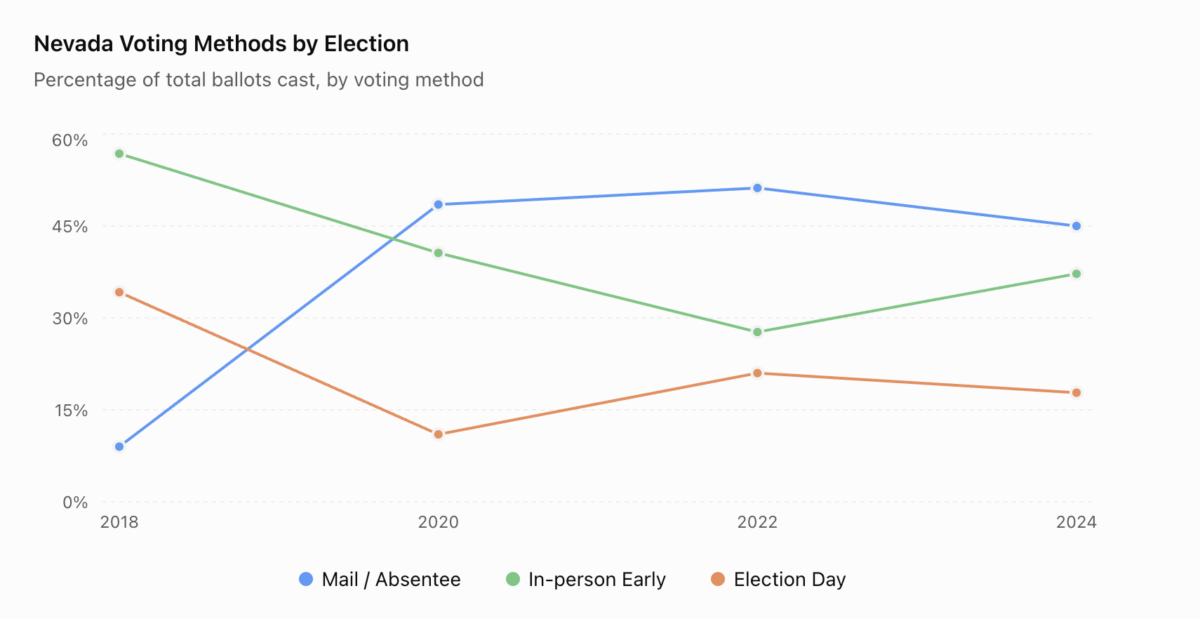
Here's how it breaks down by party:
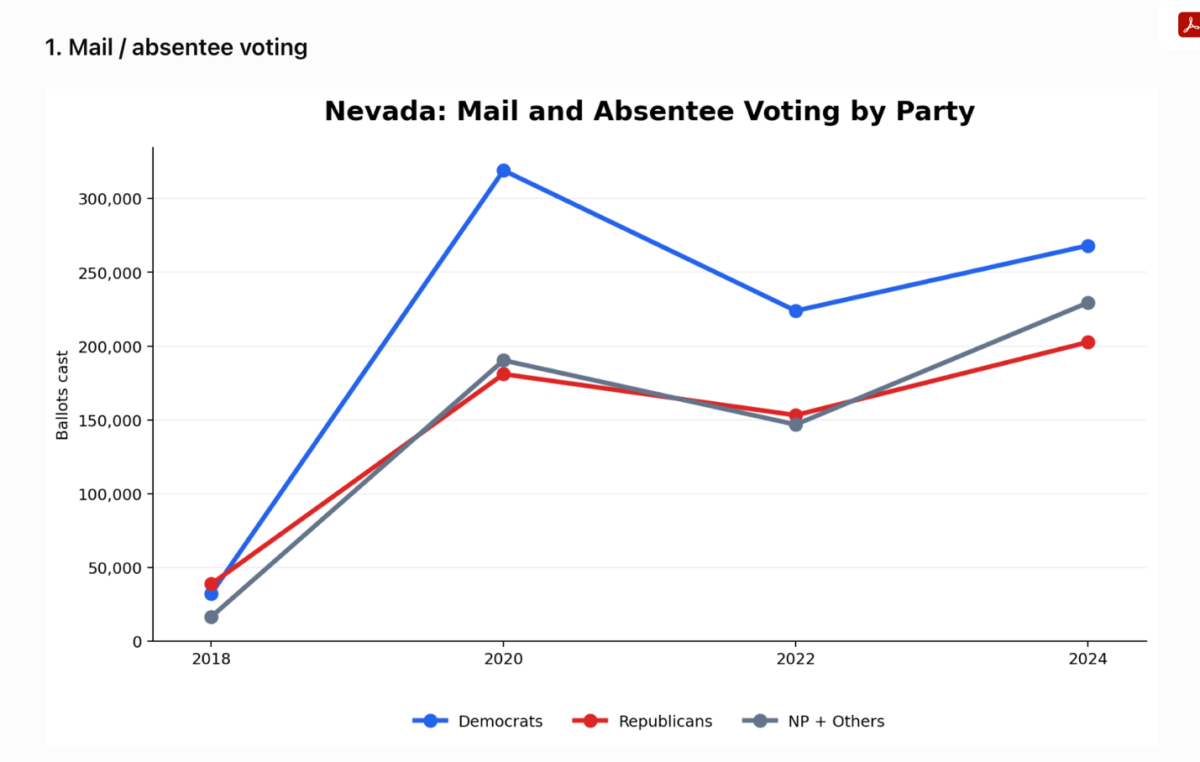
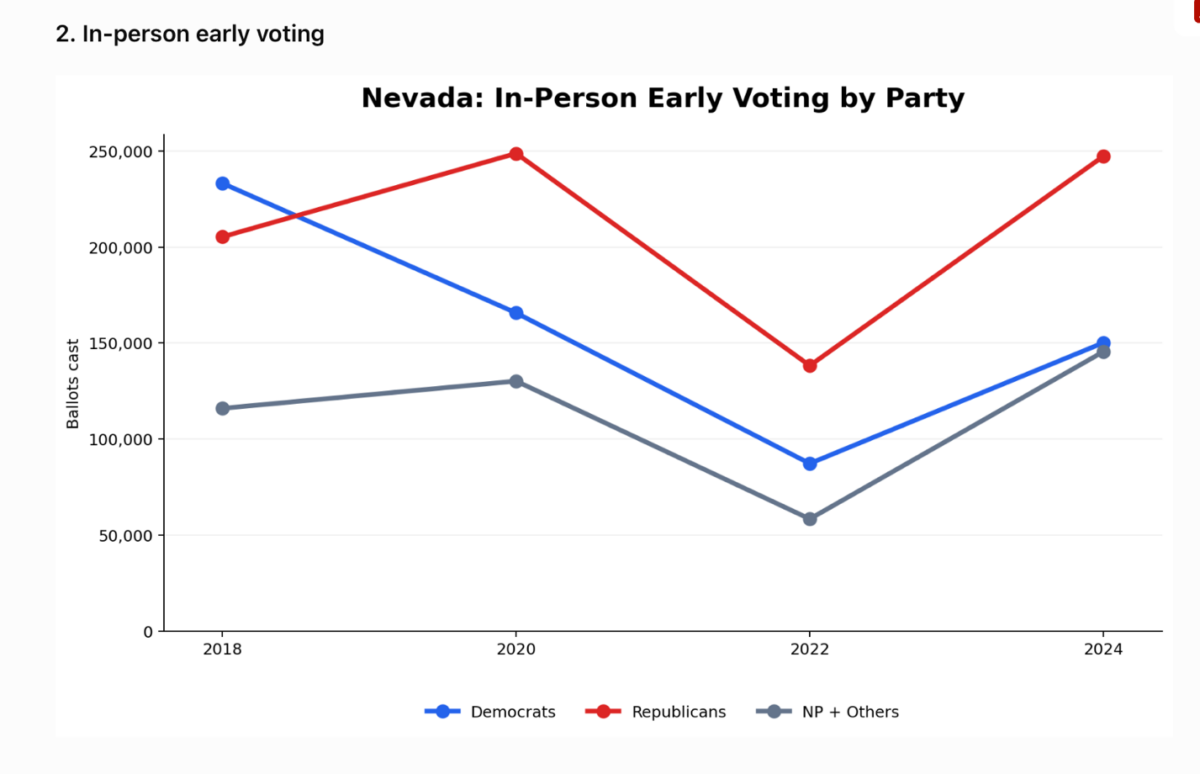
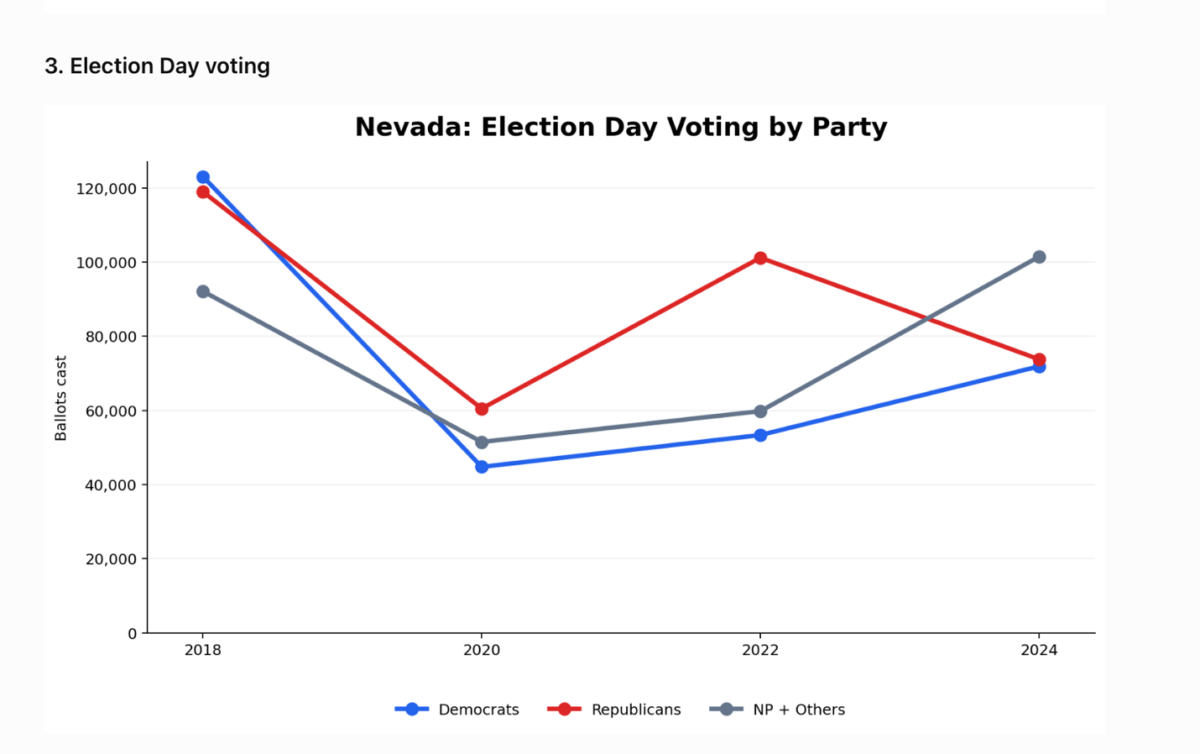
So if past is prologue, 80 percent to 85 percent of the vote will be in before Nov. 3. We will know a lot.
WHAT TO LOOK FOR ON THE FIRST DAY OF IN-PERSON EARLY VOTING
Clark will always be most important. I love Washoe and the rurals, but Clark is where the votes are and drives the rest of the state. In 2022:
11,396 turned out the first day
This was the breakdown:
D – 4,221 (37 percent)
R –5,154 (45 percent)
O – 2,021 (18 percent)
So Rs had an 8-percentage-point lead after the first day. in Clark. I don't love these comparisons because every midterm is different, and this one could be very different. I make only one initial prediction and that is that turnout will be higher than 2022 on the first day in Clark, maybe by a lot. If not, enthusiasm may not be as high as I project.
One more chart before I unveil my model, historical turnout by region:
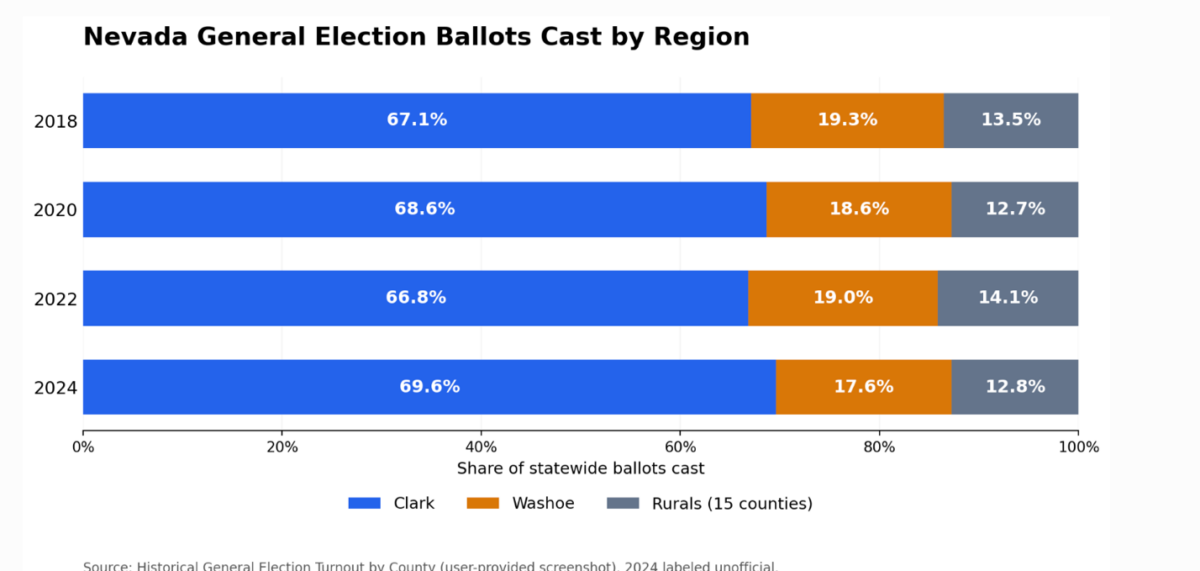
Not a lot of change cycle to cycle, but enough to make a difference in close races. Clark and rurual numbers usually the ones to watch, but if Washoe gets higher than normal, that could be the canary in the coal mine for a bad year for Republicans, including in CD2. If not, then I think the seat gets Flippoed, not flipped.
OK, this post is getting long, so here's the model:

Lemme know what you think. Until I blog again….
UPDATED, 10/16/26, 10:30 AM
Hello, fellow data nerds! (I apologize for being remiss until now with my cheery greetings!)
Some tech glitches with the state file and will have more detail soon, but good news is that the SOS dashboard is now live for mail, in-person early voting and Election Day.
Give you a snapshot for now:
32,213 mail ballots accepted:
12,138 D 38 percent
10,752 R 33 percent
9,323 The rest 29 percent
This is still a very small number, less than 2 percent of active voters. So try to ignore all the breathless tweeters who are making pronouncements on Twitter. You know who you are.
I'll send more detail soon on the eve of early voting, when I think the first day will produce a very large turnout and may give us the first glimpse of any trend. Then I may allow -- even make myself! -- breathless pronouncements. I will also give you a preview with historical trends, the first glimpse of my dynamic model and more.
Are you not excited?
Coming soon…
UPDATED, 10/15/26, 5 PM
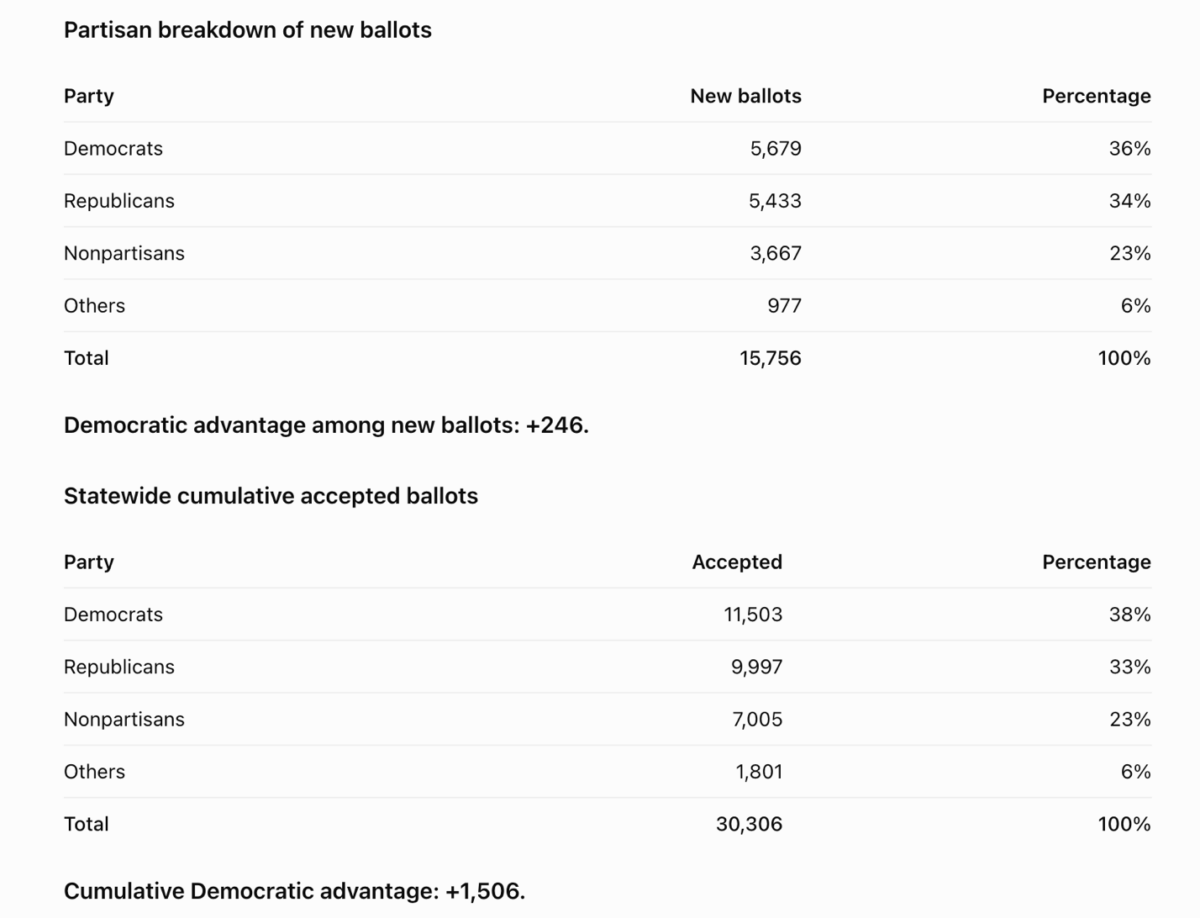
The latest SOS ballot total doubled the previous one, now at 30,000 ballots, or almost 1.5 percent of active voters. That's probably up to 2.5 percent of what I project turnout will be, give or take.
The latest:
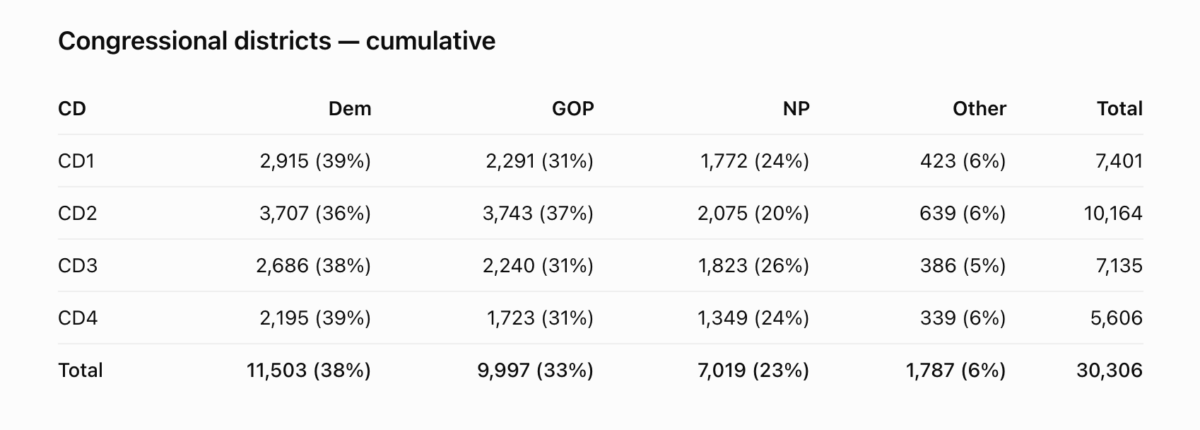
In the congressional districts, the Dems have significant leads (7 percentage points plus) in three of the four, and they are only a percentage point behind in CD2:
In CD2, Washoe is now up to 73 percent of the ballots, which is about what TBT would need it to be to have a chance to pull off one of the biggest upsets in state annals. Dems have an 8 percentage point lead over Rs in Washoe:

These numbers should give Dems some hope in CD2, although I repeat: IT IS VERY EARLY.
On the other hand, the Clark numbers don't look so bad for the Repubs, so there is something for them to be happy about, although – wait for it! – IT IS VERY EARLY. The counties:
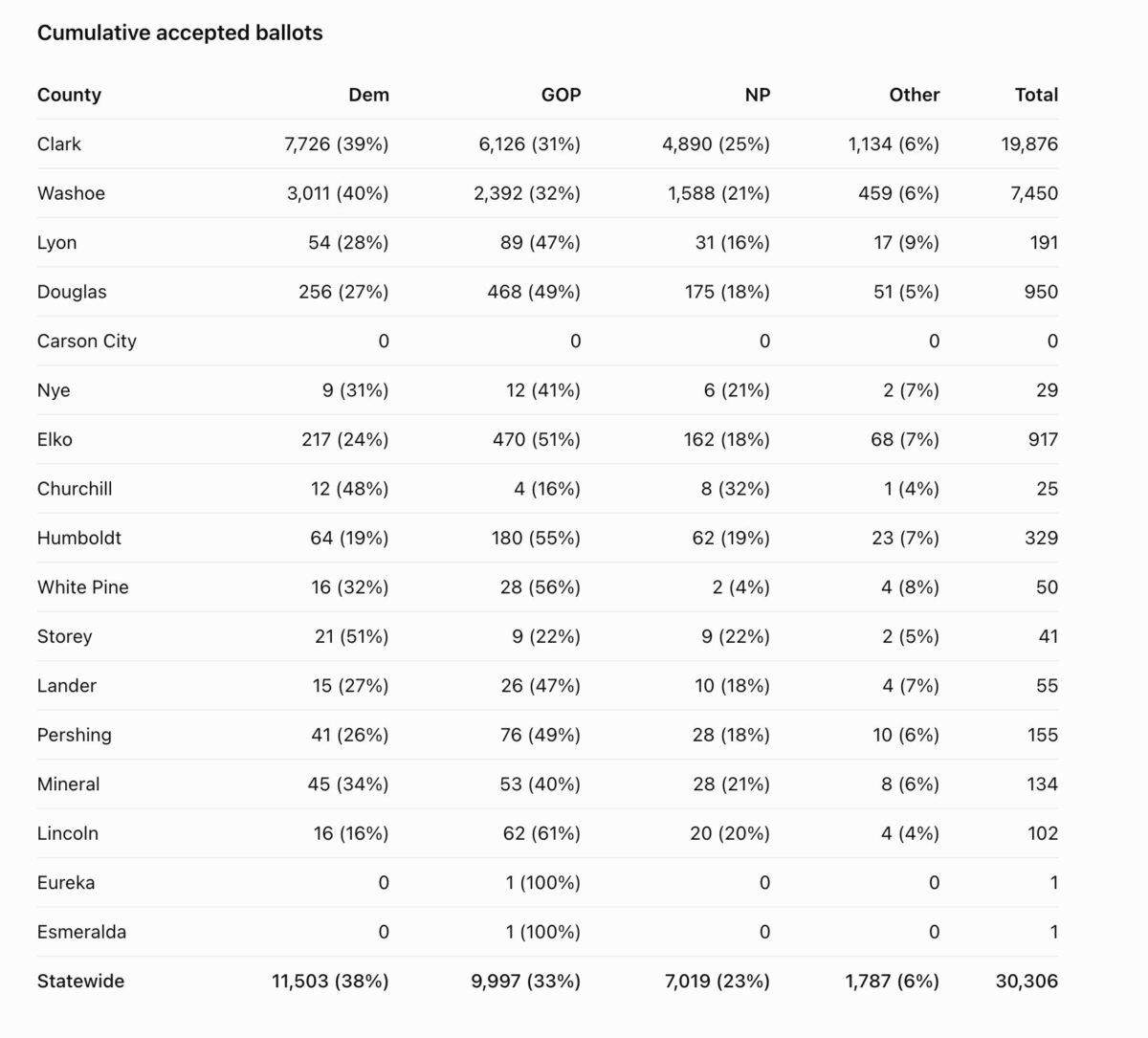
Bottom line: Once early voting starts and we have numbers Saturday and Sunday, we will see a lot more ballots and be able to see if these are patterns or just early blips. It could be either, frankly..
But because of this strange year, with so many folks fearing some kind of election interference, we may see very different voting patterns than in the last two cycles and comparisons may not be so useful. Mail has been half the votes in the last two cycles, but will it be this time? We will know more when we see how big in-person early voting is, starting Saturday.
Starting tomorrow, I hope to give yoi a chart-heavy post with the first glimpse of my model, whcih I can adjust as votes come in, as well as historical data to keep an eye on as we move forward in the two-week in-person voting period.
Watch this space, email me if you want…
UPDATED, 10/15/26, 9:30 AM
About 700 new ballots in latest state file, and the breakdown is:
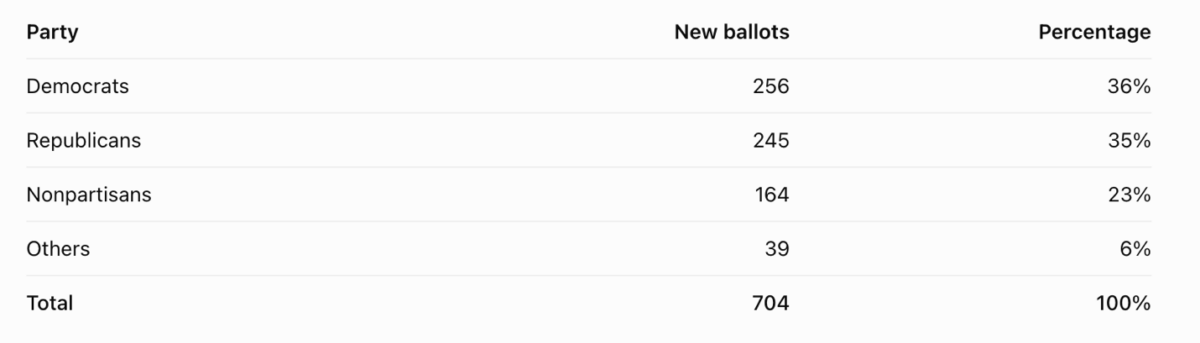
This didn't change much – Dems still with 9 percentage point lead among 14,500 ballots, but still very small number of ballots coming in, less than 1 percent of active voters. Democrats lead Republicans by 1,260 ballots statewide, an increase of just 11.
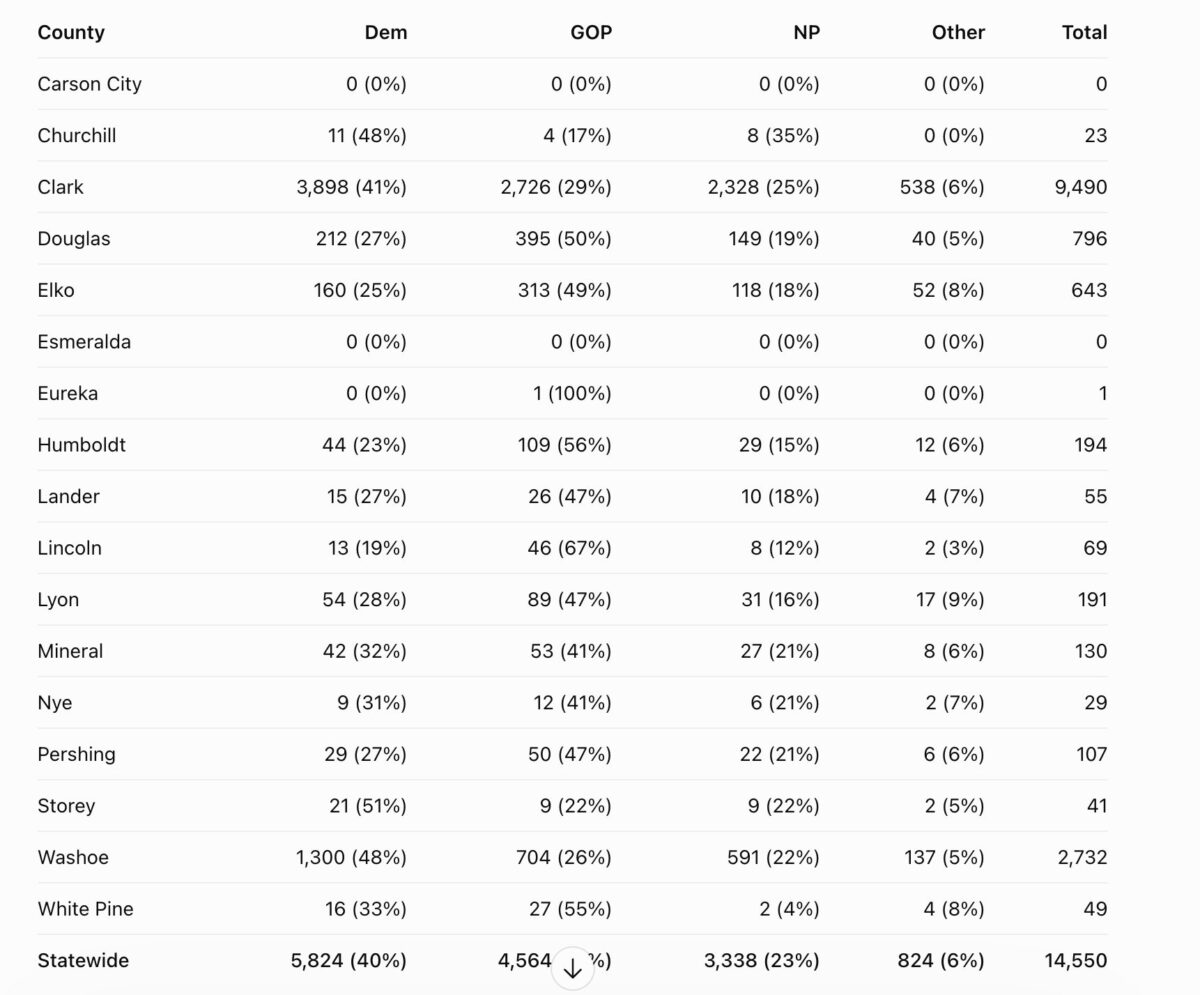
In CD2, the Dems continue to have a slight lead, which is very unlikely to continue as rurals start to come in. Keep an eye on Lyon and Elko counties for rural turnout here and elsewhere.
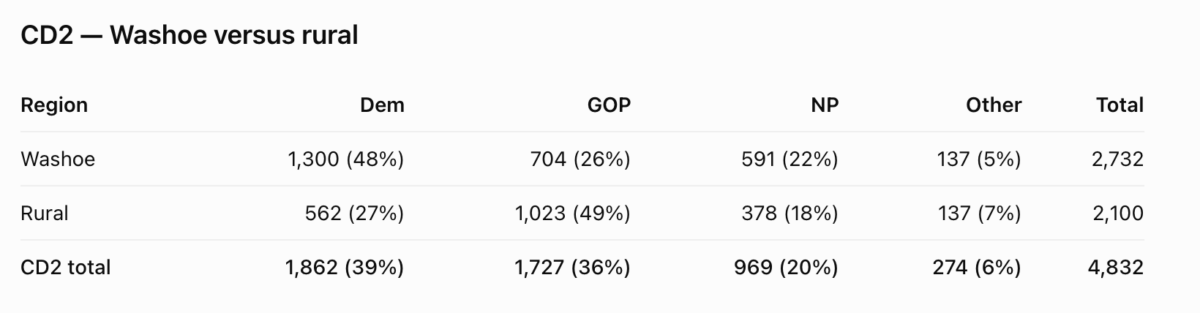
More when I have it, and an early voting preview tomorrow…
UPDATED, 10/14/26, 5 PM
First sizable batch of ballots added to state file this afternoon, more than doubling what we saw before. More than 7,300 new ballots, total is nearly 14,000 accepted.
Let me show you:
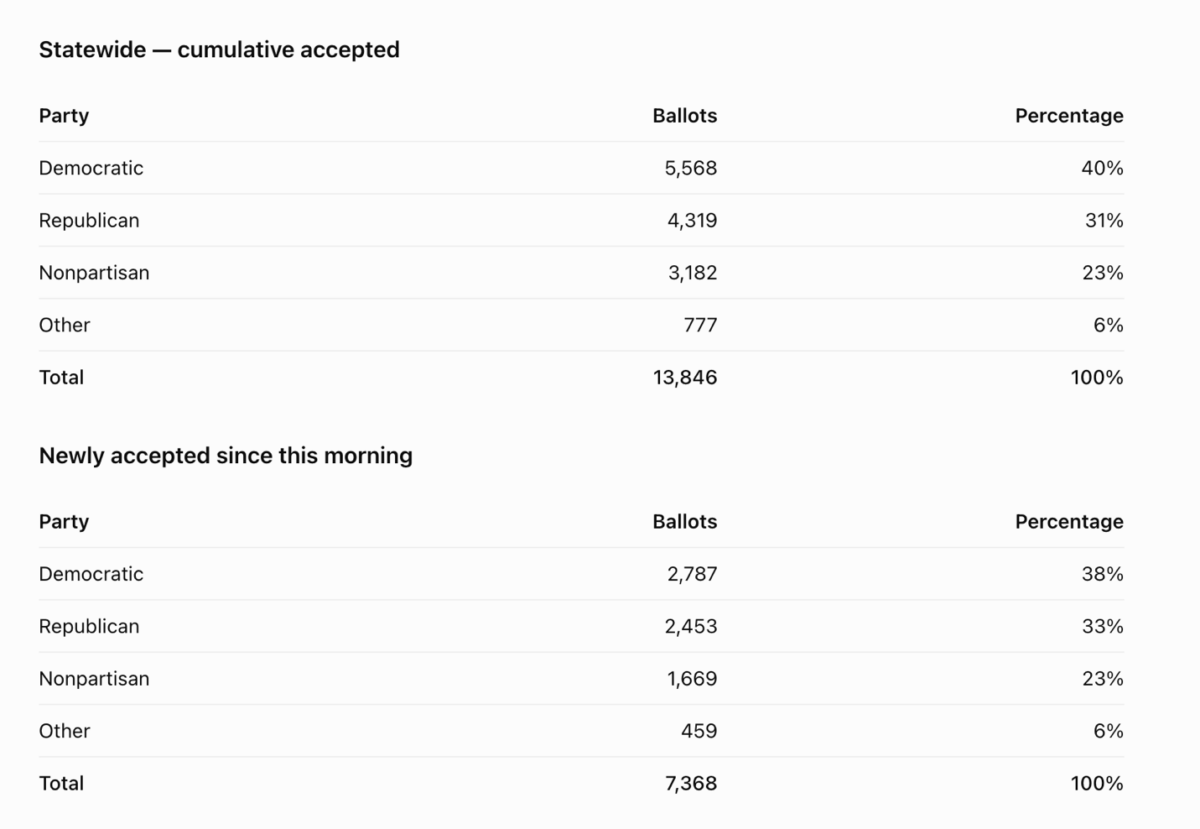
Clark has 75 percent of the new ballots and the Repubs were only 400 ballots behind out of more than 5,500 ballots added to the file. Overall, Dems have a 12 percentage point lead in Clark right now. The numbers:


Look at those Washoe numbers: The Dems are doing very well in Nevada's swing county, where Dem statewide candidates have run well during recent cycles.
The latest from CD2:
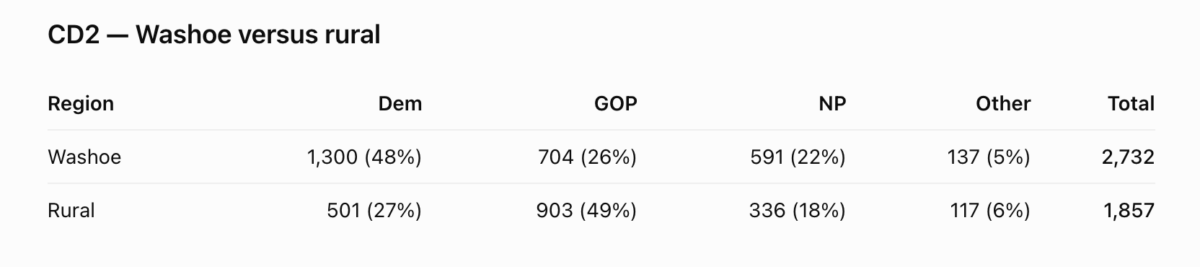
Washoe now represents 60 percent of accepted CD2 ballots. Of the 1,741 new ones, 1,089 came from Washoe and 652 from rural counties.
Remember, the higher percentage from Washoe, the better chance TBT has to win. The math is still difficult, but I think it needs to be at least 5 percentage points higher than it is now unless Flippo is hemorrhaging in the rurals (possible).
So what does this all mean? Some thoughts:
--Almost 14,000 ballots is still only about .7 percent of active voters, but likely to be a little more than 1 percent of total turnout. (Turnout was 55 percent in 2022 and 62 percent in 2018.) If it's 60 percent this cycle, that means about 1.3 million voters, so 14,000 would be 1.2 percent. Still not a lot, but we are getting there, slowly but surely.
--The Dems have about a 1,200-ballot lead statewide, which is 9 percent. If that stays there, it's very significant. But if the Clark numbers are tight, that could change. Clark is now 65 percent of the vote; that's about 7 percentage points below the number of active registered voters. Still a long way to go.
It's way too early to draw any conclusions, as I keep saying. But we are starting to get sizable batches of ballots, we may see some trends soon – and certainly by Saturday when in-person early voting begins.
What am I missing? Send me your thoughts!
UPDATED, 10/14/26, 12:20 PM
The latest statewide SOS file shows 630 new ballots, which doesn't change a lot. Total is now 6,478 accepted ballots and just under 3,500 are from Clark.
First all of the charts, then some analysis besides IT'S STILL VERY EARLY:
Statewide:
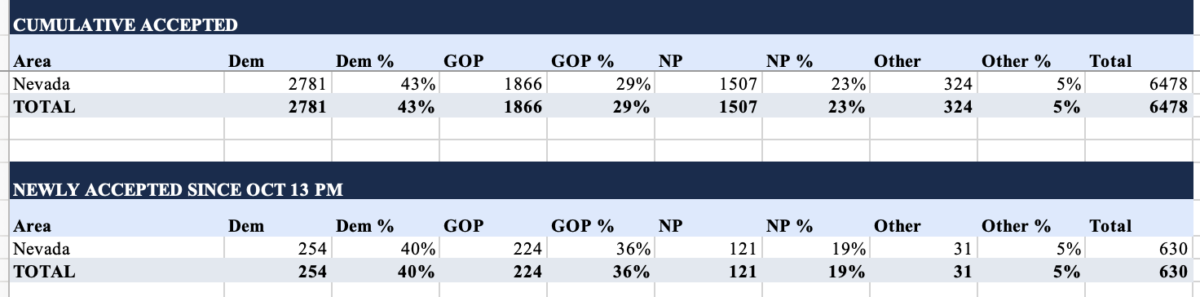
CDs:
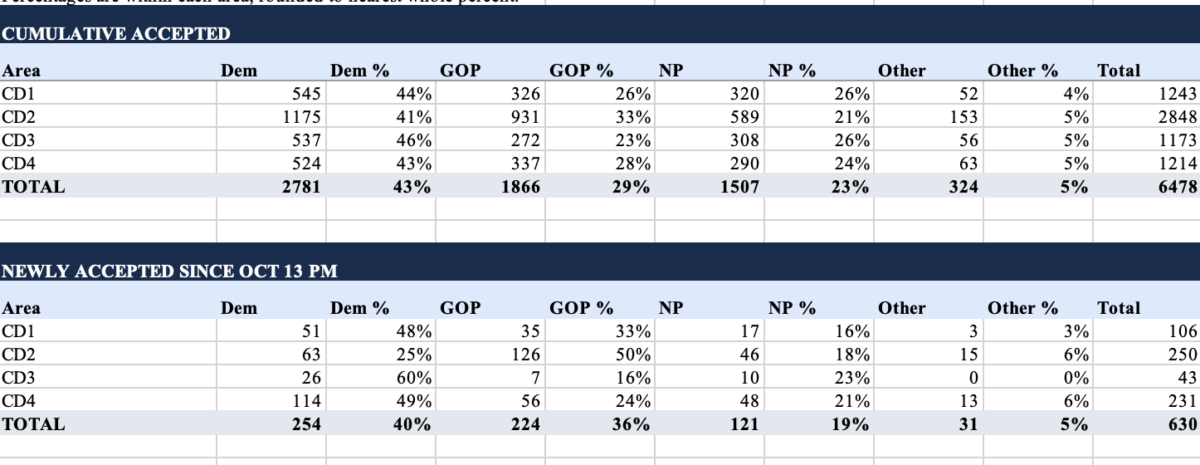
Counties:
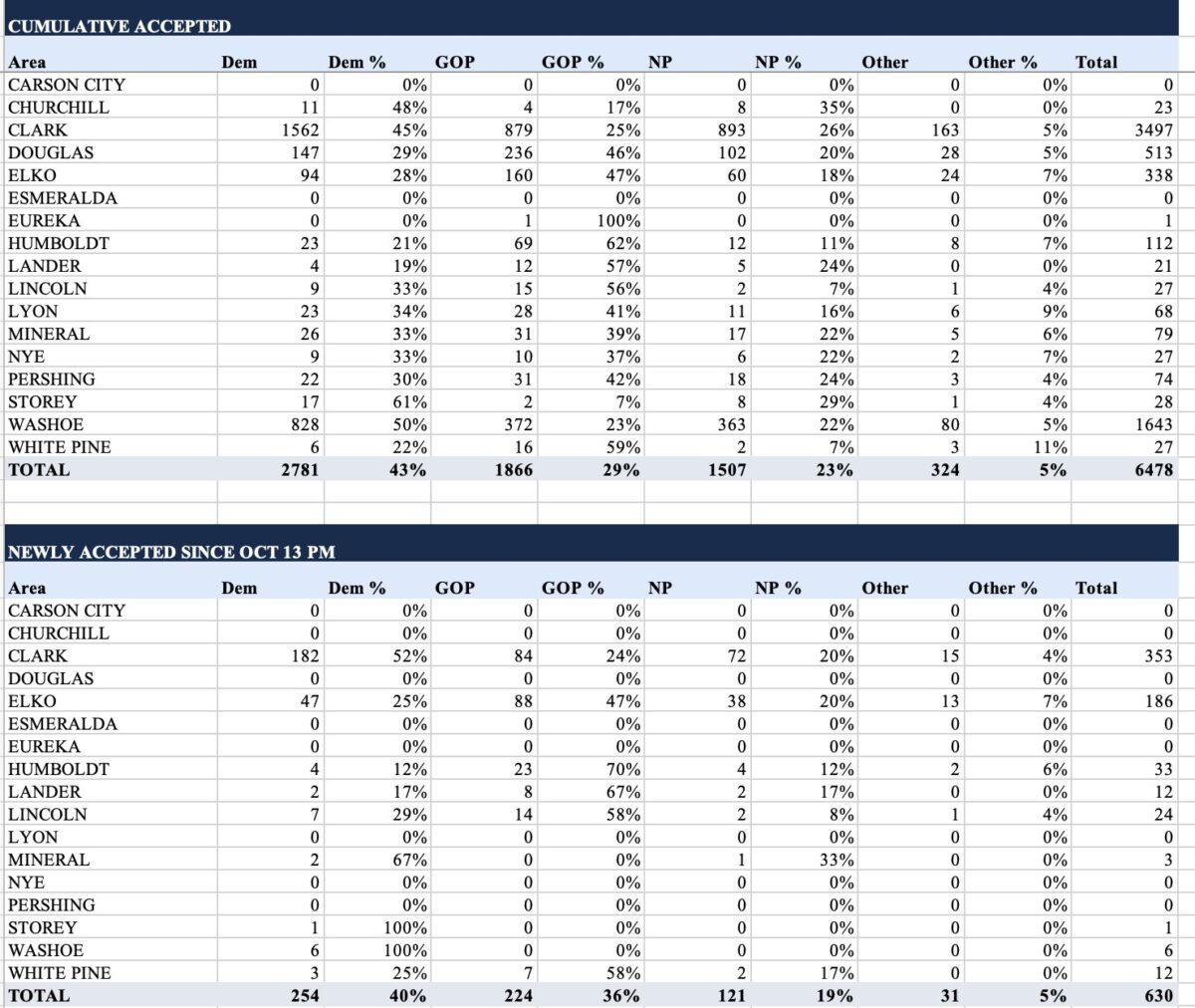
CD2 breakdown:
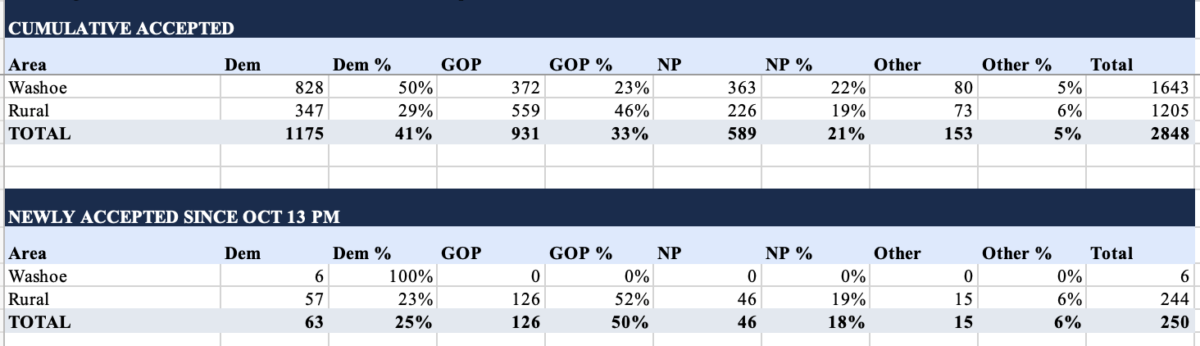
So, we are still at about .3 percent of active voters and probably at about .6 or .7 percent of those who will turn out. Folks, despite what you may see on Twitter, there are no trends yet. These are just super-early voters who want to be done with it already; some days, I wish I could join them!
Washoe has fallen to under 60 percent of the overall CD2 returned and accepted ballots (Democrats scream in panic)! but the Dems still have an 8 percentage point lead right now (Democrats declare victory!). You can see why these numbers don't tell us much yet.
I don't think we will know a lot until this weekend and even then we may not be able to draw any preliminary conclusions.
More data when I have it. You know where to find me.
UPDATED, 10/14/26, 6:50 AM
Just a quick one as i wait for a larger state update this morning, but Doc Samuelson has a Clark update and I downloaded the file and found similar numbers. Professor McDonald has statewide numbers, too, and mine also are close to what he has. Note throughout the process, you may see slightly different numbers from people tracking this stuff -- it all depends when they downloaded the file and looked at ballots that have been accepted.
The bottom line is that there are just under 7,000 ballots in statewide (still not at 1 percent of what we will see in toto( and about 3,000 in from Clark, with Dems ahead by about 15 percentage points. (I don't think any comparisons to past cycles are very useful yet.)
More later. with charts after a busy morning of running around...
UPDATED, 10/13/26, 4:15 PM
About 900 ballots added to state file in latest update, pushing the number of ballots accepted so far at just under 6,000. Contain your excitement: This is still only about .3 percent of active voters.
The Dems still have a 15 percent lead over the GOP in the very early going, but the latest batch had a slight GOP advantage over the Dems, mostly because a third of them were from dark-red Douglas County and Clark and Washoe had about 200 each. These are still VERY small numbers.
The latest statewide:

By county:

By CD:

I wouldn't read much into any of this yet, but when we look back, we will see if these were harbingers or not.
More in the AM...
UPDATED, 10/13/26, 10:30 AM
Only about 400 ballots added in the morning SOS update – here's how they break down:
| Party | New ballots | Percentage |
| Democratic | 206 | 50% |
| Republican | 89 | 22% |
| Nonpartisan | 86 | 21% |
| Other | 27 | 7% |
| Total | 408 |
The new totals:

About 5,000 ballots is still not a statistically significant sample – probably half a percent of total I expect, or less.
One interesting (maybe) note about CD2: Democrats accounted for 92 of the 143 newly accepted ballots (64 percent), compared with 24 Republicans (17 percent). And Washoe is 73 percent of the votes so far, above what it usually is.
Yes, it's still VERY early in the vote-counting. But if those trends continue, the Dems have an outside shot to reverse four and a half decades of frustration. Big IF!
In case you are curious about the county-by-county breakdown of all the votes so far:
| County | Dem | GOP | NP | Other | Total |
| Clark | 1,309 | 729 | 749 | 137 | 2,924 |
| Washoe | 729 | 318 | 309 | 69 | 1,425 |
| Douglas | 66 | 85 | 35 | 11 | 197 |
| Elko | 38 | 53 | 15 | 9 | 115 |
| Pershing | 17 | 22 | 14 | 2 | 55 |
| Humboldt | 13 | 32 | 5 | 4 | 54 |
| Mineral | 15 | 21 | 12 | 3 | 51 |
| Lyon | 17 | 16 | 6 | 5 | 44 |
| Churchill | 10 | 4 | 7 | 0 | 21 |
| Storey | 8 | 2 | 8 | 1 | 19 |
| White Pine | 3 | 9 | 0 | 3 | 15 |
| Lander | 2 | 4 | 3 | 0 | 9 |
| Lincoln | 2 | 1 | 0 | 0 | 3 |
| Eureka | 0 | 1 | 0 | 0 | 1 |
| Nye | 0 | 1 | 0 | 0 | 1 |
| Carson City | 0 | 0 | 0 | 0 | 0 |
| Esmeralda | 0 | 0 | 0 | 0 | 0 |
| Statewide | 2,229 | 1,298 | 1,163 | 244 | 4,934 |
When I get more data, you'll get more data. Let me know of any questions
UPDATED, 10/12/26, 5 PM
Good of the SOS to update the file right before the Bills game, so:
An additional 1,600 ballots added this PM, a 50 percent increase in overall ballots.
In the first sizable drop, Republicans held their own with the Dems:

The new totals:

The breakdowns you want:

More when I get it....now: GO BILLS!
UPDATED, 10/12/26, 11 AM
Five days until early voting and numbers still very small. 3,000 ballots is the number so far and not even close to 1 percent yet of all that will be cast! I do have one bonus for you, which is I calculated in CD2 what happens if Lynn Chapman is the repository of more than 5 percent because of disgust by voters with David Flippo.
First, the current numbers:
Statewide partisan breakdown
| Party | Accepted | Percentage |
| Democratic | 1,436 | 48.6% |
| Republican | 657 | 22.2% |
| Nonpartisan | 734 | 24.8% |
| Other | 128 | 4.3% |
| Total | 2,955 |
Second, here are some Chapman scenarios and how they might change the math for Teresa Benitez-Thompson to have any shot. The percentages show what TBT would need to beat Flippo under those assumptions:
| Chapman districtwide | Flippo 60% rural | Flippo 65% rural | Flippo 70% rural | Flippo 75% rural |
| 3% | 55.5% | 58.6% | 61.7% | 64.7% |
| 5% | 55.2% | 58.2% | 61.3% | 64.4% |
| 10% | 54.2% | 57.3% | 60.3% | 63.4% |
| 15% | 53.2% | 56.3% | 59.4% | 62.4% |
So if there is a big I-can't-vote-for-TBT-or-Flippo so I'll vote for the third-party candidate vote, TBT might only have to get to 55 percent or so in Washoe, which has rarely been done by a Dem but in a deep blue wave year…
More later…
UPDATED, 10/11/26, 9:55 AM
Largest number of ballots added to the SOS voter file so far, but still very small: 590 new ballots, all in Clark, with Republicans having more for the first time. But you can see, in the VERY early going, nonpartisans holding their own:
New ballots:
| Party | New accepted | Percentage |
| Democratic | 191 | 32% |
| Republican | 214 | 36% |
| Nonpartisan | 158 | 27% |
| Other | 27 | 5% |
| Total | 590 | 100% |
Statewide totals:
| Party | Accepted | Percentage |
| Dem | 1,378 | 48% |
| GOP | 638 | 22% |
| NP | 712 | 25% |
| Other | 123 | 4% |
| Total | 2,851 | 100% |
More later if I have anything, but I doubt another Sunday update is coming. It's time for real life – i.e. football!
UPDATED, 10/10/26, 10:40 AM
This is what I feel like every day:
I am not going to bother you anymore with the granular breakdown charts that say nothing until votes really start coming in. Here's where we are:
225 new accepted mail ballots in the SOS file, and the breakdown is about the same of the 2,261 in there:
| Party | Accepted | Percentage | Net change |
| Dem | 1,187 | 52% | +87 |
| GOP | 424 | 19% | +80 |
| NP | 554 | 25% | +44 |
| Other | 96 | 4% | +14 |
| Total | 2,261 | 100% | +225 |
This is still way, way under 1 percent of the total vote, but I expect the pace to pick up next week and then early voting starts a week from today.
I'll just mention one thing that may or may not mean anything: About two-thirds of the new ballots are in Congressional District 2, where the math is daunting for Dem nominee Teresa Benitez-Thompson but GOP nominee David Flippo seems to be in scandal-a-day model. and national Republicans are desperately trying to save him from his own accumulating baggage.
105 of the new ones are from the rurals and 43 are from Washoe. Here's the overall breakdown so far:

Again, this is very early and doesn't mean much, but the ultimate breakdown could be key to whether TBT has a chance. Nearly three-quarters of the CD2 ote is now from Washoe, well above the usual 62-38 breakdown favoring Washoe. Let's see what happens…
I'll keep posting whenever I get new data. Always happy to answer questions, get feedback at [email protected].
UPDATED, 10/9/26, 10:30 AM
Still slow – most Clark County voters are just getting their mail ballots – but 197 voters added to the mix this morning by SOS. I updated the charts below, but this is still only 2,000 ballots.
Remember that turnout in the last two midterms was 62 percent in 2018 and 55 percent in 2022. Keep those numbers in mind throughout this next few weeks.
If turnout is 60 percent or so, that would mean about 1.2 million voters cast ballots. And 2,000 out of 1.2 million is .16667 percent.. Try not to get excited, Dems, even though the first 2,000 votes look good for you:
| Party | Oct 9 | Percentage |
| Democratic | 1,100 | 54% |
| Republican | 344 | 17% |
| Nonpartisan | 510 | 25% |
| Other | 82 | 4% |
| TOTAL | 2036 |
Here's the breakdown by congressional district:
| CD | Dem | % | GOP | % | NP | % | Other | % | Total |
| 1 | 198 | 51% | 59 | 15% | 114 | 30% | 14 | 4% | 385 |
| 2 | 471 | 56% | 147 | 17% | 189 | 22% | 38 | 5% | 845 |
| 3 | 275 | 55% | 68 | 14% | 138 | 28% | 21 | 4% | 502 |
| 4 | 156 | 51% | 70 | 23% | 69 | 23% | 9 | 3% | 304 |
And by county:

So not much to go on, but soon we may see trends develop.
Stay tuned…I may even standardize the chart sizes eventually...
UPDATED, 10/8/26, 11:20 AM
The state has updated its voter file, still under 2,000 in all, and hardly significant in any way. But I am going to take this opportunity to show you a little bit about what you can expect to see here as votes start pouring in. In addition to what you see below, I will also soon start showing you how many votes are left statewide and in various political subdivisions and what that might mean based on various turnout scenarios.
Here are the latest numbers:
| Democratic | 1009 |
| Republican | 296 |
| Nonpartisan | 465 |
| Other | 69 |
| TOTAL | 1839 |
Here's the breakdown by congressional district:
| CD | Dem accepted | Rep accepted | NP accepted | Other accepted | Total accepted |
| 1 | 180 | 50 | 102 | 9 | 341 |
| 2 | 458 | 128 | 182 | 35 | 803 |
| 3 | 232 | 60 | 121 | 17 | 430 |
| 4 | 139 | 58 | 60 | 8 | 265 |
And by county:
| County | Dem accepted | Rep accepted | NP accepted | Other accepted | Total accepted |
| CARSON CITY | 0 | 0 | 0 | 0 | 0 |
| CHURCHILL | 9 | 3 | 6 | 0 | 18 |
| CLARK | 547 | 164 | 282 | 34 | 1027 |
| DOUGLAS | 0 | 0 | 0 | 0 | 0 |
| ELKO | 10 | 12 | 8 | 4 | 34 |
| ESMERALDA | 0 | 0 | 0 | 0 | 0 |
| EUREKA | 0 | 0 | 0 | 0 | 0 |
| HUMBOLDT | 3 | 4 | 0 | 2 | 9 |
| LANDER | 0 | 0 | 0 | 0 | 0 |
| LINCOLN | 0 | 1 | 0 | 0 | 1 |
| LYON | 11 | 7 | 5 | 2 | 25 |
| MINERAL | 4 | 3 | 1 | 0 | 8 |
| NYE | 0 | 0 | 0 | 0 | 0 |
| PERSHING | 0 | 0 | 1 | 0 | 1 |
| STOREY | 1 | 0 | 3 | 0 | 4 |
| WASHOE | 421 | 95 | 159 | 26 | 701 |
Once things really get going, I will update these charts at least once a day, sometimes more often. I just wanted to give you a glance at what I will be providing, and this is only a small sample because the major chart with votes remaining, etc. has yet to be unveiled!
As always, ping me with ideas, critiques and anything else on your mind at [email protected].
----
UPDATED., 10/7/26, 8:30 AM
Only a few more ballots have come in – 1,599 in all – so not worth talking about at all. (I also don't know why the prof has 7 in-person early ballots listed – must be a coding problem because that doesn't start for 10 days.)
While we wait, I will have some fun with charts and projections.
Today let me show you how difficult it is for Republican David Flippo, despite all of his controversies, to lose in CD2 to Democrat Teresa Benitez-Thompson. It seems obvious because it is a Trump-plus-14 district. But it's even more stark.
Here are some recent GOP performances in the rurals:
| County | Trump 2024 | Brown 2024 | Laxalt 2022 |
|---|---|---|---|
| Carson City | 54.3% | 50.0% | 52.6% |
| Churchill | 73.8% | 68.5% | 71.2% |
| Douglas | 65.4% | 62.8% | 64.8% |
| Elko | 77.2% | 71.3% | 75.2% |
| Esmeralda | 81.6% | 75.3% | 75.8% |
| Eureka | 87.8% | 80.9% | 85.9% |
| Humboldt | 76.5% | 69.0% | 72.9% |
| Lander | 80.0% | 71.0% | 75.6% |
| Lincoln | 85.3% | 79.8% | 80.1% |
| Lyon | 71.1% | 65.8% | 69.0% |
| Mineral | 66.6% | 58.0% | 59.3% |
| Nye | 70.2% | 64.2% | 66.4% |
| Pershing | 76.4% | 70.6% | 71.6% |
| Storey | 68.6% | 64.2% | 67.5% |
| White Pine | 77.3% | 72.9% | 74.7% |
Remember IAP hopefrul Lynn Chapman, who got 5 percent in 2024 when she ran, is also on the ballot. I assume she will get about the same, but maybe she will be a repository for "none of the above" voters looking to register a protest?
Here's what TBT would need to get in Washoe -- the headers show what percentage of the vote Washoe might be and the columns show what she would need under various scenarios:
Chapman at 5%
| Flippo rural | Washoe 60% | Washoe 62% | Washoe 65% | Washoe 68% |
|---|---|---|---|---|
| 60% | 55.8% | 55.2% | 54.2% | 53.4% |
| 65% | 59.2% | 58.2% | 56.9% | 55.7% |
| 70% | 62.5% | 61.3% | 59.6% | 58.1% |
| 75% | 65.8% | 64.4% | 62.3% | 60.4% |
How unprecedented would it be for TBT to get above 55 percent?
Both Dem senators were at about 50 percent in Washoe during the previous two cycles. Barack Obama got 55 percent in the Dem wave year of 2008. You have to find races where the GOP opponent was quite bad – worse than Flippo? – to find Aaron Ford getting 55 percent against Sigal Chattah in 2022. Now, CCM got 65 percent in Washoe against sacrificial lamb Don Chariez in the 2010 AG race, but that is an outlier.
Nevada is purple; Washoe is purple, although Dems have run well there in recent cycles.
So TBT would need either a very unlikely performance in Washoe at 60 percent or so, Washoe would have to be a significantly larger percentage of the vote than usual or rural turnout/margins would have to be down to have any chance. And even under any or all of the scenarios, it is likely to be close. Tribalism in the rurals is just so strong.
Flippo remains the favorite despite being such a terribly flawed candidate. It's hard to see the math working for TBT, but we will know more when votes really start coming in.
(Thanks, as always, for some AI help with the chart calculations.)
----
Welcome to the early voting blog!
For those who have been with me for previous versions, welcome back!
For those of you who have not, you are in for a treat if you care about actual data and not so much about polls. Here is what I did in 2024 and 2022.
I am trying to make this better every cycle, and ChatGPT has been a big help in refining my model this year. There will be something in here for everyone, whether you are interested in the marquee race for governor or congressional races or legislative contests.
I am not ashamed of seeking help along the way, so if you have information to impart or advice to give or corrections to make, email me at [email protected].
There is not much to go on yet – not many ballots are in. But I want to frame the discussion and show you some historical baselines before the deluge of mail ballots begins, perhaps as early as later this week.
Let me tell you what this is and what it isn't:
This blog is about who is voting, not whom they are voting for. But partisan turnout patterns can tell us plenty about the electorate taking shape.
I'll start with several assumptions, including that roughly 90 percent of Democrats and Republicans will support their respective parties' candidates. I'll also show what happens when those assumptions change.
One of the numbers I'll be watching most closely is the Republican turnout advantage. I'll initially model scenarios ranging from R+1 to R+5 percentage points, adjusting as the actual returns come in.
And I'll keep asking the question that matters more with each passing day: Given who has already voted, what would have to happen among everyone who hasn't?
In the past, with huge Clark County firewalls for the Dems — the number of votes they had banked — I was even able to declare outcomes before Election Day. Those days are gone because of diminished Dem registration advantages in Clark County, which houses Las Vegas and has nearly 73 percent of active voters.
But I can still discern trends, as I did in 2024 with GOP turnout. My ultimate prediction in my Indy column — that Kamala Harris would eke out a victory — turned out to be wrong, although I correctly called the other five federal races.
But this blog is not about predictions; it is about raw data. And I will give you a lot of it. Think of it as a buffet: You can choose what you want to feast on.
Before the ballots start pouring in, let's establish four historical benchmarks.
First, how Nevadans vote has changed dramatically. Mail ballots now account for roughly half the vote — every voter has been mailed a ballot since COVID — and most ballots are cast before Election Day.
Second, Republican turnout has generally exceeded Democratic turnout in recent midterms. How large that gap becomes this year will be one of the numbers I watch most closely.
Third, geography matters. Clark County contains nearly three-quarters of Nevada's active voters, but turnout there has historically lagged Washoe and far behind rural Nevada. The relative turnout in those three areas can substantially change the composition of the statewide electorate.
Fourth, voters who aren't registered with either major party will be an enormous part of this election. We know how many of them vote. We don't know whom they support. That's where the assumptions — and the math — become particularly interesting.
So now we are ready for the votes to start coming in.
Here is the electorate we start with, as of Oct. 1 from the SOS:
Only about 1,500 ballots have been cast so far. Michael McDonald, the professor not the chairman of the NV GOP — is a great source of information. I expect the mail ballot number to start steadily increasing very soon.
What I'll be watching every day
There are several numbers I care about more than the raw statewide D-versus-R ballot count.
Turnout. What percentage of registered Democrats have voted? Republicans? Non major-party voters?
The turnout gap. If Republicans are turning out at 4 percentage points more than Democrats, that means something very different from an R+8 turnout advantage — regardless of the raw ballot margin.
Geography. How much of the vote is coming from Clark? Washoe? The rurals? Are those places producing the electorate we would normally expect?
For a baseline, just under 73 percent of active voters reside in Clark County, just under 16 percent are in Washoe and just under 12 percent are in rural Nevada. The higher rural turnout is relative to Clark and Washoe, the more those quarter-million voters can affect the composition of the statewide electorate. If it's smaller than expected …
What has to happen?
I'll also keep a running set of turnout scenarios, from R+5 to Even. Those numbers refer to the difference between Republican and Democratic turnout rates — not the partisan margin in ballots or votes.
As more ballots come in, I'll calculate what would have to happen among the remaining electorate under different assumptions about partisan loyalty and non-major-party voters. At first, those scenarios will be mostly hypothetical. But as hundreds of thousands of Nevadans vote, the assumptions will matter less and the composition of the actual electorate will matter more. That's when this gets really interesting.
A special CD2 watch
I'm also going to spend more time on the 2nd Congressional District this year because it may be more competitive than it has been in a long time. I'll particularly focus on its two very different components: Washoe and rural Nevada. Based on the registration snapshot we've been working with, approximately 62 percent of CD2's registered voters are in the Washoe portion and 38 percent are in the rural portion.
The interesting mathematical question is straightforward.
If a Democratic candidate receives X percent in the rural portion, what percentage would that candidate need in the Washoe portion to reach 50 percent or thereabouts (there is a third-party candidate) districtwide?
And vice versa.
Again, that's not a prediction. It's math. As I will show you, the district is so Republican and rural Nevada usually votes so red that a Dem might need to get to 60 percent in Washoe (quite unlikely but not impossible) to win under normal conditions.
Get ready for updates, and I like to say, as Bette did (but for weeks and, I hope, not months!):
It was not just lip service earlier: If you have questions, suggestions, criticisms, corrections (I will make mistakes!) or, heaven forfend, kudos, please email me.
Onward!
Support Independent Elections Coverage and Journalism in Nevada
You’ve enjoyed unlimited access to our reporting because we’re committed to providing independent, accessible journalism for all Nevadans.
But sustaining this work — informing communities, holding leaders accountable, and strengthening civic life — depends on readers like you.
Nevada needs strong, independent journalism. Will you join us?
A gift of any amount helps keep our reporting free and accessible to everyone across our state and funds our elections coverage.
Choose an amount or learn more about membership