Aaron Ford's secret weapon in Nevada's governor's race? Influencers.

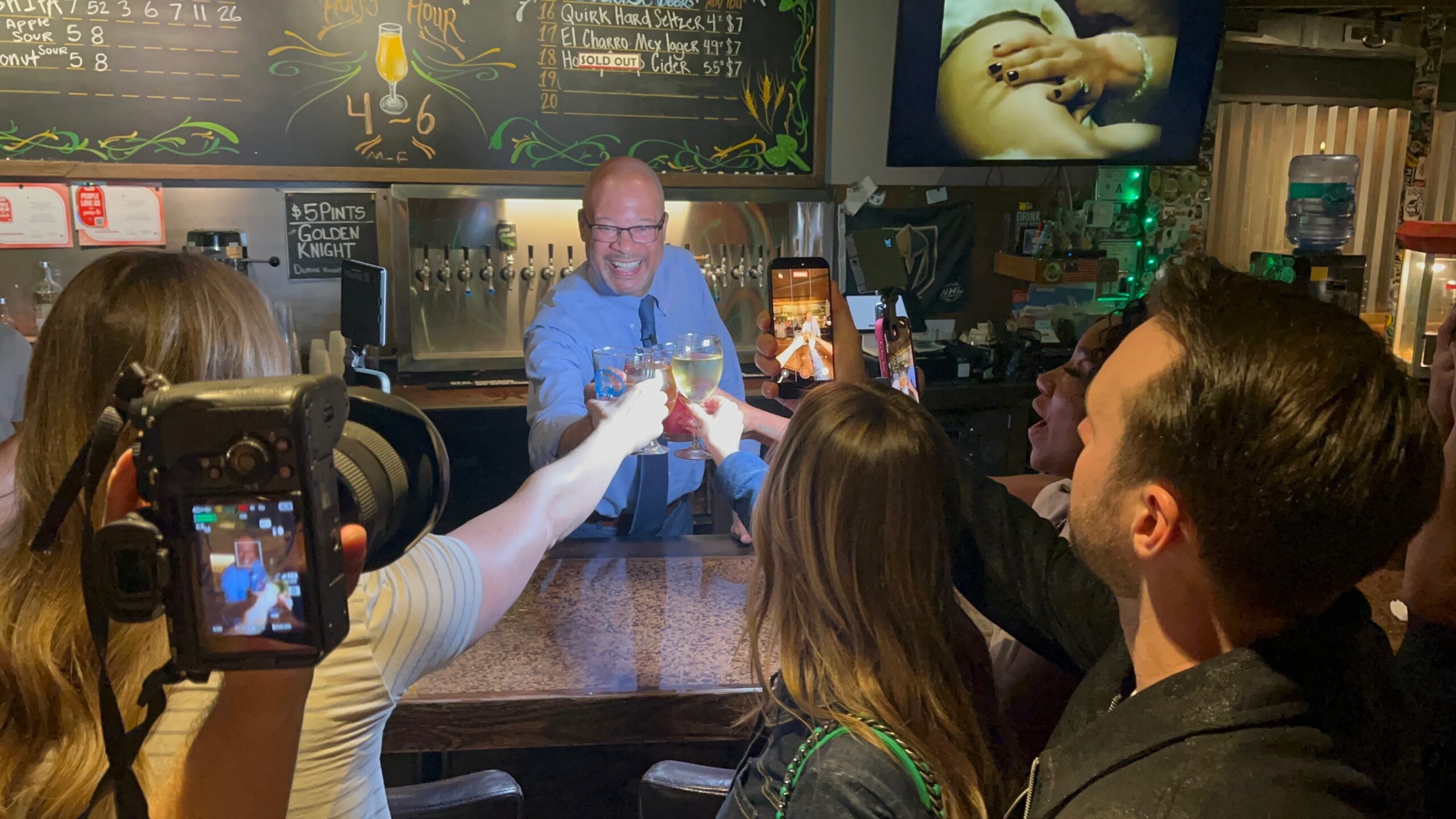
It had all the hallmarks of a traditional media event.
As cameras rolled on a warm Friday night in the Las Vegas Arts District, Attorney General Aaron Ford introduced himself to customers in a Main Street pizza shop and stepped behind the bar at a brewery to pour beers.
Except, most of the media there was brought by Ford. At least half a dozen phones trained on him as he chatted with voters and business owners, most belonging to online influencers who are part of the Ford campaign's "Creators for Aaron" program. It was part of the campaign's effort to reach voters by partnering with left-leaning content creators who have follower counts ranging from the low thousands to millions.
"I got a chance to get to know Aaron Ford a little better, and one thing I noticed was the intention to go where the people are," wrote Briana Jackson, a Las Vegas-based "lifestyle creator" with more than 50,000 followers, in her Instagram post caption recapping the night, which was co-posted by Ford's campaign.
Ford's team refused to make him available for questions from actual, credentialed press at the event, but in a brief conversation with an Indy reporter, Ford said attending events such as First Friday — with influencers in tow — was proof that his campaign was based on "people telling me what their concerns are" rather than "sitting in a corner coming up with theories."
Social media personalities are becoming a key part of Ford's in-person events and online outreach, an indication that political momentum is increasingly generated online and another way Ford is trying to even the playing field in his bid against Gov. Joe Lombardo (R), who has significantly outraised Ford and outspent him on digital and cable advertising.
Influencers volunteer to join the "Creators for Aaron" program and are not paid for their pro-Ford posts, according to the Ford campaign and the influencers themselves. But they do receive advance notice about events and a level of access often unavailable to traditional press, with influencers conducting one-on-one interviews with Ford at events where he has not held press gaggles.
Fifteen Nevada governor's race-focused videos reviewed by The Indy had racked up 30,000 likes across Instagram and TikTok. The six accounts that posted the videos have combined more than 24 million followers across both platforms.
Influencers and media experts who spoke to The Indy say social media partnerships are an effective way for candidates to signal to voters, especially younger ones, that candidates are authentic and unfiltered. Many of these voters feel disillusioned with government, read traditional news outlets less than ever and want input from voices they deem trustworthy.
"I enjoy providing a more grounded, authentic viewpoint to people, and I do think that's what people are craving right now," said Virginia Larmore, a Reno-based content creator whose Instagram account, @BattleBornVirginia, has more than 6,000 Instagram followers.
Ford spokesperson Prerna Jagadeesh wrote in a statement that Ford's social media efforts aren't meant to replace traditional media events, writing that Ford had conducted more than 100 interviews with reporters since the launch of his campaign.
"Just as we invite reporters and community members to our events, we are also inviting creators," Jagadeesh wrote.
Lombardo's team hasn't collaborated with influencers as extensively, although it has still built out its social media operation, with a focus on Hispanic voters. His campaign told The Indy in a statement that it has not established any paid partnerships with social media influencers.
Content creators and political commentators with large online followings tend to ask more softball questions when they sit down with politicians, aiming to introduce the candidate to their audience rather than drill them on policy specifics.
"I come from humble beginnings, you come from humble beginnings," said Larmore during her interview with Ford, before posing her first question: "When fuel prices go up, what happens to everything else?"
In a recent Media Insight Project survey, 57 percent of respondents said they received news often or sometimes from "independent creators or influencers."
Content creators are especially popular news sources among young voters. Social media was the top news source recorded by respondents in a recent YouGov poll of Nevada registered voters aged 18 through 29. At least 50 percent of respondents said they had received news from TikTok, Instagram and YouTube over the prior week, while just 21 percent said they had received news from "news websites or apps."
Daniela Rabalais, 30, has more than 57,000 followers on TikTok, her biggest platform. She's partnered with campaigns in Nevada before and was paid by the influencer-focused firm Vocal Media to post positive content about Sen. Catherine Cortez Masto (D-NV) in 2022.
"People my age and younger, we're not reading the newspaper," she said. "We're too burnt out and broke."


The influencer economy
With news consumption increasingly moving into unofficial online channels, candidates from across the country have turned to social media.
The Democratic National Committee is expanding its "Influencer & Creative" program ahead of 2028. California's Democratic gubernatorial primary drew eyebrows nationwide after The Sacramento Bee reported that billionaire candidate Tom Steyer had paid influencers up to $10,000 for flattering posts. The mayor of Denver, Colorado worked with local influencers last year to boost a ballot question on infrastructure bonds.
The Ford and Lombardo campaigns have also zeroed in on nontraditional media. Ford has also gone on liberal-leaning podcasts such as Pod Save America and Charlamagne Tha God's The Breakfast Club, going into candid detail on the latter about his prior arrests, while Lombardo has gone on Las Vegas-based podcasts On The Corner of Main Street and Fargo Talks.
Both campaigns also launched TikTok accounts in March, a new frontier for Nevada gubernatorial candidates.
The Lombardo campaign has partnered with influencers primarily to reach a narrower audience: Hispanic voters. The campaign's "Latinos con Lombardo" effort aims at mobilizing Latino support after more than one-third of Nevada's Hispanic voters backed President Donald Trump in 2024.
The Latinos con Lombardo Instagram has fewer than 200 followers but has been tagged and boosted by a variety of Hispanic social media personalities, including a Selena impersonator with more than 137,000 Instagram followers and a pastor with more than 35,000.
Multiple influencers featured on the account did not respond to The Indy's request for an interview.
Lombardo's influencers don't post videos about policy issues in the same way Ford's do. But they do attend Latinos con Lombardo events, including a recent one focused on how to reach people via social media. One coalition member, a digital creator and self-described "WomenLifeCoach" named Karen Nunez who has 35,000 Instagram followers, appeared in a Spanish-language ad for Lombardo that aired during the World Cup.


Liberal-leaning social media influencers who spoke with The Indy said they post videos about the gubernatorial race not just because they support Ford but also because they feel that they can bring Nevadans reputable perspectives that are missing online.
Stephanie Valdez has 12,000 followers on her Instagram account, @Steph.olution, and calls herself a "news creator." She studied broadcast journalism in college and said she draws on her education to inform her videos, many of which focus on issues in public education given her past work as a substitute teacher.
"I like to ask difficult questions," Valdez said. "I like to share facts, but I'm also going to share my opinion on things."
Other influencers echoed Valdez, saying they try to cite their sources in each video and hope to teach people about the news, not just get them fired up about a candidate.
"Obviously, what creators are doing is not journalism, but what I am trying to do is bridge that gap," said Larmore.
For her interview with Ford, she said the campaign did not ask her to share questions ahead of time.
Valdez, who has posted multiple interviews with Ford, said, "Sometimes, they've asked, 'Hey, just so we have a heads up, what are you going to ask?' And I don't mind. Like, I am not a gotcha journalist type person."
What's the appeal?
Valdez contrasted her videos with those made by "hot take creators," or people who peddle political misinformation to generate controversy, and those made by more traditional journalists that "want to have just the facts, like an AP news source or whatever."
Creators such as Valdez are well-suited for people who want the news, she said, but also want influencers' interpretations: "People that are like, 'Hey, these are facts, but also this person is, like, on my side.'"
Other influencers echoed Valdez, telling The Indy their appeal partially stems from a willingness to disclose their own views on issues and discuss their personal backgrounds.
Rabalais said she grew passionate about politics after learning she was undocumented when she was brought to the U.S. as a child.
"A lot of people, rightfully so, have skepticism about what they see online. But I think there's a lot to be said for firsthand resources, firsthand accounts of events, whether it is violence with ICE or intimidation at the polls," she said, referring to Immigration and Customs Enforcement.
UNLV professor Benjamin Morse said that "influencers" in politics is nothing new, pointing out that Democratic campaigns have partnered with A-list celebrities for years.
The difference is that voters are no longer captured by celebrities and instead are craving "micro-influencers," as Morse called them, or social media personalities — such as those who have partnered with Ford's campaign — who are not famous in the traditional sense.
"If I can get 10 micro-influencers, working moms and stuff like that, … Suddenly it becomes a matter of, 'Wow, 10 different people just like me all feel the same way.' That's going to be so much more convincing," said Morse.
These influencers help make candidates such as Ford seem more "authentic," he said, which he described as the chief aim of any campaign's social media partnerships.
None of the influencers who post about Ford's campaign are paid to do so, the influencers and the campaign told The Indy.
If social media accounts based in Nevada are paid for political posts, it's unclear if they need to disclose it. Nevada requires disclosures on "general public political advertising" that cost more than $100, but state law doesn't clarify if that category includes social media accounts. The federal government does not require social media accounts to disclose payments for political support, while TikTok bans all paid political content.
Let's agree to not disagree
Media experts say as social media becomes a dominant news source, it's likely to cause Americans to remain in their political lanes and interface less with people they disagree with.
"There was a beautiful kind of golden age where it did feel like, if you were someone who wanted to get all points of views, social media was a great place to find it," said Morse. "Then the algorithmic nature kind of killed that to the point where … all you're seeing are people who agree with you, and that kind of reinforces, 'Oh, I must be right.'"
"If people are no longer getting their news and information from a common source, it's very difficult to agree on a shared basis of reality," said Arthur Soto-Vásquez, a media studies professor at UNLV.
Influencers are aware of this dynamic, but they figure if you can't overhaul how social media platforms are wired, you can at least make them better.
"I understand that I am participating in a format that is trying to polarize us," said Larmore. "Even though my intent is not to do that — my intent is to try to bridge that — I understand that I'm fighting an algorithm that doesn't want that."
She said she longs for an era of U.S. history where people agreed on "impartial news information" and had "in-person conversations" about politics. She'd be happy to bring on a Republican candidate for an interview, she said.
"We are isolated, and those political conversations don't happen," she said.
Influencers also stressed that they operate independently of Ford even though they're helping his campaign. Larmore said she is willing to criticize him, pointing to her wish that Ford would pursue a stronger plan to curtail data centers in Northern Nevada — an issue she described as "life or death."
Rabalais said that after she posted a video interviewing Ford, some followers left comments expressing dissatisfaction with his answer on preventing deportations, calling his plan unclear.
"I was kind of like, 'Hey, your concern is valid.' … But that's opposed to his opponent, who is absolutely in support of everything the Trump administration is doing," she said. "So let's take this positive sentiment, and once we elect him, we have to hold him accountable."
This article was updated at 8:10a.m. on Oct. 6, 2026, to reflect that Ford has conducted more than 100 interviews with reporters.
Support Independent Elections Coverage and Journalism in Nevada
You’ve enjoyed unlimited access to our reporting because we’re committed to providing independent, accessible journalism for all Nevadans.
But sustaining this work — informing communities, holding leaders accountable, and strengthening civic life — depends on readers like you.
Nevada needs strong, independent journalism. Will you join us?
A gift of any amount helps keep our reporting free and accessible to everyone across our state and funds our elections coverage.
Choose an amount or learn more about membership