Did anger over data centers lead to Nevada's blue tsunami?


On Election Day, voters in Boulder City overwhelmingly rejected a ballot question that would have allowed data centers on city-owned land in the Eldorado Valley.
With nearly 71 percent of voters saying no, opposition to the question outperformed statewide ballot questions about abortion rights and voter ID.
But the results also show the issue didn't sort neatly by party. Boulder City's decisive vote came in a town where registered Republicans outnumber Democrats more than 2 to 1, and the same voters comfortably re-elected a mayor who had expressed openness to a data center.
Nationally, data center opponents won all but one of 41 local ballot measures last week, according to preliminary tallies. But an analysis by Heatmap, a climate and energy news site, found that communities fighting data centers largely kept voting as they had before. In Conneaut, Ohio, about two-thirds of voters backed a local moratorium while splitting between the two candidates for governor. In Boulder City, Mayor Joe Hardy also comfortably won re-election despite an openness to data centers, and candidates running hard on the issue failed to oust incumbent city council members.
The data center vote also didn't come at the expense of Gov. Joe Lombardo (R) in Boulder City. He won about 67 percent of the two-party vote in the city's four precincts, slightly better than in 2022, even as his share across Clark County fell by about 5 percentage points, according to a Nevada Independent analysis of official precinct results.
Managing data center development — and especially the tax incentives Nevada offers them — played a major role in local and statewide races this midterm election cycle, with candidates who promised to rein in data centers largely winning their races. There are more than 80 data centers operating, under construction or planned in the Silver State, according to a tracker from More Than Just Parks, a group focused on protecting public lands.
Exit polls suggest data centers mattered to many voters but rarely decided their vote alone. Nationally, a majority of voters called AI and data centers a crucial or major factor in their vote for Congress, but The Associated Press found the issue was less motivating than the cost of living.
In Nevada, exit polling found that a quarter of voters called data centers a crucial factor in their vote, and those voters backed Attorney General, now Gov.-elect, Aaron Ford (D) over Lombardo by more than 2 to 1. Sixty-nine percent of Nevada voters in the survey opposed building a new data center in their community.
The question remains as to what extent voter frustration over data centers contributed to the historic blue tsunami, if at all.
David Damore, a UNLV political science professor, said data centers weren't a single cause of Democrats' gains, but they fed a broader sense that Republicans were out of touch, especially as President Donald Trump (R) leaned into the industry and AI while other politicians tried to distance themselves.
"I think it was just sort of the perfect populist issue at the perfect populist moment," he said.
Damore said he hasn't seen evidence that data centers drove turnout. The quarter of Nevada voters who called the issue crucial were likely already leaning toward Democrats, he said, and data centers gave them one more reason to back the party.
"It seemed like the main thing that people were interested in this voting cycle in the entire country was if you were a D or an R," said outgoing Assm. Rebecca Edgeworth (R-Las Vegas), one of five Republicans whose seat flipped to Democrats this cycle.
What Boulder City decided
Question 1 asked whether data centers should be allowed on roughly 14,000 acres of city-owned land in the Eldorado Valley, where Boulder City already leases land for solar, battery storage and a natural gas plant. Supporters argued the city needs new revenue as its solar leases expire, while opponents cited water and power concerns.
The vote followed months of resident pushback over a separate data center proposed on federal land within city limits, which the Bureau of Land Management approved in June. The city appealed and a federal appeals board threw out the approval in October.
In a city that has built its economic development around renewable energy, a data center pitched by a solar developer likely left a bad taste, Damore said. "It's a little bait and switch," he said.

Hardy, who voted with the council majority to put the question on the ballot, told The Nevada Independent in May that revenue was the reason he was open to a data center.
Hardy, who did not respond to a request for comment on this story, comfortably beat challenger Brent Foutz with about 77 percent of the vote, who took no public position on data centers.
Data centers also didn't appear to make much of a difference in the race for two at-large city council seats, with both incumbents, Steve Walton and Cokie Booth, finishing first and second, respectively. Neither took a clear position on data centers in a Boulder City Review questionnaire, though Walton voted to put Question 1 on the ballot and Booth cast the lone vote against it.
Adam Schultheis, who made opposing data centers the center of his campaign, finished third. Chris Gatlin, who said any data center would need strict limits on water and power use, finished fourth.
The gap between how residents voted on data centers and how they voted for city leaders fits a pattern political scientists have documented: Voters often back ballot measures that cut against the candidates they elect, partly because they rarely weigh a measure against candidates' positions.
Damore said the split likely came down to information. Hardy is well known in town, and in a nonpartisan race voters don't have a party label to go on. He said Boulder City has long guarded its independence, and many residents likely saw data center proposals as an encroachment on that.
Voters also had little record to judge the incumbents by. The council never voted on Townsite Solar 2's request to build a data center on city land, because the developer withdrew it in July and moved the project to the federal parcel next door. Hardy had supported the project.
Schultheis said many residents he met while knocking on doors didn't know council members had been open to a data center.
"A lot of people voted for me and the establishment, which would have been Booth and Walton," he said.
Schultheis, whom organizers of a petition against data centers in the city promoted as their candidate, said he made data centers the focus of his campaign. Of the roughly 2,000 voters he estimated he talked with, he said only a small number supported data centers, mostly because of the revenue. He said he thought the issue helped him on the ballot, but he couldn't make up the gap with the incumbents.
"I'm not against data centers per se. I'm against them in the Southwest, where the water element is huge," he added.
On the same ballot, voters narrowly approved a separate measure giving the city more room to spend the land lease money it already collects, a sign that voters weren't simply rejecting everything the city put before them.
The governor's race
Data centers became one of Democrats' central attack lines against the sitting governor, with Ford running a TV ad that replayed Lombardo saying he was wholeheartedly in support of data centers. That support was on the record, though Lombardo's tone shifted as the campaign went on.
In a June op-ed, he called data centers an opportunity to diversify Nevada's economy, as long as guardrails kept residents from paying higher utility bills and protected the state's water. In August, he told the Latin Chamber of Commerce that data centers could be a new gold rush if the proper guardrails were in place.
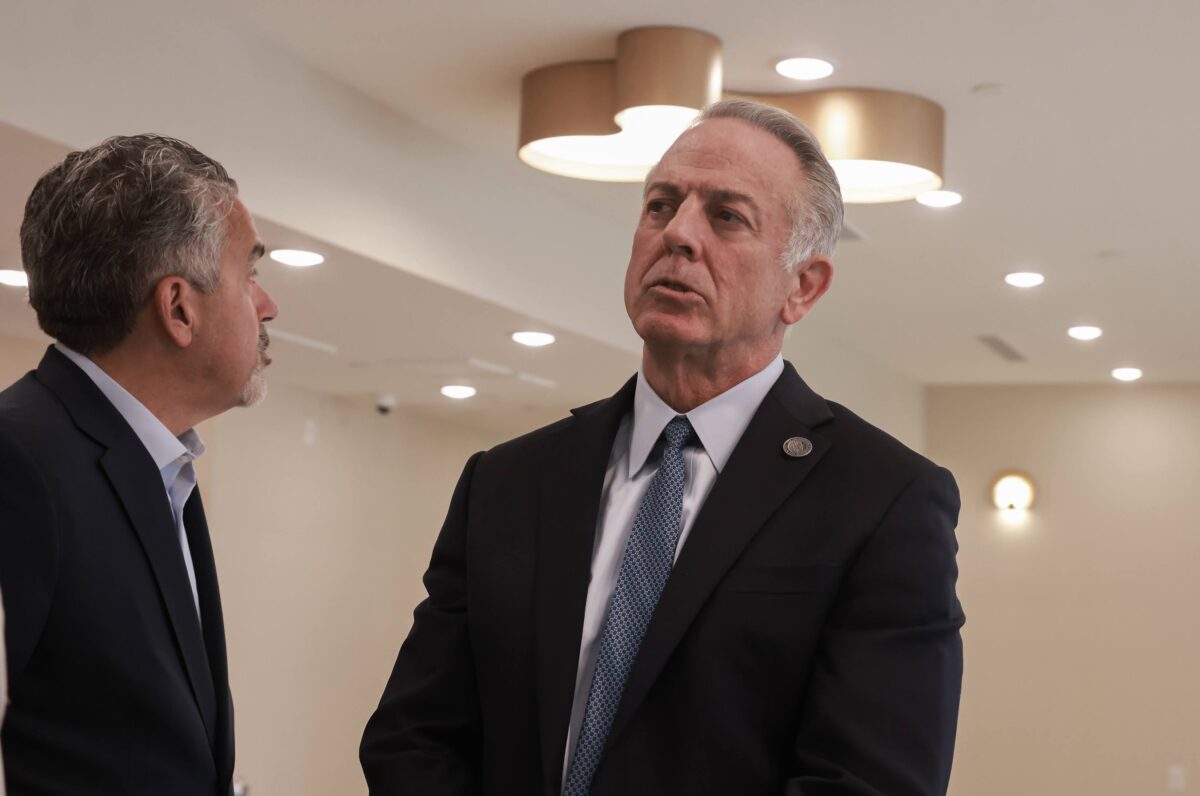
In September, with Democrats already spending heavily on ads tying him to the industry, Lombardo signed an executive order tightening requirements for data center tax breaks. The order came days after Axios reported that a Trump pollster warned Republican candidates that unqualified support for data centers was a losing position.
By then, the order likely came too late to change how voters saw Lombardo on the issue, Damore said, especially with Trump fully embracing the industry while Republicans down the ballot tried to stake out more nuanced positions. "Voters really weren't in the mood for nuance," he said.
Ford had almost a month earlier pledged to pause new data center tax abatements, even though as a state senator he co-sponsored the 2015 law that created them, a point Lombardo's campaign pressed in its own ads.
Ford won the race by nearly 8 percentage points, according to unofficial results.
Hard-line stances against data centers were part of the platforms of many Democrats who flipped governor's offices this year, including in Nevada, The Associated Press noted. But Lombardo's losses didn't track neatly with where data centers in the state are. His share of the vote fell in 14 of 17 counties compared with 2022, according to a Nevada Independent analysis.
In Storey County, home to the Tahoe-Reno Industrial Center and some of the state's largest data centers, and neighboring Lyon County, where commissioners approved a zoning change for the massive Monarch Data Center near Yerington, it dropped by about 3.5 percentage points, less than his roughly 5-point drop statewide.
Instead, the data center attacks worked as part of a broader Democratic message that Lombardo sided with the wealthy, Damore said. In his view, Lombardo's attacks on Ford for co-sponsoring the 2015 tax break law fell flat because voters held the sitting governor, who oversees the state's economic development, responsible for data center policy, even though the tax breaks are set in state law. Lombardo's campaign also spent much of its messaging on criminal justice and Ford's travel schedule, issues Damore said voters weren't prioritizing, without laying out a vision for the state.
In a statement to The Nevada Independent, Ford said his top priority as governor-elect is lowering costs for working families.
"I've been clear that data centers will have to use an alternative to our fresh water, build out the grid and pay for their increased clean energy use and deliver on their promise of sustainable high-paying union jobs," he said.
Lombardo's campaign did not respond to a request for comment.
Reno and down the ballot
The clearest candidate contrast on data centers came in the race for Reno mayor, where Councilmember Kathleen Taylor cast the only vote against the city's moratorium on new data center approvals. She argued the pause was political posturing and asked city officials to fast-track code changes instead. She said she opposes data centers in residential neighborhoods and data center tax abatements.
She made that case to voters in a September campaign ad. "I'm not against technology. I'm against a bad deal," Taylor says.
Former Lt. Gov. Kate Marshall backed the moratorium and made opposition to data centers within city limits a focus of her campaign. Her ads called Taylor the "Data Center Queen" and pointed to her votes approving data centers.

Marshall beat Taylor comfortably in unofficial results, and data centers helped bring at least some voters to the polls. Rashonda Stubblefield, a 40-year-old small-business owner, told The Nevada Independent on Election Day the mayor's race brought her out for her first midterm, partly because of data centers.
"I'm not an AI or data center fan … especially on public land. I love Nevada and it's beautiful and I don't think [they] should be taking up our resources, put them somewhere else," she said.
Party played a role, too: Taylor highlighted her conservative background in the nonpartisan race, and Marshall her Democratic endorsements. Neither Taylor nor Marshall responded to a request for comment.
Down the ballot, Democrat Vinny Spotleson, who supports a temporary moratorium on data centers, won his race in Assembly District 41. He also opposes continuing tax abatements for the industry.
In Assembly District 35, Democrat Joe Spica beat the Republican incumbent, Edgeworth, after casting her as a rubber stamp for Lombardo and data centers. In responses to The Indy, Spica opposed continuing the abatements, while Edgeworth was neutral.
Republican attorney general candidate Adriana Guzmán Fralick, who was also attacked over earlier comments that the state should go along with data center growth, lost to Democratic state Sen. Nicole Cannizzaro (D-Las Vegas), who called for more consumer protections for Nevadans dealing with the industry. Guzmán Fralick did not respond to a request for comment.
The debate now moves to the Legislature, which convenes Feb. 1 with Democrats in control of both chambers and the governor's office.
Ford has promised to pause new tax abatements, and state Sen. Dina Neal (D-North Las Vegas) has said she plans to introduce a bill in 2027 to repeal data center tax breaks and impose a moratorium on new projects. Cannizzaro has requested her own bill, which would require environmental reviews, closed-loop cooling and public reporting of data centers' water and power use. The bill would also give residents a say in where data centers are built.
"Ultimately, I think the question for the Legislature is: Do we need to subsidize this? And I think the answer is probably going to be no," Damore said.
He said the bigger question lawmakers face is who pays for the power and grid upgrades data centers need, so the costs don't land on everyone else's bills.
Eric Neugeboren contributed to this report.
Support Independent Elections Coverage and Journalism in Nevada
You’ve enjoyed unlimited access to our reporting because we’re committed to providing independent, accessible journalism for all Nevadans.
But sustaining this work — informing communities, holding leaders accountable, and strengthening civic life — depends on readers like you.
Nevada needs strong, independent journalism. Will you join us?
A gift of any amount helps keep our reporting free and accessible to everyone across our state and funds our elections coverage.
Choose an amount or learn more about membership