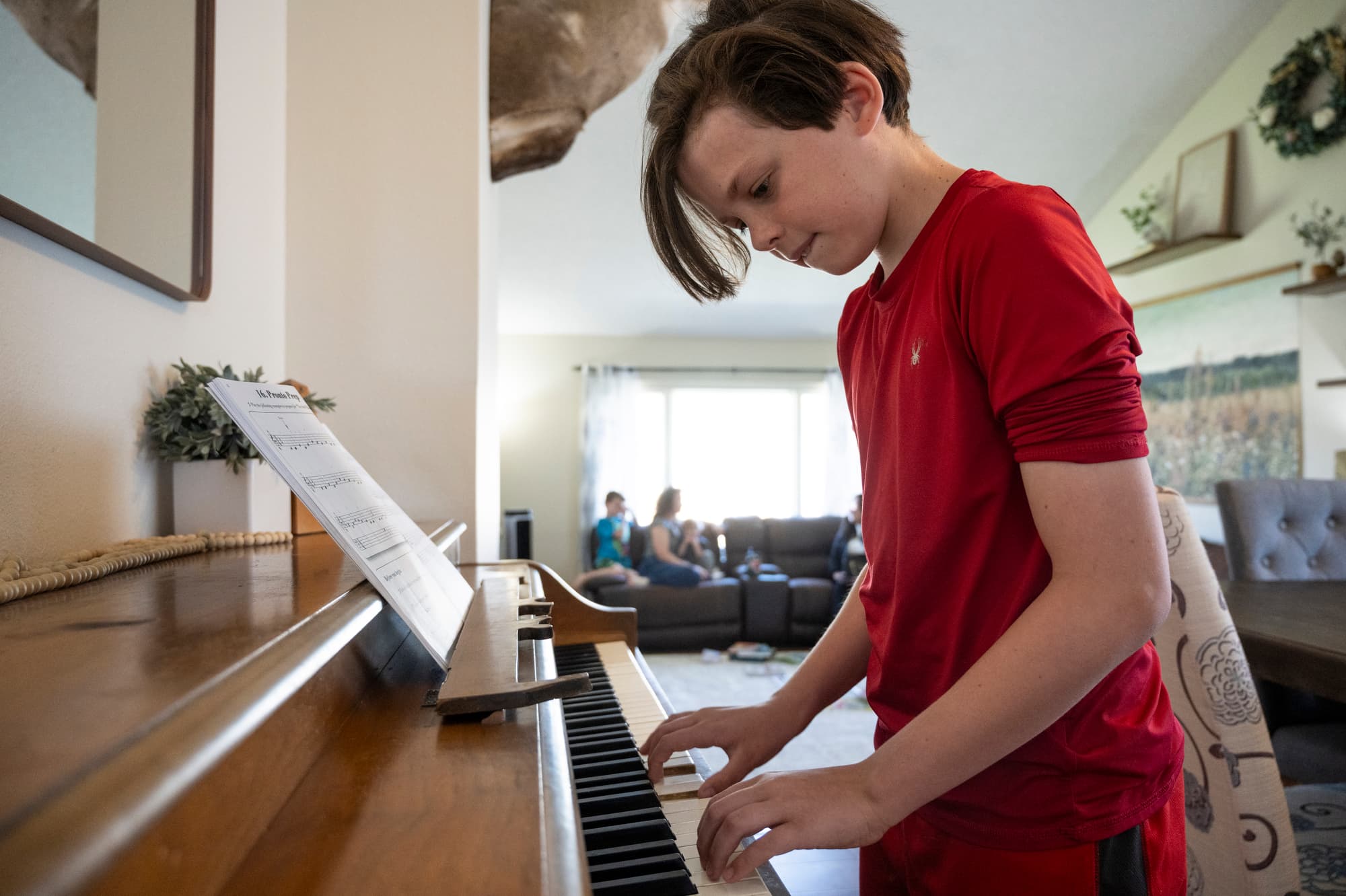
For families who want complete control over their child's education, more flexibility about how they learn and more facetime with their kids, homeschooling is an attractive option — and the pace at which people are taking the leap in Nevada remains higher than it was pre-pandemic.
Nevada legalized homeschooling in 1947 and was one of the first states to do so, according to Johns Hopkins School of Education's Homeschool Research Lab and Hub. It's among more than two dozen states with few homeschool regulations, according to the Home School Legal Defense Association, and doesn't ask much from parents compared with high-regulation states such as New York, where parents are expected to file quarterly reports to school districts documenting how much instruction students are receiving and require an annual assessment.
During the 2023-24 school year, 6 percent of families with school-aged children in Nevada reported they were homeschooled in a Household Pulse Survey conducted by the U.S. Census Bureau.
According to an analysis of the data by the Hub, the respondents were predominantly white, 64 percent. A small percentage, 7 percent, identified as lesbian, gay, bisexual or transgender, and about a third had a bachelor's degree or higher. Respondents' incomes levels varied.
However, there's not much data on how many students are homeschooled in Nevada.
The Nevada Department of Education does not track homeschool enrollment in real time, State Superintendent of Public Instruction Victor Wakefield said at a March 17 legislative committee meeting.
Instead, data around homeschooling is limited to notices that families turn into school districts to inform them of their initial decision to homeschool their kids; there are no requirements for annual status updates. The state doesn't track whether families stick with homeschooling through high school or whether they do so for a temporary period before enrolling in a public or a private school.
Still, some states have even less oversight over homeschoolers than Nevada, according to the Home School Legal Defense Association. Twelve states including Idaho don't require any notice about a decision to homeschool.
Data shared with The Nevada Independent by some school districts shows homeschool notices spiked during the 2020-21 school year, similar to findings from the U.S. Census Bureau during the pandemic. The number of submitted notices have tapered off since then, but in some districts they are still higher than they were pre-pandemic.
Here's what you need to know if you are interested in homeschooling.
Do I need to notify school officials or the state that I will homeschool my children?
Yes, parents of students must submit a notice of intent to homeschool in Nevada. They can do so through a form they submit to the school district they reside in for each child they are homeschooling. They must do so:
- when the child turns 6, which is the state's minimum age of attendance for public school;
- within 10 days of withdrawing a student from a public school;
- within 30 days of becoming a state resident if they recently moved to Nevada.
Parents of students in a charter school or a private school can also submit the form to their corresponding school district.
Generally, parents only need to fill out this form once unless the name or address for the parent or child changes. Under state law, parents must file a new form within 30 days after the change. Elissa Wahl, a longtime Nevada homeschool advocate and chair of the Nevada Homeschool Network, a social welfare organization that provides resources and support to homeschool families, said parents also have to fill it out again if their student(s) reenters homeschool after enrolling in public school.
The form asks parents to attach their plan to educate their child. Wahl said the plan doesn't have to be elaborate or detailed. It can be as simple as their ideas for the subjects they want to teach. She adds that parents won't be held to the plan they submit, and they are free to change their mind on how to educate their children.
State law prevents school districts from denying a notice of intent to homeschool based on the education plan and from requiring or requesting any additional information or assurances from the parent who filed the notice.
The state law says parents must be prepared to present the educational plan of instruction and proof of identity of the child to a court if asked.
According to guidance from the Nevada Homeschool Network, simply homeschooling a child does not constitute educational neglect under state law. Any allegations of educational neglect should have credible and detailed enough information that show that a child is not receiving a proper education and could result in a visit from a social worker.
If the family fails or refuses to provide to a court evidence that education is taking place, the social worker, at the direction of the court, will provide the family with referrals to educational programs and resources as appropriate. If the family does not access or implement referrals to educational programs, it could lead to further court intervention.
Wahl said by filling out the form, parents consent to assuming full responsibility for their children's education.
After the form is submitted, the school district will provide parents with a written acknowledgement that the form has been received. The written acknowledgment serves as proof of compliance with Nevada's compulsory school enrollment and school attendance law.
Does the state set any educational expectations for homeschool students?
The state's regulations on homeschool leave it up to parents to decide how much instruction time their students will receive per day and per year, what content they are going to learn, and when, Wahl said.
Homeschooled students are also not required to take state standardized tests. However, state law allows homeschool students to take college entrance exams, such as the SAT or the ACT. Under state law, school districts are required to provide homeschooled students with adequate notice of the exams by posting the information on their websites.
Are homeschooled students required to be vaccinated?
Nevada requires students to be vaccinated or submit an exemption for medical or religious reasons before they can enroll in a public or private school.
However, the state's homeschool statutes do not include a separate immunization requirement for children who are educated solely at home, according to the Southern Nevada Health District. Therefore, if a child is being homeschooled only and is not attending a district school, private school, charter school, or licensed child care facility, the family is not required to submit school immunization records or exemption forms to the state or the school district solely for homeschooling purposes.
However, the Southern Nevada Health District strongly recommends that all children receive the recommended age-appropriate vaccines to help protect their health and the health of those around them.
Can a student enroll into a formal school setting after being homeschooled?
Yes, but the process might be different depending on the student's age, what grade they want to enroll in and what school they want to attend.
Under a 2023 law, AB65, homeschooling doesn't count as completion of kindergarten or first grade, according to additional guidance from the Nevada Department of Education. A child who is 6 years of age on or before Aug. 1 who did not complete kindergarten at a public school, including a charter or a private school, would be placed in kindergarten if they are enrolling in a public school.
Another department memo states that children who are 7 years old by Aug. 1 and have not completed kindergarten can undergo a screening to determine if they are prepared developmentally to be placed in first grade.
A Clark County School District policy for students of all other age groups states children will be placed in the age-appropriate grade based on their age as of Aug. 1.
CCSD said in a statement that students enrolling in the district from homeschool can provide transcripts for the chance to receive credit for completed coursework.
The bill's enrollment requirements only apply to public schools. Private schools are free to enroll students in any grade they see fit when a student enters from homeschool regardless of age.
How much does homeschooling cost?
The costs can vary from family to family depending on how many children they are homeschooling and whether they want to buy certain education programs or curriculum or pay for tutors.
LeAndra Surprenant, an Incline Village mom of three and homeschool advocate, estimates her family spends about $500 a year to educate her three kids. Another mom, Holly Wittwer, estimates she spend a couple of thousand dollars per year on educating her three kids.
Homeschool moms recommend relying on free resources, such as the library, to supplement their child's education while keeping costs down or buying used materials whenever possible.
Wahl said she advises families not to spend more than $25 on any one item.
"You can learn about the Grand Canyon through a book, through watching YouTube videos, or through driving there and experiencing it," she said. "One is not better than the others. One is definitely going to cost more than the others."
Do parents need to have any experience in education to homeschool their kids?
Homeschool advocates say no formal education is necessary. But they recommend that parents find resources that can help them figure out what and how to teach and ask for support from other homeschool families.
"So do you need to be a teacher? Absolutely not," Surprenant said. "Do you need to be a motivated and loving parent who actually cares about how you're educating your child? Absolutely."
Does Nevada provide any funding to support homeschool students?
No. Wahl said Nevada homeschool families have historically been against receiving public funds that come with strings attached, such as required assessments of students' academic performance.
However, it's possible that most students eligible to enroll in a K-12 public school, including homeschoolers, may be able to receive funding from President Donald Trump's school choice tax credit program.
Can homeschool students participate in certain classes, sports or extracurricular opportunities offered by public schools?
Yes. State law allows homeschooled students to participate in classes and extracurricular activities provided there is space available and the parent or guardian can demonstrate that the child is qualified to participate. The parent must file a form to request participation, and school boards can ask for proof of the student's identity, such as a birth certificate.
School districts would not be required to offer transportation to these homeschooled students.
Homeschooled students wanting to participate in sports governed by the Nevada Interscholastic Activities Association must follow the same rules and expectations as their non-homeschooled peers in order to be eligible to play, such as completing a physical exam and paying participation fees.
State law allows the school board to revoke a homeschooled student's access to classes, sports or other extracurricular activities at public schools if officials determine the student is not following applicable rules and regulations.
Can a student who has special needs be homeschooled?
Yes. Wahl said students with special needs who are being homeschooled can still go to their public school to be evaluated. They might also be able to access the same services, such as speech or occupational therapy, at a public school as private school students.
But she warns parents that the school district's service may not be in line with their beliefs and values for their child's education. If parents are not comfortable with what the district provides, she suggests they see if they can go through their insurance to get those services covered or pay for them out of pocket.