Who voted in Nevada's 2026 primary? Turnout up slightly, still about 20%

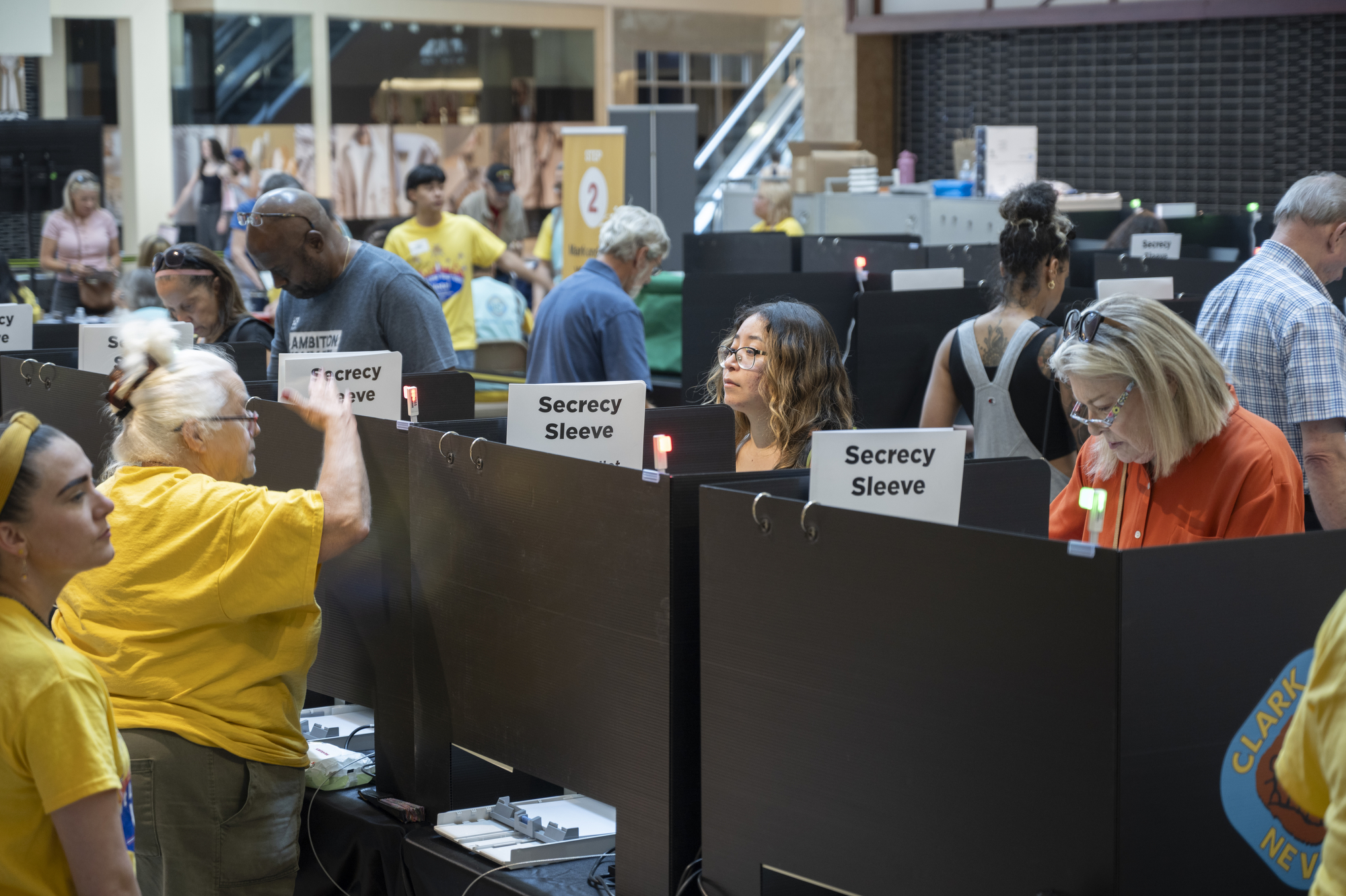
Turnout in Nevada's primaries increased slightly this year compared with the 2024 election, as competitive races especially in Northern Nevada helped boost participation.
As of Thursday evening, about 46,000 more Nevadans voted in this year's primary versus 2024. The overall turnout rate was only about 20 percent, slightly above last cycle. It's the first primary since 2020 in which turnout increased.
Additionally, mail voting continued to reign supreme, making up about 60 percent of ballots cast. The method was also especially popular in about two-thirds of rural, heavily Republican counties, despite GOP officials' opposition to the state's universal mail ballot laws.
Votes are still being counted and even received via mail if they were postmarked by Election Day, but those ballots typically represent a tiny percentage of results.
Esmeralda County had the highest voter turnout at more than 50 percent. Clark County had the lowest at about 18 percent, which, while 2 percentage points more than in 2024, was still the second lowest since 2016.
The modest increase in votes was welcome news for Nevada officials, who initially suspected participation might be lower because there were no U.S. Senate primaries for the first time since 2020, and that typically helps boost voting.
However, Secretary of State Cisco Aguilar (D) said in an interview that because primary elections determine officeholders in regions with steep partisan gaps, there is a disadvantage to such low turnout.
"I wish the turnout was higher," Aguilar said in an interview. "So few people have a voice [in those districts]."
Ken Miller, a UNLV political science professor, said in an interview that "for most voters' perceptions, these elections aren't that big of a deal but … for who actually ends up occupying many of these offices, it is the most important election."
Although the state has largely seen increases in the number of primary votes, the turnout rate has ebbed and flowed.
Miller added that as more voters register as nonpartisan — meaning they are not affiliated with a political party and, as a result, not allowed to participate in party primaries — then the number of eligible voters in primaries diminishes.
Nonpartisans are the highest share of registered voters in Nevada.
"As we see declining partisan affiliation, you're gonna see declining participation in primaries," he said.
Did competitive Northern Nevada races boost turnout?
For the first time in years, there were competitive primaries on both sides of the aisle for Northern Nevada's Congressional District 2 following the retirement of Rep. Mark Amodei (R-NV).
It seems to have made a difference in turnout.
Most of the 12 counties located fully or partially in the district reported increased participation from 2024, an increase of more than 18,000 votes. Turnout was lower than in 2022 — when there was a U.S. Senate race on the ballot — and in 2020, when participation soared amid the pandemic.
"Federal races are generally going to be more compelling for people than state and local races, even though, frankly, state and local politics probably has more impact on people's day-to-day lives," Miller said.
The importance of this congressional race was seen in Carson City. The state capital was the only region in Nevada to have no nonpartisan races on its primary ballot, meaning about 15,000 voters, or about 40 percent of the city's electorate, were ineligible to participate.
Still, about 43 percent of voters in both major parties participated in the primary — the number of total voters was only slightly lower than in 2024 despite the lack of nonpartisan contests.
Scott Hoen, the Carson City clerk-recorder, said in an interview that the congressional primary, as well as closely watched Republican races in Assembly District 40 and Senate District 16, likely led to higher-than-expected turnout.
"[Republicans] were just a little bit more energized," he said.
In Washoe County, the number of votes could reach a record. As of Thursday evening, about 94,000 votes had been counted, so there is potential to surpass 2020's record total of about 96,000.
Mail ballots reign supreme again
Nevada has a universal, opt-out mail ballot system, which has at times caused derision from Republican officials who have argued it invites fraud. There is no evidence of widespread voter fraud in Nevada.
For the fourth consecutive primary, most votes were cast through the mail. As of Thursday afternoon, mail ballots accounted for about 60 percent of the votes cast, slightly lower than last cycle but higher than in 2022.
About 64 percent of Democrats voted by mail, compared with about half of Republicans, according to a Nevada Independent analysis of voting data published by the secretary of state's office.
Additionally, the four counties with the highest mail ballot percentage were rural.
"Mail ballots are just so much more convenient, and there's such an enfranchising force for local voters," Miller said.
Support Independent Elections Coverage and Journalism in Nevada
You’ve enjoyed unlimited access to our reporting because we’re committed to providing independent, accessible journalism for all Nevadans.
But sustaining this work — informing communities, holding leaders accountable, and strengthening civic life — depends on readers like you.
Nevada needs strong, independent journalism. Will you join us?
A gift of any amount helps keep our reporting free and accessible to everyone across our state and funds our elections coverage.
Choose an amount or learn more about membership