Can Alexis Hill do the impossible? On the trail with the underdog Democrat for Nevada governor
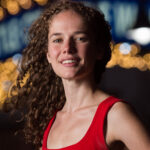

It's an unseasonably hot day in Las Vegas, and Alexis Hill is knocking on doors, sporting sunglasses atop her head, a teal T-shirt emblazoned with "Nevadans First" and dark blue tennis shoes.
The two-term county commissioner from Northern Nevada drops off flyers under the doormats of houses amid stops to talk with residents in the Crestwood neighborhood. It's a quiet residential area in the downtown part of the city, with an eclectic mix of trees and desert plants, as well as a broad palette of home features betraying the lack of a homeowners' association.
Every once in a while, as the temperature seems to tick up a degree every hour, she stops to glance at a map on her phone and make sure she is heading to the right address.
"What are you trying to sell?" three people sitting at a table in front of one of the houses call out, smoking cigarettes in the hot sun.
"I'm not selling anything," Hill replied. "I'm running for governor."
Hill is attempting to do the impossible — win a Democratic statewide primary in a state that has, for decades, gone with the choice of entrenched party interests.
Though Hill is established in her political career — she formerly chaired the Washoe County Commission, which oversees the state's second-largest county — the favorite to challenge incumbent Gov. Joe Lombardo (R) is "Reid machine" choice Aaron Ford. He's a two-term attorney general and former top state lawmaker endorsed by all five Democrats in the state's congressional delegation and 33 state lawmakers.
He's lapped Hill in fundraising; most public polls, including one released by her campaign, either don't include her as an option or show her down by double digits. Prediction markets haven't, until recently, even included Hill as an option — and even now give her a 2 percent chance of winning.
Ford's campaign has effectively ignored the primary. Yet the 42-year-old Hill is hoping it's through conversations she's having on this sunny March day — including one with a "mentalist" who offered to perform at her next event and bring a firebreather if she was open to it — that she can break through and win the primary without the money, statewide name recognition or endorsements typically viewed as prerequisites.
"I would not be doing this if I didn't think we could win," Hill later told The Nevada Independent. "What voters are looking for right now is relationships and authenticity. And the only way you do that is … connecting with people, and that is what I'm doing every day."


Growing frustration with the status quo
Hill holds a bachelor's degree in political science from Texas A&M and a graduate degree in public administration and policy from UNR. She worked in city planning and public policy for more than a decade in Sparks and Reno. And she still gets frustrated when there's a simple, cost-neutral solution to a pain point community members face.
In this and all her conversations in Las Vegas, Hill maintains eye contact, asks the people she's talking to for their stories, and highlights her perspective as a county commissioner who has seen the struggles people face at the local level and wants to leverage the governor's office to help. She focuses on the individual, discussing retirees' financial struggles on a fixed income and listening to concerns from a young couple seeking to purchase their first home, while conveying her campaign's talking points.
She focuses on growing frustration with the existing Democratic Party and emphasizes her role as an alternative to the status quo. Though her website promises to "TAX the billionaires," implement universal Pre-K and temporarily cap rent, Hill distances herself from the "progressive" label, describing her platform as "moderate changes to the state," which may only seem extreme because they've been neglected.
For example, she's not advocating for gold-plated schools, but rather being in the "meaty part of the middle" — bringing Nevada's per-pupil funding to the national average.
"This is not an extreme thing to want and to expect from your state," she said, even though hitting that goal is estimated to cost an additional $2.7 billion per year by the end of a 10-year ramp-up period.
Hill's plan focuses on paying for that largely by closing corporate tax loopholes and taxing billionaires. There's also a portion that includes adjusting property tax abatements. Past proposals to change the property tax formula have hit dead ends in the Legislature.
Ford, when asked about whether he'd support property tax changes to boost school funding, has said he doesn't want to raise homebuying costs for Nevadans.


Hill has focused on direct interactions with voters to share her platform, using phone banking, door-knocking, text messages, Ask Me Anything threads on Reddit and community forums.
Her follower count on social media tends to lag behind Ford, save for Instagram, where she has almost twice the followers, yet she's built a sizable following given her relatively low profile compared to Ford, who's been in state politics for 14 years. She's going for approachable: In between photos of campaign events are makeup-free selfie videos of Hill decrying SNAP cuts, clips of her, cross-legged in sweatpants in her hotel room and recapping a day on her statewide tour.
Since announcing her bid for governor in September, Hill has spent about half of each week in Las Vegas. She stays in touch with her husband, Matthew Tuma, 4-year-old daughter, Zora, and foster daughter, who joined their family in December, via FaceTime calls.
When it comes to the election, Hill said it's likely to come down to the 135,000 to 180,000 Democrats expected to vote in the primary — and the fact that most of them live in Las Vegas is another obstacle for a candidate still unknown outside of the Northern Nevada communities where she hikes and bikes in her free time.
But slowly, she's winning over fans.
"There's no artifice about her," said longtime Las Vegas philanthropist Beverly Rogers, who's a major donor to Hill's campaign. "She's genuine. She's not entitled or anointed. She has backbone. She owes no one. … She's not beholden to the casino or mining industries … She believes in Nevada's potential and what we can be."
The chairman of the Rogers Foundation and a longtime Las Vegan said she was initially intrigued and asked to set up a meeting after watching a clip of Hill criticizing the Hollywood and union-backed effort to expand film tax credits in the Silver State — a stance Rogers shared.
They met at a campaign coffee gathering, and Rogers attended community forums and other Hill campaign events. She said Hill takes the time to answer questions and acknowledges when more research is needed, which stands in contrast to others in the political world.
Oftentimes, in Nevada politics, politicians can settle for the status quo, Rogers observed. Hill offers an alternative.
"I'm tired of what I like to call placeholders, which is what I feel we have had in that and some other positions for some time," Rogers said. "And I feel like she's the person who can make that happen, and I want to do my best to help her in any way I can."


What's different?
Watching Hill's campaign is a bit of dejá vu for Chris Giuchigliani.
In 2018, she unsuccessfully ran a grassroots campaign for governor against her then-fellow Commissioner Steve Sisolak, who, like Ford, was also backed by Nevada's Democratic Party apparatus.
Similar to Hill, Giunchigliani faced a fundraising deficit but attempted to push forward progressive issues, including pro-choice measures, services for seniors and corporate accountability. She lost to Sisolak by about 12 percentage points.
"Chris G," who is now supporting Hill and volunteers for her campaign, said there's a difference in name recognition in Southern Nevada, but she sees Hill is now facing many of the same struggles she experienced, including the media largely ignoring her and a hesitancy among donors.
Giunchigliani said Ford represents the status quo, while Hill is focusing on challenging it.
"Once people go in to vote, you're going to see people trusting a woman far more so than the man," she said. "People want a change."
Hill has focused on small house parties and gatherings at local businesses, such as the one in late March hosted at Sticks Tavern, a hockey bar in Henderson, that attracted around 15 to 20 people.


As Hill mingled with the crowd over wine and an elaborate charcuterie board, many said they'd heard about the event through a text message campaign and were excited about the potential of a woman candidate. They added that they liked the specificity of her platform and the emphasis on raising Nevada's per-pupil education spending to the national average.
One attendee, Sarah, a writer and Democrat who declined to share her last name, said she came after Hill cold-called her phone with an invitation. She said she hasn't made up her mind yet about whom to vote for in the primary, but is glad Hill has a plan and is interested in hearing more about it.
She added Ford, who has limited questions from reporters at events and declined opportunities to debate Hill, "is not doing himself any favors."
"The biggest hiccup is that I feel like he has been silent, and that's a problem," she said. "I regularly call and email my state rep and my two senators, and I would tell him what I tell them, which is either lead or get out of the way."
Investment in voters, not campaign fundraising
Hill's campaign manager, Cecia Alvarado, said the narrative that the biggest fundraiser will win ignores something critical: direct connections with voters.
"She has the money that she needs to win," Alvarado said. "Everybody in this campaign is getting paid. She is investing a lot of her time talking to voters."
In the first three months of 2026, Ford reported raising $1.5 million across his campaign and affiliated Forward Nevada PAC. His campaign has $2.7 million in cash on hand.
Hill, on the other hand, raised $171,000 in the first three months of 2026, the majority of which ($126,000) consisted of loans from her and her husband. Her donor base did not feature any large PACs, corporations or other interests; she has less than $100,000 in cash on hand.
Fundraising totals are often an indicator as to who will win a political race. An analysis by The Nevada Independent found that in two-thirds of the closest legislative races from 2016 through 2022, the winning candidate raised more money in the year before an election.
Hill herself has noted that when she first ran for Washoe County Commission in 2020, she was not expected to win and largely ran without the broader support of the Democratic Party. She ultimately won her seat with 55.1 percent of the vote that year.
Hill's platform and priorities have grown out of one question she's asked almost every voter she's spoken to: What problems do you see in your community?
It's a question that led her to incorporate a suggestion from Mikey Kelly, an Army vet and former chair of the Nevada Democratic Veterans and Military Families Caucus, into her economic plan.
When he shared that it's difficult to translate skills gained in the military to civilian jobs, Hill added a line in her plan to simplify state licensing requirements for veterans whose service includes equivalent health care, law enforcement, commercial driving or other work experience.
Kelly said Hill's willingness to listen and have a discussion with him and other veterans is one of the main reasons he is supporting her in the primary.
He noted that, as repugnant as he finds President Donald Trump, what allowed him to get elected was his willingness to directly answer questions about individuals.
"I have yet to hear that from either [Ford] or even the governor," Kelly said. "I'm not hearing direct answers. What are you going to do to lower utility costs? Not from them. I've heard it from Alexis."

Those close to Hill say that Kelly is an example of how Hill interacts with voters.
The power of that direct connection was also visible in an interaction Hill had in the clubhouse of a senior living apartment complex in the Crestwood neighborhood.
Two retirees, one of whom identified herself as Gloria, had never heard of Hill. Gloria told Hill they were on fixed incomes and were moving in together after she had been recently evicted. The meandering, roughly 10-minute conversation covered the different places they had lived, the challenges with public transportation, the high cost of living and the state's rental laws.
Before Hill left, she took a picture with the two, and Gloria told her, "You've got my vote."
The conversation may have translated into a vote for Hill. But her biggest hurdle is whether she will have enough time between now and the June 9 primary to connect with enough voters.
"We don't know if I will, but I do feel like I am definitely making inroads," Hill said. "People are ready for something new. People want change."
Support Independent Elections Coverage and Journalism in Nevada
You’ve enjoyed unlimited access to our reporting because we’re committed to providing independent, accessible journalism for all Nevadans.
But sustaining this work — informing communities, holding leaders accountable, and strengthening civic life — depends on readers like you.
Nevada needs strong, independent journalism. Will you join us?
A gift of any amount helps keep our reporting free and accessible to everyone across our state and funds our elections coverage.
Choose an amount or learn more about membership