Did Donald Trump sink Nevada Republicans? Here's what the data says.


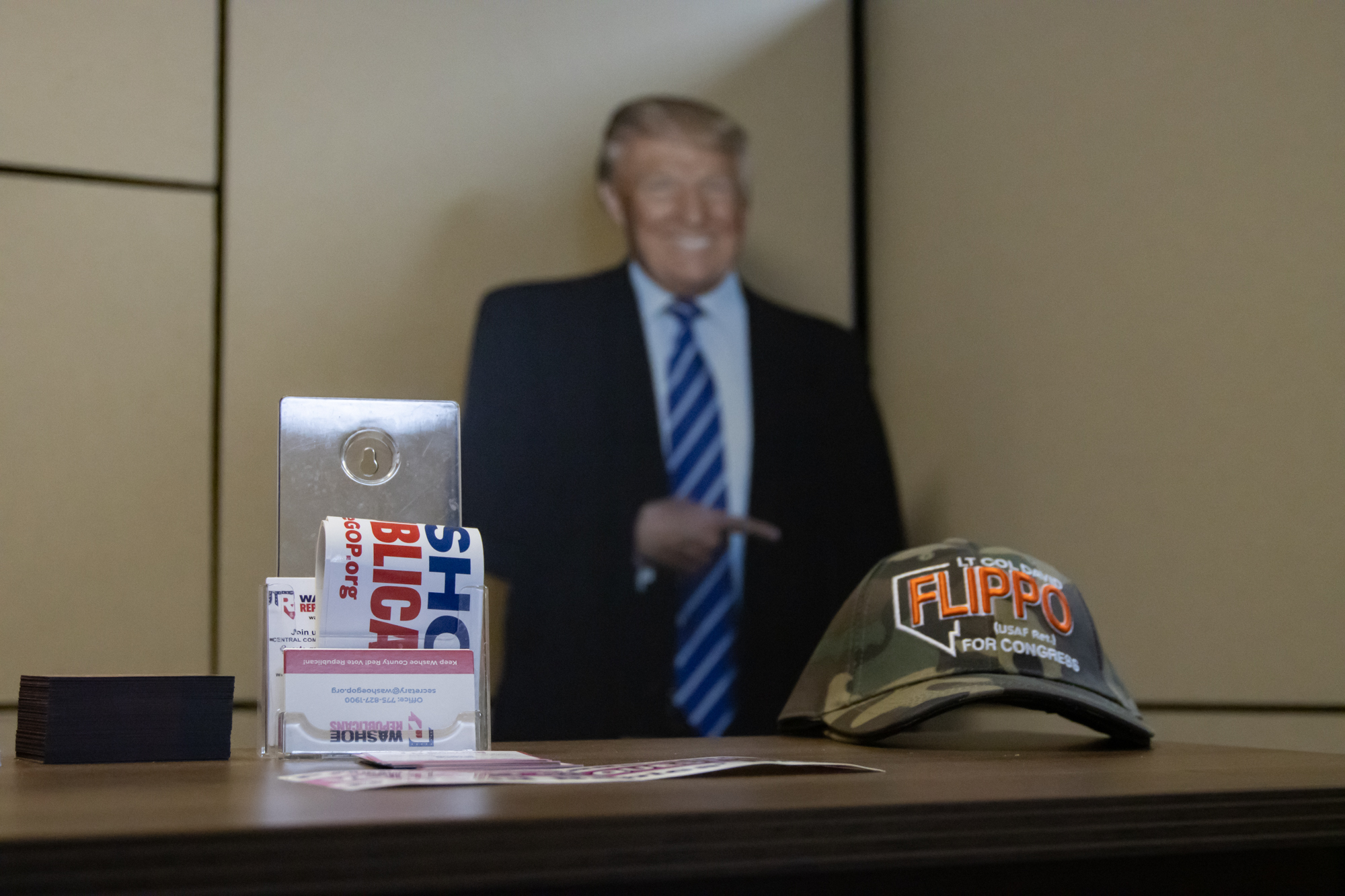
This fall, President Donald Trump told voters to "pretend I'm on the ballot."
Last Tuesday, voters in Nevada did just that — resulting in historic victories for Democrats, who won all six statewide offices and all four Congressional districts. Multiple voters told The Nevada Independent they cast their ballots specifically to rebuke Trump and the leaders they said enable him.
Many Nevada Republicans sensed what was coming. Mentions of the president and his once-coveted "complete and total" endorsement dried up on the Republican side after the state's June primaries; Trump himself came only as close as Bullhead City, in Arizona, during his furtive, furious pre-Election Day stretch of rallies.
The distancing did not work.
"At the very least, it didn't matter to get the Trump endorsement for the general, and at worst the Trump endorsement was harmful," one Nevada Republican politician, granted anonymity for professional reasons, told The Nevada Independent. "The reason nonpartisans voted against us was because of Trump's policies, and the reason that Democrats were so energized to vote was because of Trump's policies."
A Nevada Independent analysis of voting data found that the midterms were indeed a referendum on the president. Republican statewide candidates who were less tied to him — often because they weren't endorsed — posted the best electoral performances, measured relative to Nevada's partisan lean and the national environment. The same was true of congressional candidates in their districts. In the general election, Trump's endorsement was worth its weight in lead.
"The way Trump leads the Republican Party gives so little wiggle room to incumbent Republicans to distance themselves from him," UNR political science professor Jeremy Gelman told The Nevada Independent. "In 2006, during the Iraq War, you had Republicans coming out and saying, 'We're now reluctant to continue this,' and in 2010, Democrats would say, 'Obamacare maybe wasn't exactly everything I was looking for.' … But just the nature of how Trump and the Republican Party operate with one another, there was just no way for any of these incumbents to do that. Which is why they all lost."
Unsurprisingly, the single biggest Republican overperformer in Nevada was Gov. Joe Lombardo (R), who benefitted from incumbency, high name recognition and a huge spending advantage. But Lombardo tried to have it both ways — he publicly embraced Trump at an August rally in Las Vegas while otherwise trying to keep his campaign far from Washington politics, emphasizing in interviews and on the trail that he was worried exclusively about Nevada and believed voters felt the same.
"Who gives a crap what's going on in the rest of the world, right?" Lombardo said during remarks at his campaign's Election Night party, which lost steam as poor results for Republicans rolled in nationwide. "We care about Nevada."
Statewide candidates who embraced Trump and bragged about his endorsement did worse than they might have otherwise. Secretary of State candidate Jim Marchant (R) tagged Trump in nearly all of his social media posts — including ones unrelated to federal issues, such as a celebration of Nevada Day.
Marchant, heavily outraised and outspent, was the single biggest underperformer of the GOP's statewide slate. In the congressional races, too, the candidate who performed second best relative to partisan expectations was the only one not endorsed by Trump, an indicator of the albatross he represented around their necks.

Running from Trump
The GOP's statewide candidates were careful to sidestep discussion of the president, with zero mentioning Trump in any ads released after the June primary. It was a starkly different approach from that of the Democrats' statewide candidates, who tied their opponents to Trump at every turn — mentioning him in nearly $9 million worth of ads that ran after the June primary. That represented roughly $1 of every $3 the Democratic candidates spent on advertising.
Some Republicans were more careful than others — Lombardo especially.
When Lombardo won in 2022, he received Trump's endorsement but didn't portray himself as a MAGA loyalist and criticized Trump's false claims that the 2020 election was stolen. Four years later, Lombardo used a similar playbook, saying in March that he thought Trump was doing a "good job" as president but avoiding mentioning him by name as the campaign progressed.
Just days before he lost re-election, Lombardo told The Indy that he was "more concerned about what influence I could have within the boundaries of our state."
"He is not MAGA," Steve Wolfson, the Clark County district attorney and a Democrat who endorsed Lombardo, told The New York Times in October.
When Lombardo did associate with Trump, it got him in hot water. He skipped Trump's visit to Las Vegas in April but came onstage with the president in August, where Lombardo went off script to defend Trump's "billionaire friends." Democrats clipped the remarks and turned them into a $150,000 ad campaign that featured Lombardo saying to the audience: "You love him too, right?"
In the end, Lombardo's moderate tenor and advertising avalanche did get him farther than other Republicans. He lost by 6 points, overperforming most Republicans in the state on a historically bad night for the party. AnIndy analysis of results in the eight states where incumbent Republican governors ran for re-election found that Lombardo was a middle-of-the-road electoral performer, slightly overperforming the national environment but not as much as GOP governors who held on in blue states such as New Hampshire and Vermont.
Other Nevada Republicans fared much worse. In the Republican primary for attorney general, Adriana Guzmán Fralick's victory was powered by a Trump endorsement that she spent thousands of dollars promoting in primary ads — the only statewide Republican who mentioned Trump in any ads in 2026. Though she pulled down most of them after easily winning the primary, Guzmán Fralick still wound up underperforming, running 2 percentage points behind what her vote total should have been, given the political environment in Nevada and the nation.
So did Trump's other endorsed candidates in statewide races, Lt. Gov. Stavros Anthony (R) and Marchant.
Besides Lombardo, the only other overperformer among Republican statewide candidates was Controller Andy Matthews (R), whose final result exceeded expectations for the race by a slim 0.2 percent. His overperformance was likely buoyed by his incumbent advantage and fundraising — he raised roughly seven times more than his opponent, Controller-elect Matthew MacDougall (D), whose campaign did not run any ads.
Matthews also ran without Trump's endorsement. In his ads, he presented himself as a policy wonk and accounting nerd intent on keeping watch over even the most boring details about Nevada's bank accounts.
"My focus really was to just make sure that I kept the conversation in my race specific to the controller's office, and not get involved in talking about broader issues or national issues," Matthews told The Nevada Independent in a Monday interview.
He said he didn't have any communication with the White House about the race. Would it have helped to have distanced himself from Trump more?
"The environment was such that I don't think it would have mattered, really," Matthews said. "In a downballot race like controller that doesn't get a lot of attention to begin with, you're limited in what you can really do to make news. … It's probably a race, more than most, where you are very susceptible to the political climate. … there really isn't anything we could have done."
Republicans were stuck. Shunning Trump could have depressed turnout among the most committed members of their base with little benefit. Some theorize that it would have been hard for GOP candidates to shake the Trump association in any world, pointing out that there were leftward swings even among past Trump supporters.
"The same Republicans that elected Donald Trump, the first Republican winner in Nevada in 20 years, they just didn't show up," said a longtime Republican political strategist, given anonymity to speak freely. "Or if they did show up, they were so pissed off at Trump that they went the other way."
Trump likely hurt congressional candidates, too
In Nevada's congressional races, Trump endorsed three candidates: state Sen. Carrie Buck (R-Henderson) in the 1st Congressional District, small-business owner David Flippo (R) in the 2nd, and video game composer Marty O'Donnell in the 3rd.
In the primaries, that support helped propel them to victory. But after they became the Republican nominees, what had been a boon started to backfire.
"Many of the smarter Republican candidates didn't necessarily want the Trump endorsement even in the primary, because they knew what a liability it would be in the general," said the Nevada Republican politician, who spoke on condition of anonymity.
In Southern Nevada, Buck tried to carve her own profile apart from the president. During the general election, Buck didn't mention Trump in her ads or on social media. She expressed doubts about two of the subjects tied most closely to Trump, tariffs and the Iran war.
UNLV political science professor Rebecca Gill said Trump tied himself to the issues that upset voters.
"He made a point to put himself in the middle of everything, to take a position on everything, and when you do that, then you become an avatar for all of the things that aren't working, even things that might not have much to do with him, per se," Gill said. "I think it is mostly anti-Trump, inasmuch as he made himself the hinge point of all sorts of different issues that people would have."
In September, Buck hinted that she didn't support his approach to immigration enforcement, but never explicitly disagreed with it.
O'Donnell hewed closer to Trump, who won the 3rd Congressional District in 2024. The Republican nominee even appeared at an October rally with him in Bullhead City, Arizona, after the president skipped Nevada during his final midterm travel. His opponent, Rep. Susie Lee (D-NV), spent hundreds of thousands of dollars on ads that highlighted Trump's endorsement.
Flippo seemed to want to hug Trump. Running in a deep red district that Trump won by 13 points, doing so seemed like the right move. In the primary, Flippo ran ads promising "to give more firepower" to the president. Club for Growth spent $250,000 on ads on his behalf, stating that Trump needed "reinforcements in Congress."
Even Flippo may have sensed the tide turning, as his campaign began to foreground Lombardo's endorsement over Trump's in the general election. On the whole, though, Flippo didn't do much distancing. He accused his opponent of wanting to repeal "the Trump tax cuts" and kept a banner on his website touting the president's endorsement. On Election Day, he retweeted Trump's praise.
Rancher Cody Whipple (R) was the opposite. Although Whipple said he would welcome Trump's endorsement, he told The Nevada Independent he didn't ask for it. He ended up being the only Republican congressional candidate in the state who ran without the president's support, a fact which appeared to work in his favor. Whipple wasn't immediately available for an interview.
Though many other factors also shaped the results, poor performance was somewhat correlated with embracing Trump. Flippo and O'Donnell underperformed expectations in their districts by more than Buck and Whipple, who also underperformed but by slightly less.
Even more notable is that, while Whipple performed a little worse than Buck compared to expectations, he managed to do roughly as well as all the other Republican nominees, all of whom benefitted from several million dollars in campaign cash and outside spending. Whipple, meanwhile, raised less and had less outside spending on his behalf, according to the most recent campaign finance filings.
His lack of a Trump endorsement was the most obvious difference between his campaign and the others.
Some things, money can't buy.
Tabitha Mueller and Piper Heath contributed to this story.
Support Independent Elections Coverage and Journalism in Nevada
You’ve enjoyed unlimited access to our reporting because we’re committed to providing independent, accessible journalism for all Nevadans.
But sustaining this work — informing communities, holding leaders accountable, and strengthening civic life — depends on readers like you.
Nevada needs strong, independent journalism. Will you join us?
A gift of any amount helps keep our reporting free and accessible to everyone across our state and funds our elections coverage.
Choose an amount or learn more about membership