Ex-lawmaker wants his rural seat back. He'll have to get past 3 more Republicans first.
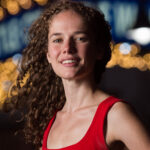
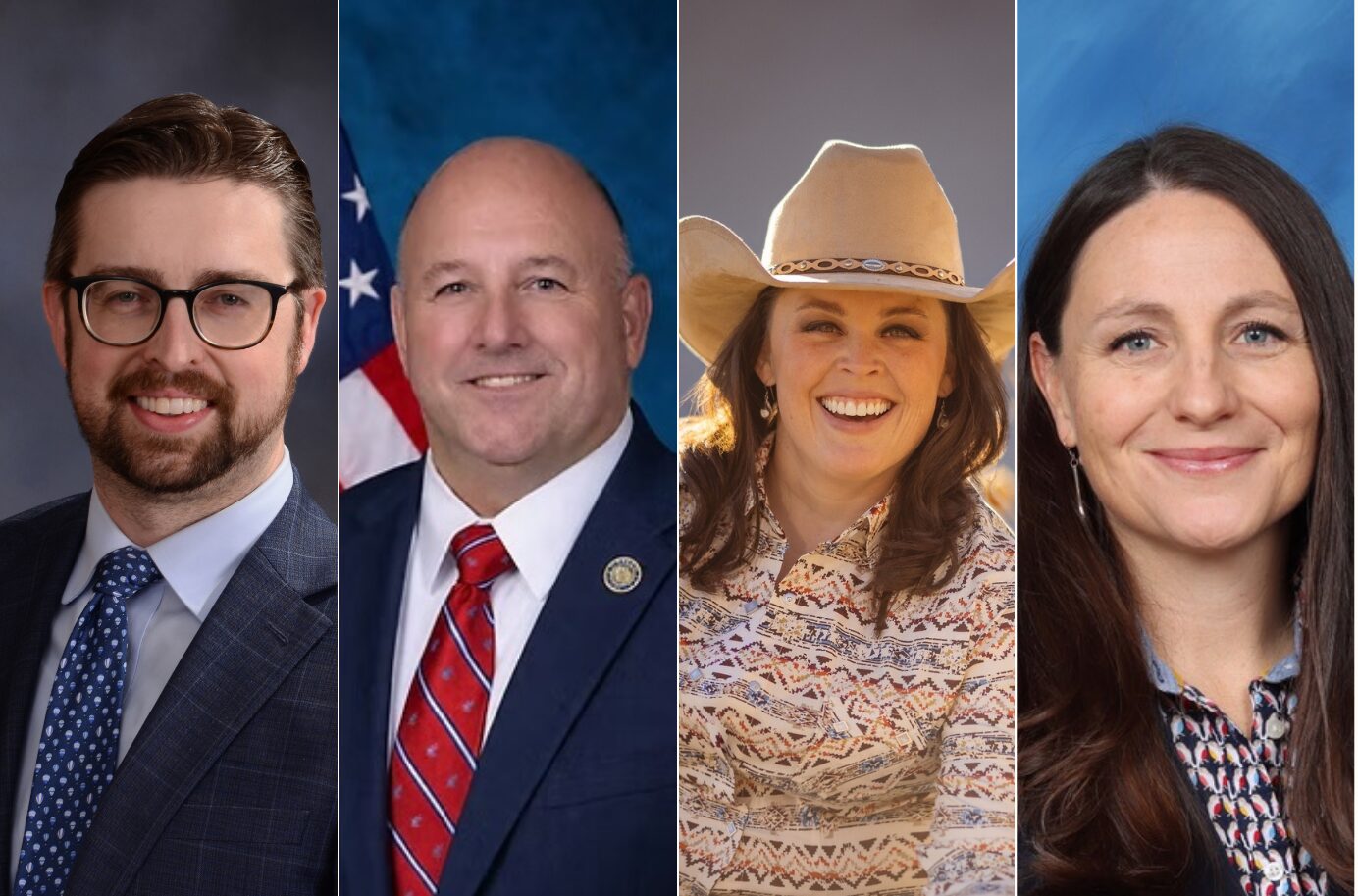
A former lawmaker who resigned from Northern Nevada's Assembly District 39 wants to make a comeback — and it's created a heated, four-way Republican primary.
Assm. Blayne Osborn (R-Gardnerville), 36, who was appointed to the seat in October 2025 and is endorsed by Gov. Joe Lombardo (R), is facing challenges from former officeholder Ken Gray, 66, who left the position to take a role in the Trump administration, small-business owner and Navy veteran Brianna Cowan, 35, and former Lyon County School Board Trustee Bridget Peterson, 49.
All four have played up their Republican bona fides, cast themselves as true conservatives willing to go to bat for their constituents, oppose new taxes, called for voter ID laws and taken a stand against far-left ideals that they warn are rampant in the Legislature controlled by Democrats.
Though Democrat Eric Obermayer is also running for the seat and will be on the general election ballot, the district's heavy Republican voter registration advantage means that whoever wins the primary will likely win in the November general election.
The district includes parts of South Lake Tahoe and the towns of Dayton, Minden, Zephyr Cove, Genoa and Gardnerville, as well as parts of Indian Hills.
In terms of fundraising, three of the candidates raised similar amounts in the first quarter of the year. Osborn led the pack with $24,400 in donations and nearly $50,000 in cash on hand; Gray had $23,000 in contributions and almost $10,000 in the bank; and Cowan reported $21,300 in donations and nearly $12,000 in cash on hand. Donation totals do not include in-kind contributions or self-loans.
Peterson has reported $3,300 in self-donations.
Read below to learn more about each of the candidates and their stances on certain issues.
Meet the candidates
Osborn, who was born and raised in the district, said after graduating from Douglas High School in 2008, his plan was to join the Marine Corps. But a diagnosis of severe scoliosis and a subsequent procedure to address it made that dream impossible.
Instead, he put his desire to serve his community to work in the Legislature, first as an assistant to lawmakers, then with the Assembly Republican Caucus and eventually in healthcare policy as the president of the Nevada Rural Hospital Partners, an alliance of 13 small rural hospitals.
His nearly two decades of experience with the Legislature, Osborn said, differentiates him from the other candidates in the race. The relationship-building skills he's learned during his time in office are also a boon, making him a more effective lawmaker when it comes to getting policies passed in a divided government.
During the most recent special session, he said he worked on an amendment that was included in a bill sponsored by Senate Majority Leader Nicole Cannizzaro (D-Las Vegas).
"Being able to do those kinds of things — especially when you have a divided government — you have to be able to do it," he said. "So that is somewhere where I can excel that nobody else in the race can."
He said he and his wife love the district's beauty, access to the outdoors and community.
Gray, an Air Force veteran, is retired and lives in Dayton with his wife.
Born in Long Beach, California, Gray moved to Gardnerville in 2022 and served as a Lyon County commissioner from 2017 to 2022. He left the position to represent Assembly District 39 in 2023 and stepped down from his seat to take a role in the Trump administration last year as the senior adviser to the National Cemetery Administration at the U.S. Department of Veterans Affairs.
Though he's faced criticism from his opponents for leaving the district to work in Washington, D.C., he said he returned to Nevada because of a stalker who threatened his family and the stress it was placing on his wife. He emphasized that he has a passion for public service and wants to address unfinished legislative business.
"Our district and our state still needs a very strong, true conservative voice," Gray said.
Gray said that what sets him apart is his life experience and ability to translate that into "smart decision-making." He noted that he's willing to sign on to good policies, regardless of politics, having co-sponsored legislation brought by Democrats and Republicans.
He describes his two kids as his greatest accomplishment and said he has lived his life in a way that he hopes gives back to the country.
Cowan was a Navy nuclear reactor operator for nearly seven years and now owns a government affairs firm that advocates against progressive government overreach. She said advice from her father — "If good people decline to do what is right, you have no business complaining about it" — inspired her to run.
She said she wants to be a champion of rights for people living in the district and make it a better place for them and her son.
Though her opponents have deeper legislative track records and the backing of key political players, Cowan said she has more grassroots support and is "unworried" and "unbothered."
She noted that she faces the same challenges as other district residents and is uniquely positioned as a self-described everyday Nevadan to represent the district in the statehouse.
"I'm a mom, I'm a veteran, I'm a small-business owner. That is huge," she said. "We will get some big wins in Carson City, because this is the right thing to do and there is no compromise."
A Nevada resident for more than 26 years, Peterson raised her four children in Northern Nevada and previously served on the Lyon County School Board of Trustees. She now works as a human resources project coordinator with Nevada Rural Housing.
In 2018, then-Gov. Brian Sandoval appointed her to a task force representing school board trustees across the state. She said in her role on the task force, she worked on legislation and in her past decade in public service, she has engaged with the Legislature and even helped implement laws. She also noted she holds a master's degree in public administration from UNR.
"All of these things are just kind of culminated over the years. And so I figured, why not?," Peterson said. "My kids are grown up and moved out, and I have time to continue serving, and I have all this experience, so it just seemed like it would be a good fit."
Peterson said she views herself as a moderate who wants to understand policies before she makes a decision. That lends itself, she said, to an ability to work well across the aisle in a Democrat-controlled Legislature and get wins for her constituents.
Priorities
Osborn said he'd like to help homeowners in the Lake Tahoe area better access fire insurance. After the fires in the past few summers, he said there have been challenges with rising costs and carriers leaving the state.
He said state lawmakers passed a measure in the last legislative session that gave insurers greater freedom and flexibility to develop plans for the area, but those plans haven't materialized.
He added that he would like to address increased expenses and confusion stemming from a DMV requirement that anyone who re-registers a vehicle must also re-register to vote. The default to nonpartisan when that happens often leads to concerns about fraud and other issues, he said.
He and Gray also mentioned working on energy reliance.
Gray said lawmakers should consider taking some abatements and using them to attract oil refineries to the state and to develop micro nuclear power plants. He said there's too much reliance on solar and that the energy it produces is often sold across state lines.
He also wants to stop issuing driver authorization cards for undocumented immigrants. The cards, Gray said, should not go to people who are here illegally, and he worries about it giving a false sense of security.
One of Cowan's key goals is to make it easier for small businesses to get through regulations. She also wants to look at measures that increase funding and support for law enforcement and first responders and that address issues for veterans.
To help veterans, Cowan wants to work with existing organizations and programs, rather than standing up a new government program.
Peterson said her priorities revolve around education, the economy and public safety. She said she'd like to untie teachers' hands when it comes to school discipline for administrators and teachers and find a way to de-escalate situations with police, such as having trained mental health providers respond to a situation alongside law enforcement officers.
She added that, with the cost of living rising, she likes the idea of a cap on corporate home purchases, which was proposed during the fall special session last year and wants to explore ways to make the housing market more affordable.
Data centers
Osborn said he's OK with a moratorium on new data centers. It's important to weigh their water and electricity usage, he noted, adding that one proposal for a data center in a rural area would require three times the electricity output of the existing utility, and that's a difficult need to meet.
"There are legitimate questions that we need to ask before we approve these," Osborn said.
Gray said the need for more data storage is inevitable, but data centers are water- and energy-intensive. He said a moratorium on data centers "needs to be looked at" and they often don't provide the number of jobs promised.
Cowan says it's important to have "everything in balance."
Data centers provide jobs, but take up resources, she said. She'd rather see more investment in small-business growth.
Peterson said no one wants data centers, but everyone wants the services they support. As such, she said it would be on a case-by-case basis, and her support for them depends on where they are located, whether resources are available to serve them and the feasibility of the project.
"We can't give up water that our citizens need if it's not actually feasible to do," she said.
Economic incentives
Osborn said the Governor's Office of Economic Development has done a good job of attracting businesses from other states and that economic incentives are about balancing costs and job creation.
He voted against expanding film tax credits during the 2026 special session and said he's not a big fan of subsidies in general. He said he appreciated the effort to create jobs, but the potential for the state to end up in the red led him to vote against it.
Gray added that the film tax credit expansion effort was a "horrible bill from start to finish," and that lawmakers and others need to look more closely at the returns on investments when it comes to economic incentives.
His biggest issue with the film proposal, he said, was concern that the jobs were not going to be long-term or steady, and the benefits weren't going to outweigh the costs.
Cowan said aside from subsidies for very specific needs, such as rural hospitals, she is opposed to them and prefers letting the free market operate on its own.
The state needs to boost the small-business sector through deregulation, she added, noting that the government doesn't make products and it doesn't make sense to use tax dollars to create winners and losers.
Peterson said the state needs jobs but said lawmakers shouldn't " give away the farm." She added that it feels like the state has gone a bit far with subsidies and economic development incentives, so she wants to see if it's possible to moderate the amount of abatements and subsidies being allocated.
Education
Osborn, Gray and Cowan said they support education options that allow students and families to choose alternatives to traditional public schools or school choice. Peterson maintains that she supports public schools before supporting charter schools or voucher programs.
Osborn said that as rural school districts and other schools across the country are hit hard by declining enrollment, the funding formula should be tweaked to ensure rural schools don't have to cut teachers, especially since the formula allocates dollars based on student counts.
The districts need to take fiscal responsibility, too, he said, noting that the Douglas County School District is already getting creative by selling school buses and that at least one consolidated school is considering using portions of a building for a daycare facility.
Gray noted that rural schools are losing students and closing buildings. He said the per-pupil funding formula isn't working and wants to cut administrative costs.
He said the focus of educational institutions should be on building foundational skills, such as reading comprehension, writing and arithmetic.
Cowan said she believes schools are not run as efficiently as they should because there's little to no competition. She'd like to open the education system to more free-market principles and give parents more choices. She added that it's going to be uncomfortable for public schools to reduce spending, but she sees room for cuts in the diversity, equity and inclusion offices.
Still, she said, it's important to ensure schools have the funding they need to remain open.
Peterson said she wants to invest in Nevada's school system so that every child has access to modern technology, strong academic programs and qualified educators.
She added that education needs to take precedence over other programs and wants to find creative ways, such as allocating funds from marijuana taxes to the state's education system.
Support Independent Elections Coverage and Journalism in Nevada
You’ve enjoyed unlimited access to our reporting because we’re committed to providing independent, accessible journalism for all Nevadans.
But sustaining this work — informing communities, holding leaders accountable, and strengthening civic life — depends on readers like you.
Nevada needs strong, independent journalism. Will you join us?
A gift of any amount helps keep our reporting free and accessible to everyone across our state and funds our elections coverage.
Choose an amount or learn more about membership