In rare GOP-leaning Assembly seat, candidates split on the blue wave — and everything else

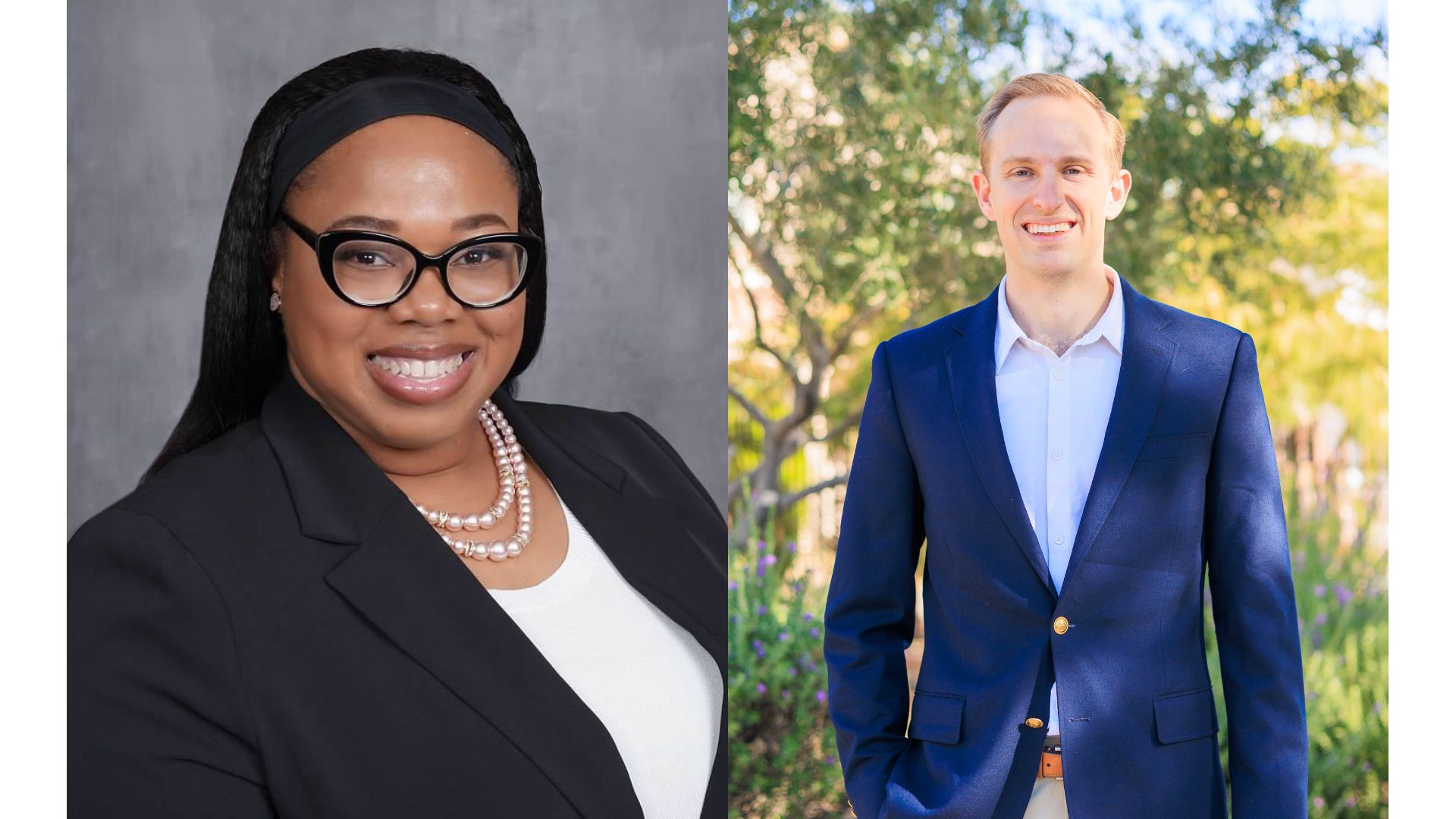
Assembly District 2 is the only genuinely competitive Nevada legislative seat that leans Republican this cycle. That distinction carries extra weight this year, as national forecasters and generic-ballot polling have shown Democrats modestly favored heading into the midterms. Five of the other six seats the two major parties consider competitive already carry a Democratic edge in voter registration, and while AD2's GOP lean is slim, just 2.8 percentage points, it's the outlier.
Democrat Kamilah Bywaters says that dynamic works in her favor, and she doesn't think it's a coincidence that the mood has shifted since 2024, when she lost a Clark County School District trustee race to a candidate backed by Moms for Liberty, a conservative parental-rights group that has pushed for book bans and opposed policies related to LGBTQ+ students in schools.
"2024 was MAGA's time," she said. "It was really a wave that was unexpected."
Bywaters said she now sees signs of that wave receding, pointing to the public's growing concern about rising grocery and gas prices, the war in Iran and strained relations with Canada, all of which she blames on the Trump administration. She said she has noticed even some committed Trump supporters souring on the party, to the point that some are telling other Republicans not to bother voting at all.
"I absolutely do" think a blue wave will help, Bywaters said. "However, that does not mean that I'm going to lighten up my work."
Bywaters ties the national mood directly to her opponent, Republican Drew Teitelbaum, arguing that his unwillingness to break from Trump will cost him with voters souring on the administration, even in a district that leans Republican on paper.
Teitelbaum, who worked in several roles in the first Trump administration, doesn't dispute that Democrats are favored nationally, but he rejects the idea that it's the dynamic most likely to decide the race. He pointed instead to Senate District 8, a competitive and higher-profile contest one line above his on the same ballot, pitting Democratic Sen. Marilyn Dondero Loop against Republican George Harris.
"I disagree with the premise," he said. "It's not the national tide. It's the fact that we're within the most competitive state Senate seat. That's the tide."
In any case, he doesn't plan to change his pitch based on the environment.
"I don't think I need to change my message based on the partisan makeup of the district," he said. "A big part of my message is: Let's be real. If I'm elected, I'm going into the minority. We're not flipping the Assembly this cycle."
The candidates
Teitelbaum and Bywaters are running for a district neither has represented before, seeking to succeed Assm. Heidi Kasama (R-Las Vegas), who is leaving to run for the Clark County Commission.
Teitelbaum moved to Las Vegas in 2021 and has since married, had two children and bought a home in the district. He served in the first Trump administration, including a stint as a staffer on the White House's Homeland Security Council, where he said he worked on counterterrorism, disaster response and resilience, and cybersecurity policy. He later moved to the Department of Homeland Security's Border and Transportation Security Directorate, focusing on immigration and transportation security issues, and also held a role at the Treasury Department.
He now works as director of alliances and government affairs for Allegiant Airlines, a role he said would not include lobbying on state-level issues if he's elected.
Bywaters, a licensed special education teacher, grew up in a Clark County School District (CCSD) family — her father taught special education at Rancho High School and her mother worked in the district's food service department. She taught in the district for three years before resigning due to what she told The Indy was a toxic work environment.
She later co-founded the Las Vegas Alliance of Black School Educators and is currently pursuing a Ph.D. in special education at UNLV, on top of a master of divinity she already holds from Howard University. In 2024, she led the primary for a Clark County schools trustee seat but lost the general election by nearly 18 points.
Teitelbaum has a significant fundraising advantage. He's raised more than $45,000 in direct donations so far, compared with roughly $13,500 for Bywaters. He's also earned the endorsements of Kasama and Republican Gov. Joe Lombardo.
Bywaters said she isn't counting on matching Teitelbaum dollar for dollar, pointing instead to name recognition from 2024 and a volunteer-heavy operation. She also said money wasn't the deciding factor in that 2024 race: She was the most endorsed candidate and raised the most in direct contributions, but still lost badly to her opponent.
Education
School choice has emerged as one of the biggest points of disagreement between the candidates this cycle.
Teitelbaum, whose platform is built around what he calls a "families first" message, said the education conversation varies by neighborhood: Families near lower-rated schools want more school choice, while families in higher-rated pockets of the district focus on preserving what's already working.
"If you go to the parts of the valley that are more heavily weighted on one- and two-star schools, you're talking about, 'How do we increase the star rating of our schools?'" he said. "You increase access to school choice."
He also said he opposes "political indoctrination" in classrooms, which he described not as an objection to the district's curriculum but to teachers injecting their personal politics into lessons.
Bywaters' view is that every school should be high quality enough that families don't feel the need to look elsewhere in the first place — though she said she understands why some students and educators leave Clark County schools for charter schools when they feel bullying, discipline issues or other needs aren't being addressed there. She also noted that the district already offers some choice through magnet schools and career and technical programs.
"I am not a fan of separating people based on the haves and have-nots," she said.
Her other education priorities are stronger accountability for at-risk education funding and better enforcement of services for students with disabilities, with input from teachers and support staff, not just administrators. She pointed to a disparity between the demographics of CCSD's student body and its administrators as evidence the district needs to do more on staff representation.
She also said she supports a bill from Assm. Erica Mosca (D-Las Vegas) that would have tied elected CCSD trustees' pay to county commissioner salaries — it failed to advance in the 2025 session — and said Washoe County officials have raised concerns with her about the state's per-pupil funding formula that she wants to examine further.
Public safety and restorative justice
Teitelbaum's public safety pitch centers on criminal justice and incarceration, specifically on the disparity between announced prison sentences and time actually served, citing Las Vegas Review-Journal reporting on a 1994 double-murder case in which the offender was resentenced in 2020 to a combined 70 years but paroled earlier this year. He wants judges to disclose, at sentencing, the earliest date a defendant could realistically be released.
"Almost nobody serves the sentences they're given at sentencing in this state," he said.
He also cited Indy reporting on the state's Medicaid fraud enforcement — which found the fraud unit has accepted less than half of referrals for investigation since 2020, citing resource constraints as one factor — and said he'd want the attorney general's office better funded to pursue more cases.
Read more: Ads say Aaron Ford isn't doing enough to stop Medicaid fraud. Here's what we found.
Bywaters supports restorative justice, an approach to addressing criminal activity that focuses on systemic causes and rehabilitation. The Legislature partially rolled back in 2023 a restorative justice law after establishing it in 2019, and Bywaters said she'd push to restore some of what was cut while keeping real consequences attached.
She pointed to what she described as low-level theft of everyday items, such as locked-up deodorant and cleaning supplies at local stores, arguing that people taking those items are likely doing so out of need — to stay clean, for instance — rather than malicious intent, and that enforcement responses should reflect that difference.
"I think that's the word: The consequences need to be appropriate to the situation," she said.
She's applied similar thinking to policy, too, when working with state Sen. Dina Neal (D-North Las Vegas) on a 2025 bill, which did not pass, aimed at getting schools and other institutions to intervene earlier when someone shows a pattern of misbehavior.
Housing and affordability
Teitelbaum said he'd focus on rolling back local zoning and permitting rules he considers outdated. He argued that cities and counties sometimes lean on them more as revenue generators than as tools serving their original safety or planning purpose, driving up the cost to build and discouraging construction of starter homes.
"When you're using it purely as pay-fors and revenue gainers, and the regulations aren't there to reach some kind of policy end goal … then you're adding costs to build houses," he said.
Bywaters said her focus is less on new supply than on tenant protections and reining in what she described as out-of-state corporate ownership of rental housing. She said she does see supply as part of the picture too, including making it easier for smaller, local builders to construct homes, but framed it in terms of giving families more affordable choices across different neighborhoods rather than construction volume alone.
"It's not right that people from out of state can come in and just buy up … all the apartments, all the housing, and then make these stringent requirements for everyday people to just be able to rent their homes," she said.
Looking ahead
Teitelbaum said he'd introduce five bills if elected, including on sentencing transparency and Medicaid fraud enforcement. Bywaters pointed to reworking the state's restorative justice framework and revisiting Nevada's per-pupil funding formula as early priorities.
Asked to make their closing case to voters, both candidates landed on a similar theme: the ability to work across party lines. Teitelbaum pointed to policy proposals he thinks can win over Democratic votes even from the minority.
"It matters what I can get done for the people of the district," he said. "I'm asking you to give me a chance to prove to you that I can be a good steward on your behalf."
Bywaters pointed to her outreach to Republican and nonpartisan voters as evidence she can represent the whole district, not just her own party.
"I have the ability to reach across party lines, and I've already done that work," she said. "I will not be a legislator only for Democrats."
Where they stand, issue by issue
Both candidates also completed The Nevada Independent's policy questionnaire on issues from tax abatements and prescription drug prices to elections. Their full responses are below.
Support Independent Elections Coverage and Journalism in Nevada
You’ve enjoyed unlimited access to our reporting because we’re committed to providing independent, accessible journalism for all Nevadans.
But sustaining this work — informing communities, holding leaders accountable, and strengthening civic life — depends on readers like you.
Nevada needs strong, independent journalism. Will you join us?
A gift of any amount helps keep our reporting free and accessible to everyone across our state and funds our elections coverage.
Choose an amount or learn more about membership