IndyTalks: Lombardo pushes against nationalizing elections, calls it 'state issue'

By Tabitha Mueller, Kate Reynolds, Oona Milliken, Rocío Hernández, Isabella Aldrete, Eric Neugeboren and Amy Alonzo
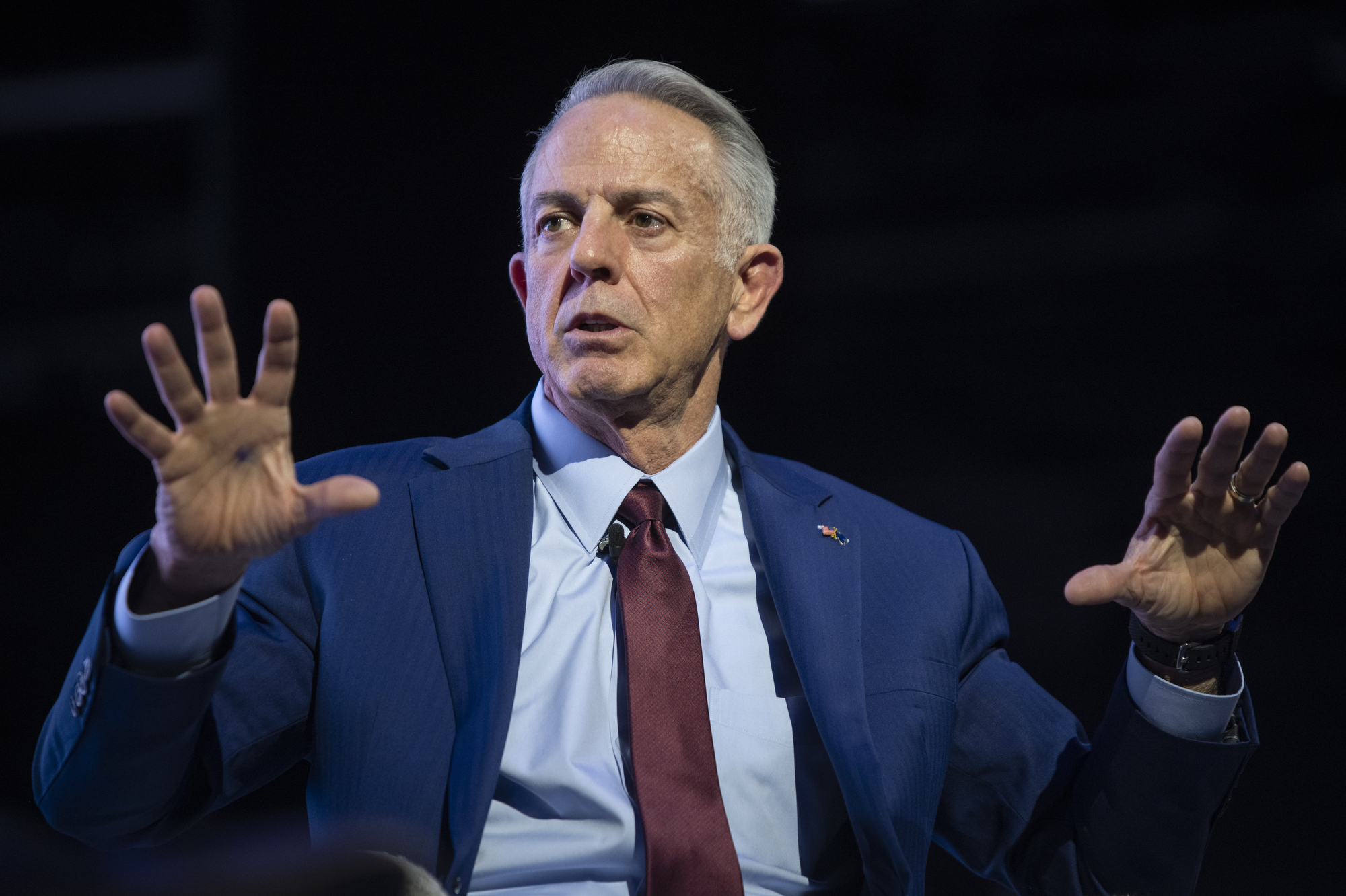
Gov. Joe Lombardo (R) said he is opposed to federalizing elections and would ask the Trump administration not to send troops to polling places during the election.
The comments were made Thursday evening during a 90-minute wide-ranging interview with The Nevada Independent CEO Jon Ralston at an IndyTalks event in Las Vegas. It was the governor's first public response to President Donald Trump's calls to nationalize elections while pushing unsubstantiated claims of rigged elections.
"I think we do a good job here in the state," Lombardo said. "Plus, it's constitutionally a state issue."
Though the governor pushed back against nationalizing elections, he emphasized he would support Trump campaigning for him "because he's the freaking president."
The governor, who is running for re-election, didn't just discuss national issues. Below are highlights from the interview. Click on the links to jump to specific topics.
- Vaccines and health care
- Transgender athletes
- Federal immigration enforcement
- Election security
- Tariffs
- Federal welfare programs
- The Boring Co.
- Colorado River
Vaccines and health care
Lombardo didn't clearly answer where he stands on the Trump administration's rollback of vaccine recommendations.
The governor said he agrees that some vaccines have been beneficial to the human population, but he doesn't know the efficacy of many of them. Instead of vaccine mandates, Lombardo said it's better to educate the public on vaccines "so they can make an informed decision on what's appropriate for them and their families."
"I think it's more of a personal choice, and I think it's the government's responsibility to provide the education that goes along with it," he said.
Lombardo added that the complexity of health care was the biggest surprise he faced as governor, but he and his team have been making progress.
"Traditionally, when you think of government, you don't think of health care," he said.
Transgender athletes
Asked about his proposed ballot question to prohibit school sport participation to a student's assigned sex at birth, Lombardo said it stems from the fact that it is "constantly brought up" on the campaign trail. According to the Pew Research Center, a majority of U.S. adults are in favor of policies that require trans athletes play on teams that align with sex at birth.
However, he acknowledged that the number of students it would affect is minuscule — he estimated it was "maybe 1 percent or less" of student athletes. There is no available data on transgender student athletes in Nevada.
Lombardo said it's an issue that matters to some parents of student athletes and that sports are a privilege, not a right.
"My opinion is I think it's worth fighting for," Lombardo said.
He also confirmed that the ballot question is a way to get people to vote, which he acknowledged in a closed-door meeting last year, as reported by The Indy.
The ballot question survived a lower court legal challenge last month, but proponents had to change the description of its effects on signature-gathering forms. The decision could be appealed to the Nevada Supreme Court.

Federal immigration enforcement
Asked whether he thought the killings of American citizens in Minnesota by federal immigration officials were justified, Lombardo said he couldn't give an answer to the question the way it was asked, but "the tactics were poor."
The former Clark County sheriff, however, said justification for deadly force is more nuanced and requires proper evaluation.
"They should have a complete investigation," Lombardo said. "They should put people out amongst the constituents that are appropriately trained and have the knowledge base that's necessary to be successful, and dot the i's and cross the t's."
Lombardo said Nevada has avoided the fate of states such as Minnesota because Nevada is not a "sanctuary jurisdiction" — which to Lombardo means it prevents cooperation with federal immigration enforcement. The state and Department of Justice signed an agreement in September to take the state off a federal list of "sanctuary" jurisdictions.
He added that he believes his status as a Republican governor doesn't shape ICE's presence in Nevada, but he does have a relationship with the Trump administration that likely prevents escalation. He added that he has the ability to ask the federal government not to "come in here and cause havoc."
"I communicate with them. They are aware of the policy and the stance that we have, and we've been proactive in addressing … undocumented immigrants for decades," Lombardo said.
Election security
Lombardo thinks Nevada "does a pretty good job" in maintaining election integrity, but he still has concerns about perceptions of fraud, which he attributed to policies such as post-Election Day ballot counting, voting by mail without ID requirements (Nevada law requires a signature to match a voter's file) and allowing people who are not related to a voter to turn in their ballot.
"There's people, whether it's right, wrong, or indifferent or perceived or not, they're frustrated and … why not give them the ability to feel better about the system?" Lombardo said.
The Democrat-controlled Legislature has resisted much of Lombardo's proposed election reforms. Lawmakers did propose a voter ID bill in 2025, but Lombardo vetoed it, saying it did not sufficiently ensure a person's identity.
A voter ID ballot question backed by the governor will return to voters this year after overwhelmingly passing in 2024.
Tariffs
Lombardo said there has been "a definite benefit" with parts of the Trump administration's sweeping tariffs, such as domestic manufacturing, though U.S. manufacturing jobs have decreased in the first eight months of the tariffs in place.
He also said the administration should not be forced to reimburse Americans for revenue loss from tariffs, but that it should take the idea "under consideration."
The tariffs have had wide-ranging effects in Nevada, including an initial decrease in gaming equipment sales because of Canada's retaliatory tariffs. Some critics have also blamed the tariffs for drops in travel to the Silver State from Canada and Mexico.
He also criticized Attorney General Aaron Ford's gubernatorial campaign for highlighting Lombardo's comments in an interview where he said that Nevadans may need to "feel a little pain" from Trump's tariffs.
The full remarks focused on how he did not think Washington should be doing "the same old thing," and that "we need to maybe feel a little pain in the short term and, hopefully in the long term, it's a huge benefit for us."
Lombardo called the attack "traditional political theater" and said Ford's office has not communicated with his on state issues.
He said he learns about lawsuits Ford has joined the state on through the news, and the only time Ford is mandated to have a conversation with Lombardo is when he attempts to hire a third-party law firm. Lombardo said the lack of interaction is "bad for the state."

Federal welfare programs
Last summer's Republican-led One Big Beautiful Bill Act authorized deep cuts to welfare programs. Lombardo said he agreed with the ethos behind the cuts, even as he acknowledged they would pressure the state's budget.
Eligibility changes, including new work requirements and the removal of existing exemptions, are expected to cut off nearly 43,000 residents from the Supplemental Nutrition Assistance Program (SNAP) and more than 100,000 residents from Medicaid.
Lombardo described the reduction in eligibility for able-bodied adults aged 18 through 64 without dependents as "appropriate."
"If people are qualified and able to function in that space, why not have them do that?" he asked.
The state will also need to pay at least $25 million more per year to cover SNAP after the federal law boosted states' funding responsibilities. And if Nevada is unable to reduce its SNAP error rate by October 2027, it'll be on the hook for an additional $50 million per year.
The funding reductions are a "challenge," Lombardo said.
The Boring Co.
Lombardo has been criticized by Democratic lawmakers and accused of using political pressure to downplay an investigation into work done by Elon Musk's The Boring Co. on its large underground transportation network in Las Vegas. The company has faced hundreds of environmental fines, as well as three publicized injuries.
Lombardo met with Boring president Steve Davis alongside the head of the state's Occupational Safety Hazard Administration in May 2025. Shortly after, a months-long investigation that proposed to levy more than $400,000 in fines was dismissed, and evidence of the meeting was deleted.
Lombardo said the investigation was brought by a regulator who had a "bone to pick" with the company.
"They were unfair, they were arbitrary, they don't make any sense, and your blame is placed in the wrong direction," Lombardo said.
Lombardo said that an investigation into who had deleted the documents had been thwarted by the cyberattack on the state in August.
As to why his office wasn't present during an interim legislative meeting that dealt with the regulation of the Boring Co., Lombardo said the office's presence wouldn't have changed the discussion.
"I like what they're doing," Lombardo said of the Boring Co. "I think in the long run, it will be very beneficial to this city. Do I like them in their tactics and how they do business? No."
Colorado River
As the seven Western states that rely on the Colorado River for water continue to wrangle over how they will share the river's dwindling resources, Lombardo said litigation is "more than likely."
The states at the lower end of the river — California, Nevada and Arizona — have not been able to reach an agreement with the upper states — Colorado, Utah, Wyoming and New Mexico — over how to address ongoing drought conditions and declining river levels.
The federal Bureau of Reclamation had issued a November deadline for the states to draft a plan. The states missed it. A second deadline, on Feb. 14, was proposed, and the states again failed to reach a consensus. Roughly 40 million people rely on the river for water, as do major agricultural areas.
The current operating agreement outlining how the water is allocated expires at the end of this year.
Lombardo said he believes litigation could happen "right away."
He also said it's "still an open question" on how the seven states will get through the coming year. Drought conditions have swept western states for years, and this winter the West is experiencing a particularly dramatic snow drought that the U.S. Drought Monitor is calling a "major concern heading into the spring."
The two main reservoirs on the Colorado River reflect that. Lake Mead is currently 34 percent full; Lake Powell is 25 percent full.
Support Independent Elections Coverage and Journalism in Nevada
You’ve enjoyed unlimited access to our reporting because we’re committed to providing independent, accessible journalism for all Nevadans.
But sustaining this work — informing communities, holding leaders accountable, and strengthening civic life — depends on readers like you.
Nevada needs strong, independent journalism. Will you join us?
A gift of any amount helps keep our reporting free and accessible to everyone across our state and funds our elections coverage.
Choose an amount or learn more about membership