Joe Lombardo is running as an education governor. Here's how to grade his record.


When Gov. Joe Lombardo ran for his office in 2022, he made education a cornerstone of his campaign. His platform included expanding school choice, accountability and addressing school safety issues and low literacy proficiency rates.
For the most part, Lombardo has accomplished his major goals.
During his term, the state approved a historic $2 billion funding increase for K-12 education. He has either sponsored or been involved in bills that have expanded school choice. He also reinstated a retention mandate for third grade students who aren't reading at grade level. As he runs for a second term, he's made his record on education and his endorsement by the politically powerful Clark County teachers union part of his core pitch.
But critics — such as the Nevada State Education Association (NSEA), which has endorsed Lombardo's Democratic opponent, Attorney General Aaron Ford, and Assm. Selena La Rue Hatch (D-Reno), a Washoe County social studies high school teacher — gave Lombardo's efforts on K-12 education an F.
They point to his inability to get Nevada's per-pupil funding up to the national average, about $17,000, which is at least $3,500 more than the state's average. Lombardo's campaign team told The Indy that their preliminary two-year budget would increase the state's per pupil funding by 12 percent. Lombardo and Ford both have said they won't raise taxes as governor.
The opponents also call out the governor for vetoing bills on free school meals, summer school and reducing class sizes.
"I don't know how he can say it's been a successful four years," said Alexander Marks, NSEA's communications director.
During a Sept. 17 education roundtable, Lombardo said it takes a long time to turn a system as large as K-12 education around, but said he found his administration got a lot done during his time in office.
"The rainbow's not out yet, but the vision is there," he said.

School choice
Lombardo's success rate on expanding school choice has been mixed.
His repeated attempts to expand the state's Opportunity Scholarship program that provides scholarships to help low-income students attend private schools has been blocked by Democrats. But he's had more luck with paving the way for charter school growth.
During his recent education roundtable, charter school advocates thanked Lombardo for approving $31 million in transportation funding over the past two legislative sessions and raises for charter school teachers in a bipartisan effort after those educators were left out of Democrats' 2023 bill, SB231, that only funded raises for school district staff.
"Hats off to you, governor, for going to battle for teacher pay raises," said state Sen. Carrie Buck (R-Henderson) during the roundtable. Buck is the president of a foundation that raises funds for Pinecrest charter school students and Nevada's 1st Congressional District Republican candidate.
"Oftentimes, what happens is Democrats pull public charter school teachers off the plate and make them a pawn," she said.
Lombardo also pushed for legislation during the past two sessions that gave cities and counties the ability to authorize their own charter schools, something Clark County Education Association (CCEA) Executive Director John Vellardita said the union opposes and thinks should be revisited.
Some say the expansion of charter schools is one of the contributing factors to enrollment declines at school districts, including Clark County.
Lombardo has also advocated for expanding open enrollment, which allows students to attend a district school other than the one they are zoned for based on their home address.
During the 2025 legislative session, he did collaborate on provisions in SB460 and Democrats' open enrollment bill, AB533, which required schools to prioritize applications from students in low-performing schools trying to move to higher rated schools and provided one-time transportation funding.
This year, Lombardo opted the state into a new federal school choice tax credit program that will launch next year. The program will allow organizations to provide scholarships to K-12 students to cover certain educational costs, including private schools.
During the education roundtable, Valeria Gurr, a senior fellow for the American Federation for Children, a national school choice advocacy group, said opting into that program was the most meaningful decision Lombardo has made for the state. It's anticipated that the majority of students in state and nationwide will meet the program's income eligibility requirements.
"This is going to come and change the landscape of education in Nevada," Gurr said.
However, opponents have said they worry the proposed rules would limit how much oversight the state has over the program.
Pat Hickey — a former Republican lawmaker turned nonpartisan and vice chair for the nonpartisan Kenny Guinn Center for Policy Priorities think tank — applauded Lombardo's work to expand school choice but said he wants to see more of a commitment toward career and technical education beyond lip service.
During the roundtable, Lombardo said he wants more kids to graduate college and be career ready.
Hickey expressed the need for magnet schools and others to specialize in career and technical skills. He said gubernatorial candidates will often talk about investing in education, but then rarely embrace "innovative things to fund new forms or systems of education."
Literacy
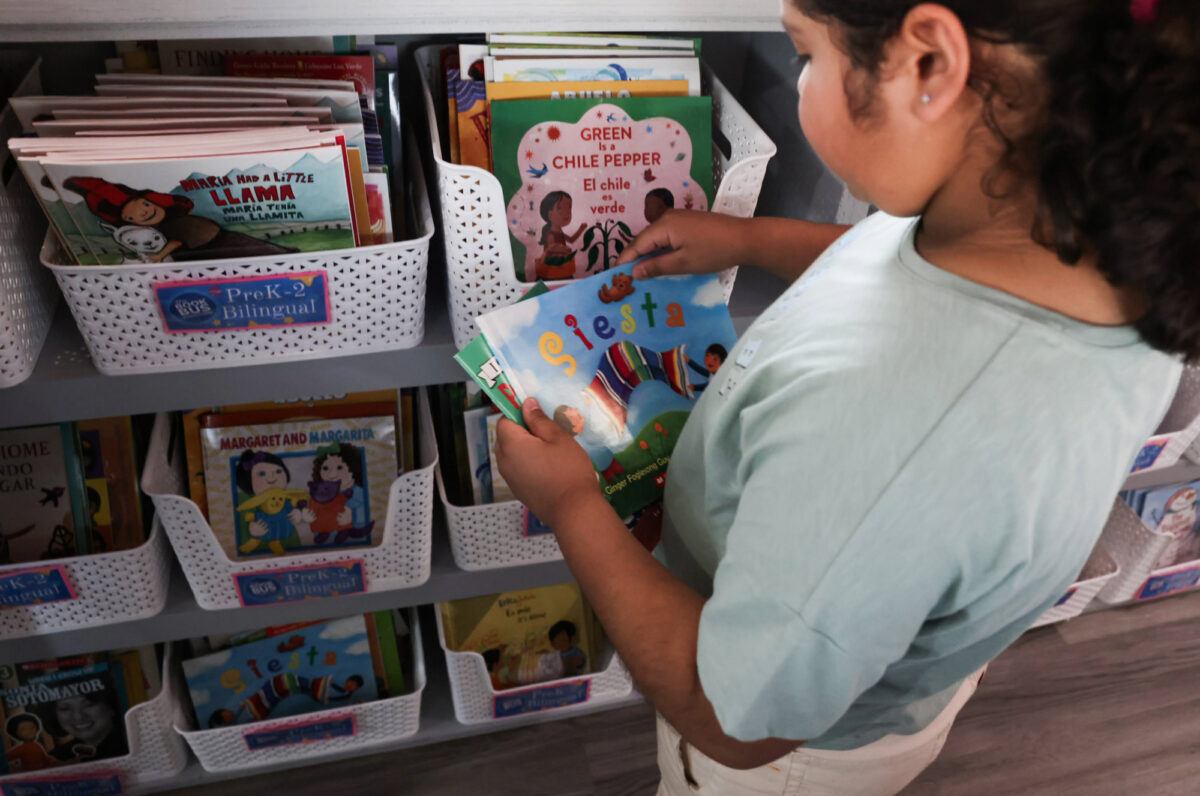
Lombardo pushed to reinstate a retention mandate for students who aren't reading at grade level by the end of third grade, which was originally included in the state's Read By Grade 3 program passed under Republican Gov. Brian Sandoval in 2015. The bill, AB400, does allow some good-cause exemptions and will be implemented in 2028.
The State Board of Education has yet to establish a cutoff score to determine which students would be recommended for retention. Dale Erquiaga, the former state superintendent of public instruction under Sandoval, wrote the original Read by Grade 3 law in 2015 and gave Lombardo credit for leaving that decision to the board.
But the Nevada Association of State Superintendents is calling for lawmakers to repeal the retention mandate. They say it doesn't work for all students and can cause more harm than good.
AB400 also included $140 million in grant funding for two years to support early childhood literacy and readiness. This funding was renewed in SB460 only for the 2026-27 fiscal year and reduced to $12 million.
Andrew Feuling, superintendent of the Carson City School District and the association's president, previously told The Nevada Independent the grants were competitive, making it hard for school districts to provide literacy programs year to year.
"Grants that are important and lauded for the impact they will have supporting literacy shouldn't be competitive grants," he said in a June 26 emailed statement.
Erquiaga said he would support giving Lombardo a second term to avoid the reading retention mandate being repealed or watered down. He added that he doesn't buy districts' "constant haranguing" over more funding to address literacy rates.
"Teaching children to read is their job. Period. End of story," Erquiaga said. He added that if adjustments are needed, the districts would have a chance to make their arguments in the 2027 legislative session.
School funding
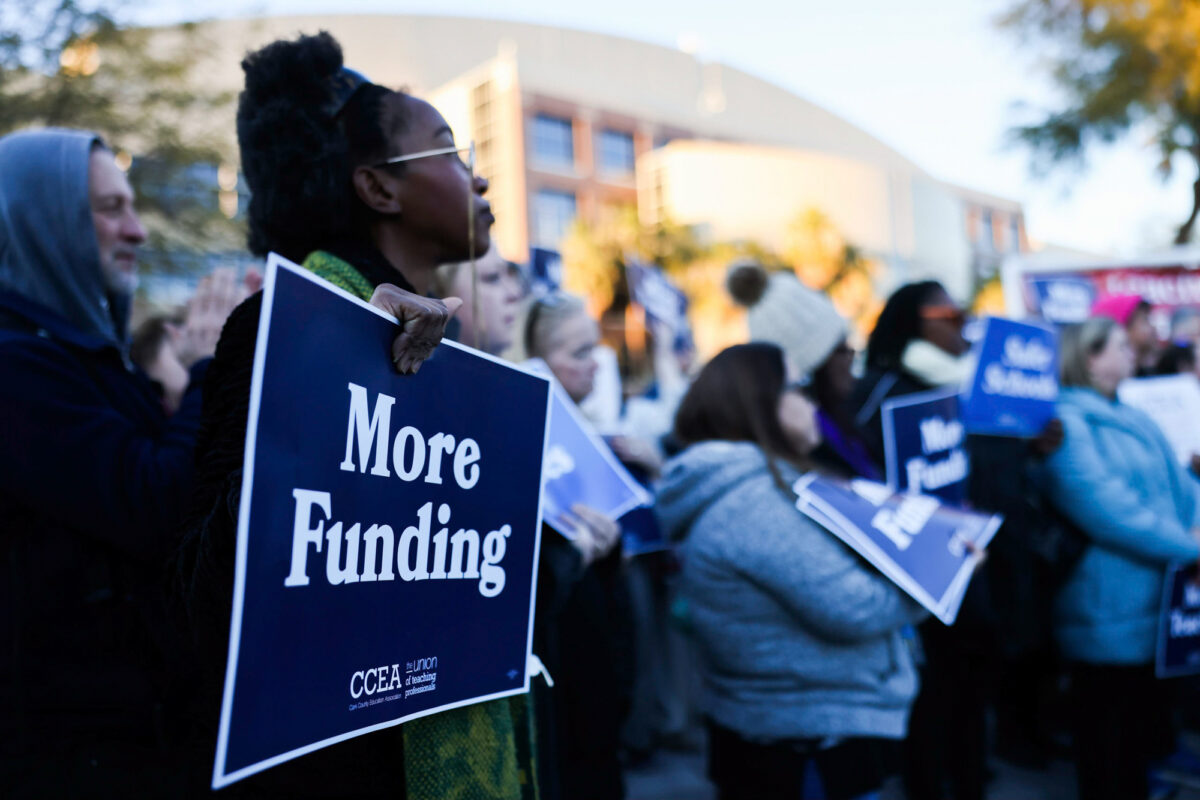
Probably one of the most notable K-12 education accomplishments during Lombardo's term is the historic $2.6 billion funding increase passed during the 2023 legislative session. That equated to $2,500 more per student by fiscal year 2025. The funding boost, coupled with $250 million in matching funding, made it possible for school districts to give out raises and led to significant declines in teacher vacancies. Lombardo's campaign team said the governor wants to continue increasing teacher pay in his next term if re-elected.
But critics wonder if the credit for the pay increase should go to Lombardo or the Legislature, or whether it was just a product of Nevada's strong economy following the pandemic.
They also point out that the per-pupil funding increase was minimal the following session at $72 per student. School officials have said this wasn't enough to keep up with inflation and rising costs.
"That $2 billion should have been the beginning of the work, not the end of it," said NSEA President Dawn Etcheverry.
NSEA has been urging Lombardo to implement recommendations from a panel of school finance experts to get Nevada's per-pupil funding up to the national average. Its ideas, including expanding the sales tax base and reforming property tax, have been largely ignored by Lombardo.
Instead, Lombardo has been looking at data centers as a possible source for additional tax revenue to support K-12 public schools, and last month he took a first step toward this through an executive order.
Lombardo's campaign said under his data center plan, a $200 billion data center investment could bring in approximately $34.2 billion in education revenue over the next 30 years.
Lombardo has also said he wants to amend the state's funding formula for K-12 education during the next legislative session to address a recent school budget crisis.
But Lombardo's call for more K-12 education funding has been paired with greater expectations and punitive actions against schools and districts not meeting the state's standards on student and school performance such as proficiency rates, graduation rates, chronic absenteeism rates and school star ratings.

School safety
During the 2023 legislative session, Lombardo pushed for a bill, AB330, to roll back parts of the 2019 restorative justice bill to make it easier for schools to discipline violent students. CCEA was among the supporters of the bill. During that session, Democrats sponsored a similar bill, AB285, which also passed.
Vellardita said those bills have led to school safety improvements, but there's more work to be done.
"I think this is an issue that is not solvable overnight because it does require a few things, one of which is more mental and behavioral health intervention, and that's where we're lacking. That's a fiscal issue," he said.
Erquiaga was part of the school safety task force that shepherded the 2019 bill. He said he understood the reasons behind the new laws, but he called on the state to balance out the repeals by finding funding for more support services, such as school mental health resources.
NSEA and La Rue Hatch say the state's large class sizes continue to be a safety issue. During the 2024-25 school year, Nevada had a statewide student-to-teacher ratio of 20:1 across all schools for grades kindergarten through sixth, according to state data.
During the 2025 legislative session, La Rue Hatch sponsored a bill, AB155, that would have expanded mandatory collective bargaining subjects to include student-to-teacher and student-to-specialized support staff ratios.
The bill was vetoed by Lombardo, who argued that state law doesn't prevent teachers unions from raising concerns regarding class sizes during collective bargaining. But La Rue Hatch said that's not how bargaining works. She pointed out that one side can bring up an issue, but the other can refuse to discuss it.
"I think that it shows very clearly he didn't read the bill and he didn't watch the hearings," La Rue Hatch said.
The governor's office said in a Tuesday statement that Lombardo was also concerned about whether school districts have the resources needed to reduce class sizes if it was a mandatory negotiation subject, and whether it would lead to legal dispute if they did not meet union's expectation.
Support Independent Elections Coverage and Journalism in Nevada
You’ve enjoyed unlimited access to our reporting because we’re committed to providing independent, accessible journalism for all Nevadans.
But sustaining this work — informing communities, holding leaders accountable, and strengthening civic life — depends on readers like you.
Nevada needs strong, independent journalism. Will you join us?
A gift of any amount helps keep our reporting free and accessible to everyone across our state and funds our elections coverage.
Choose an amount or learn more about membership