Seeds of Nevada's bitter attorney general Democratic primary were planted in the Legislature


Pull up a YouTube video or doomscroll on social media, and you're likely to find a campaign ad criticizing one of Nevada's Democratic attorney general candidates for taking more than $2 million from a cryptocurrency mogul, or another ad calling out his opponent for taking donations from predatory lenders.
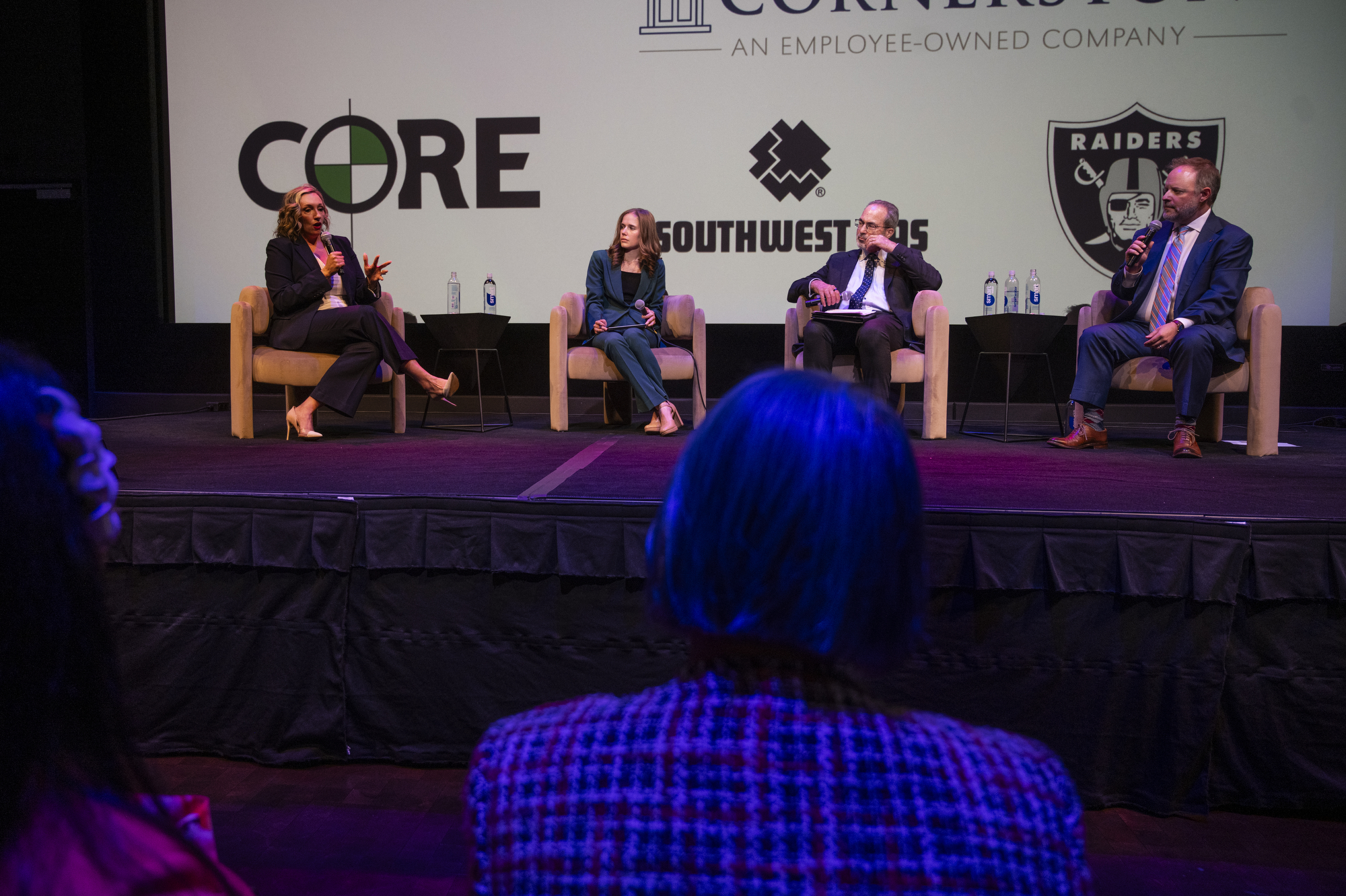
Treasurer Zach Conine (D) and Senate Majority Leader Nicole Cannizzaro (D-Las Vegas) have traded not-so-subtle digs at one another as they run for Nevada's open attorney general seat, even going so far as to question one another's integrity in a recent debate.
It's become one of the most vitriolic — and expensive — races of this primary election cycle, pitting two influential politicians against one another as they vie to win one of the most powerful roles in state government.
But the relationship hasn't always been strained.
The pair have been in politics for nearly a decade — Cannizzaro was first elected to the state Senate in 2016, Conine to the treasurer's office in 2018 — and have worked together and praised each other over the years. Conine even door-knocked on behalf of Cannizzaro when Republicans unsuccessfully tried to recall her in 2017.
Cannizzaro and Conine declined to speak on the record for this story.
Some legislative observers and political insiders, granted anonymity to speak freely, noted that the animosity likely began to percolate in 2023, when Conine began testing the waters for a bid for the seat, which Cannizzaro was known to be interested in. As Senate majority leader — with power to set agendas, determine committee leadership and unilaterally kill bills — she, alongside the Assembly speaker and governor, wielded enormous influence over the fate of Conine's and others' legislation.
In the 2019 legislative session, each of the five bills introduced by Conine's office were passed and signed into law. In the 2021 and 2023 sessions of the Legislature, as he began to consider a run for attorney general, four of the five bills he introduced in each session were enacted. But in 2025, the three bills introduced by the treasurer's office died in committee.
"She's killed some of our bills," Conine said during the May debate hosted by The Nevada Independent.
Cannizzaro's allies in the state Senate say the treasurer is responsible for his bills' failures, which came as the state's budget tightened after federal pandemic aid petered out, and even the majority leader has had bills she sponsored not move forward.
But a few legislative observers said Conine likely faced undue difficulty in the upper legislative chamber, noting that the two officials' aspirations were at odds, and it would help Cannizzaro politically if he didn't score big policy wins.
In some instances, one observer noted that Conine worked through other lawmakers to get legislation passed because he feared that having his name attached to a bill would be a death knell.
It's not the first time Cannizzaro's political opponents have seen their bills struggle.
Sen. Carrie Buck (R-Las Vegas), who was involved in the failed recall push targeting Cannizzaro and two other Democratic state senators, has never passed a bill during her six years in office. Of the 20 bills she introduced in the last legislative session, none got out of the Senate.
A few key contentions
One well-publicized Conine proposal that failed twice was a "baby bonds" plan to grant Nevadans born into low-income families a $3,200 bond they could cash out at age 18.
Conine introduced the idea in 2023, when it passed the Assembly and cleared the Senate Finance Committee, but it never received a vote in the full Senate. In 2025, a new version of the plan died in an Assembly committee. Supporters of the legislation held Cannizzaro responsible for the death of both bills.
Legislative sources connected to the state Senate pushed back, saying the 2023 bill changes came late and the 2025 version of the plan died because it lacked a clear long-term funding mechanism, which would have cost $5 million in its first two years.
Conine did attend multiple legislative hearings to present the bill and advocate for its passage. An Indy review of the minutes from those hearings shows lawmakers did not ask about funding for the bill, though such conversations are usually reserved for the finance committee.
Those connected to the state Senate said Conine is seeking someone to blame for the death of his bills, when the real issue was the state's budget crunch.
Lawmakers had to slash their own spending requests during the last session because of the paucity of funding, including Cannizzaro, who dramatically pared down her proposal to expand free pre-K. And Conine's baby bonds bill was highlighted in a 2025 analysis by The Indy of 10 bills requesting new appropriations during a tight budget cycle — only two of which ultimately became law.
Another critical sticking point came at the end of the 2025 legislative session.
In the late afternoon on the final day of the 120-day session, lawmakers in the Assembly added an amendment to the state capital improvement program budget bill appropriating up to $75 million in bonds to the Nevada State Infrastructure Bank, celebrated by some labor unions at the time as critical to developing affordable housing projects.
The State Infrastructure Bank is overseen by the treasurer's office. The Senate ultimately did not approve the addition.
It was a disappointment for Conine, but a longtime legislative observer noted that assemblymembers ultimately did not want a long fight and weren't interested in an immediate special session to process the must-pass bill, so they backed down.
Sources connected to the state Senate said both budget committees had jointly agreed to no bonding for the infrastructure bank. The last-minute addition came as a surprise, they said.
They noted that a version of the idea was incorporated into the governor's housing bill — $50 million in bonding capacity, which also stipulated that any projects that tapped this bonding capacity be subject to prevailing wage requirements to ensure that labor wouldn't be undercut.
On the campaign trail, Conine has criticized the lack of funding for affordable housing while lawmakers decided to allocate $191 million in bonds for Legislative Building upgrades and a facelift — calling the new dome placed atop the legislative building a "bureaucratic toupee" in their May debate.
The upgrades were for lawmakers' safety, Cannizzaro countered, pointing out the changes came after state lawmakers received bomb threats and amid an increasingly violent political climate.
One of the political insiders who spoke to The Nevada Independent on the condition of anonymity said the building updates were long overdue, had been in the works for a long time and included necessary security and safety updates.
They noted, however, that some of Conine's requests could have been partially funded and that bonding could likely have been appropriated to the infrastructure bank if that had been a legislative priority.
A few legislative observers noted that Conine worked through intermediaries on many of his bills, opting to have staff respond to questions about his office's budget to avoid drama and trying to leverage different channels because he didn't think his bills would be supported by a state Senate led by Cannizzaro.
Rep. Dina Titus (D-NV), who has endorsed Conine, noted that during the debate, "you had to kind of duck for the flying tomatoes." She said she's backing Conine because of his success as a treasurer, his ability to work with people and his leadership.
She added that Cannizzaro — who is halfway through her four-year state Senate term — will return to her powerful role in the statehouse if she loses the election, so people may be too intimidated to speak critically of her.
One observer added that throughout his tenure as treasurer, Conine has consistently been helpful and willing to offer ideas and suggestions on legislation. For example, they said that in 2023, Conine was critical to negotiations with Major League Baseball's Athletics and helped save the state money during that process.
The 2023 legislative session also saw contentions between Conine and Cannizzaro's offices when a Democratic press conference discussing legislative priorities included the treasurer, attorney general and Assembly Speaker, but not Cannizzaro.
Records shared anonymously with The Nevada Independent indicate that there was frustration from Cannizzaro's office that Conine was scheduled to speak first at the presser. Conine's office had organized the presser, so his staff wanted Conine to speak first.
Senators' frustrations
Another Conine bill that failed in 2025 was SB64. The state is required to recover Medicaid payments from the bank accounts of recipients who have died. Conine's bill sought to block the state from recovering such payments from specialized bank accounts for recipients with disabilities, instead allowing those payments to revert to the person's family or estate.
The bill never received a hearing.
Sen. Fabian Doñate (D-Las Vegas), chair of the Senate Health and Human Services Committee, said he decided not to schedule the bill for a hearing because nobody from the treasurer's office ever communicated with him about the proposal.
"If you're not going to put the time and effort to get your own bills passed, we have a list of other things that we have to address," said Doñate.
In response, Erik Jimenez, who serves as the chief policy deputy at the Nevada State Treasurer's Office, said the treasurer goes "above and beyond" to communicate with legislators.
"As one of the highest-ranking state officials with a disability, I think it's incredibly unfortunate that Senator Doñate and Senator Cannizzaro were too busy to even give a hearing for this priority bill for Nevada's disability community," he said.
Sen. Dina Neal (D-North Las Vegas) also said Conine was seemingly less of an advocate for his own bills than he had been in previous legislative sessions. She said that in 2025, the treasurer didn't come in person to the Senate to present his budget or his bills, all of which he chose to introduce in the Assembly. That was different from Conine's approach in past sessions, Neal said, and that of some other statewide officers.
An Indy review confirmed this, showing that last year, Conine didn't attend a joint finance meeting in person to present his budget — even as State Controller Andy Matthews (R) attended on the same day to present his — and Conine sent six staff members in his place instead.
Gov. Joe Lombardo (R) did not present his budget in-person to the committee in 2025, while Secretary of State Cisco Aguilar (D) and Ford both did.
In 2021 and 2023, Conine presented his office's budget himself.
Leadership within the Senate Majority Leader's office said that every constitutional officer except for Conine met with Cannizzaro at least once during the session to discuss bills and other legislation.
Neal said she didn't want to opine on Conine's decisions but emphasized that she found it important for politicians to defend their ideas before lawmakers.
"The legislators have to negotiate their policy with other legislators, so you don't really get to get away with not doing it," she said.
Doñate and Neal are both allies of Cannizzaro's. Doñate has endorsed Cannizzaro's bid for attorney general, while Neal credits Cannizzaro with saving her life after she had a medical issue last year. Her gratitude led her to vote for a bill expanding tax credits for film companies, despite personally opposing the idea, because Cannizzaro supported the initiative.
Doñate also brought up his frustration at Conine's recent comments on a bill (SB4) signed into law last year that limits immigration enforcement activities on school grounds. Conine told The Indy he believed the bill, which Cannizzaro has been citing in campaign ads but was pared down from original proposals, was ineffective and did nothing to make anyone safer.
Conine doubled down on the criticism during the debate.
"We didn't do anything to prevent their mother or their father from being disappeared off the street right after they dropped them off," he said.
Doñate, a co-sponsor of the bill, told The Indy he thought Conine's comments were "disrespectful."
A PAC associated with the Nevada State Education Association is now airing ads featuring an unnamed teacher who says they're voting for Conine because "he will stand up to Trump and keep ICE out of our classrooms."
Cannizzaro countered that Conine's criticism ignored the reality of dealing with a Republican-held governor's office with veto power.
"I got to work, and I found a way that we could do some policy that was going to help communities," she said during the debate. "I said to him, we are putting this in your crime bill, so you can sign it or you can veto it, but this bill is not leaving the Senate without these protections."
She added that Conine was being dismissive in his comments.
"Passing a bill that doesn't get signed doesn't do anything," she said. "You should have the guts to stand on this stage and tell all those Latino caucus members that they didn't fight hard enough for the communities that they are in every single day."
Support Independent Elections Coverage and Journalism in Nevada
You’ve enjoyed unlimited access to our reporting because we’re committed to providing independent, accessible journalism for all Nevadans.
But sustaining this work — informing communities, holding leaders accountable, and strengthening civic life — depends on readers like you.
Nevada needs strong, independent journalism. Will you join us?
A gift of any amount helps keep our reporting free and accessible to everyone across our state and funds our elections coverage.
Choose an amount or learn more about membership