
Everyone wants to win working-class voters. But have they realized many are women?

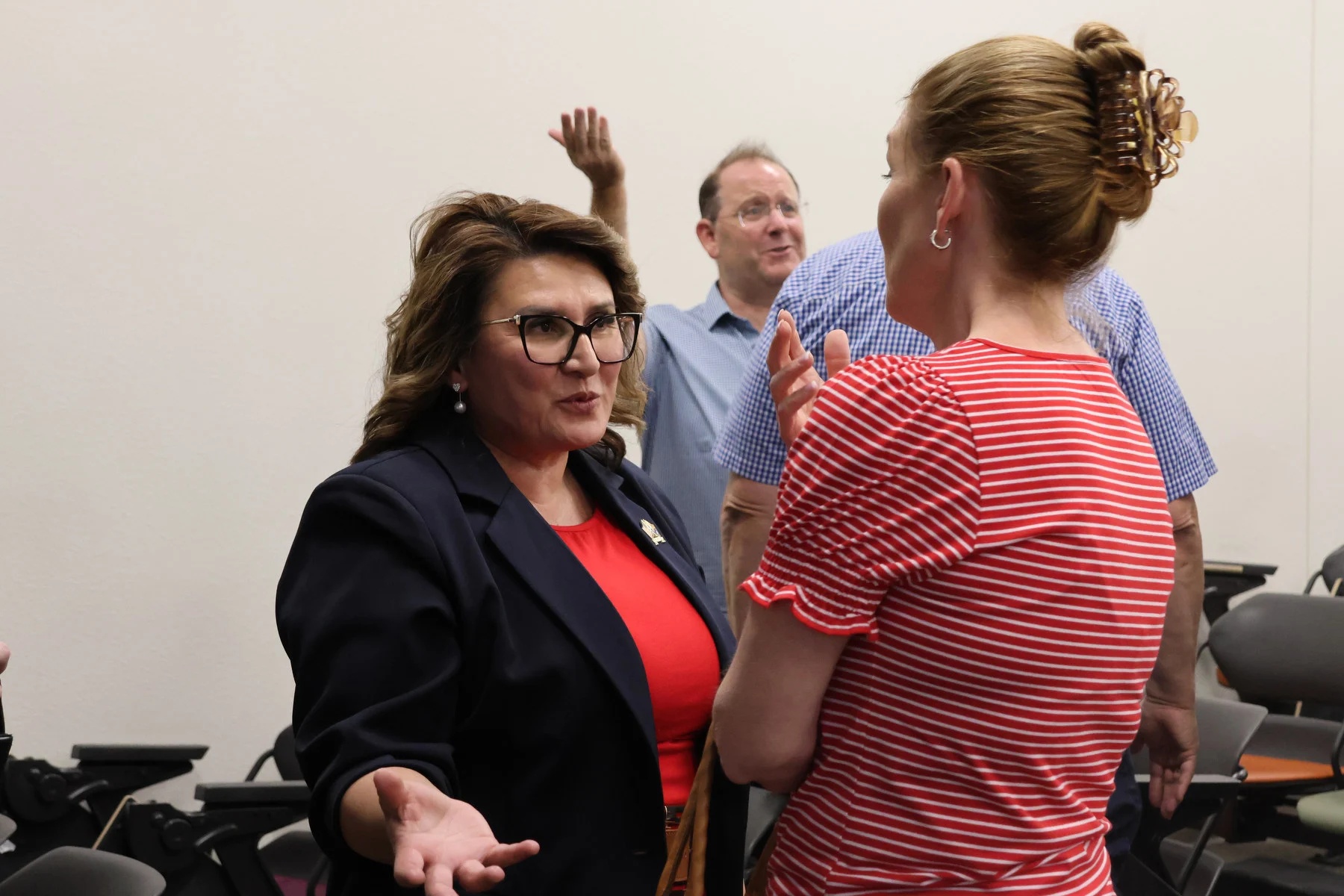
Congressional candidate JoAnna Mendoza (D) can quickly rattle off prices from the grocery store in the small town of Eloy, Arizona, where she grew up. A couple of months ago, a pound of ground beef was going for about $13, a tomato was $1.50 and "a freaking cucumber was like $3."
She knows because she's a single mom to a 10-year-old, and she's struggled with the same things most working women are facing: finding a steady job, a good pediatrician and childcare that isn't going to break the bank. Mendoza's parents were farmworkers, and she spent 20 years in the military because there were few economic opportunities for her back home. Now she's running for a seat in the U.S. House to represent Arizona's 6th Congressional District.
Working-class people, and especially women, such as Mendoza, have rarely had a seat at the political table, though they make up nearly half of working-class voters, the group Republicans desperately want to cling onto and that Democrats hope to draw back.
It's a group that is more diverse now than it's ever been. Gone are the days when the only image of a working-class voter was a blue-collar white man who works in a factory and drives a truck, though that is still who politicians often pander to.
Political messaging that speaks to the everyday needs of the diversifying working class could recapture the interest of the group, which has long been disillusioned by political candidates who don't actually understand them.
Definitions of what makes a working-class voter differ depending on who you ask. If it's education — those who have less than a bachelor's degree — then nearly half of the working class is women; in parts of the country, most of them are also people of color, said Valerie Wilson, a labor economist at the Economic Policy Institute who has studied working-class people. If working-class voters are those working low-wage jobs, then they are already majority women, who occupy two-thirds of the 40 lowest-paid occupations.
"The sort of traditional view of 'working class' was a white man in a hard hat, a construction worker, maybe someone who was in manufacturing," Wilson said.
That's gone now as those jobs have disappeared and service-sector jobs dominated by women have become the primary field for people without college degrees. Working-class people are now mostly service, retail and care workers, a group often forgotten in political and economic conversations in part because the work has been seen as gendered labor, though they have a front seat to most of the financial troubles that have plagued the country over the past several years. You don't have to tell women, who do the majority of consumer purchases in this country, that groceries and gas are more expensive. They've lived it.
A fundamental misunderstanding of working-class voters — and the messages that resonate with them — caused Democrats to fumble their advantage with this group in recent years. Twenty years ago, Democrats enjoyed a 14 point advantage with voters who didn't have a bachelor's degree. By 2024, Republicans had a 6 point advantage instead. In the 2024 presidential election, working-class voters favored President Donald Trump by 14 points.
Republicans have effectively understood that their voters want good, secure jobs that allow them to live independently and support their family. Working-class voters respect people who talk to them directly — Trump's "straight talk" — and those who have been successful through their own hard work, social inequality expert Joan C. Williams argued in 2016.
"What they want is what my father-in-law had: steady, stable, full-time jobs that deliver a solid middle-class life to the 75 percent of Americans who don't have a college degree. Trump promises that," Williams wrote after Trump was elected in 2016. "I doubt he'll deliver, but at least he understands what they need."
A decade later, Trump indeed has not delivered on many of his economic promises. His second term has been dominated by war in Iran and aggressive tariff policies that have driven up prices rather than balanced trade, as he promised. That has eroded Trump's advantage with his strongest working-class supporters, white people, who now disapprove of his handling of the economy.
Democrats see an opening this midterm cycle. A recent poll found that adults who self-describe as working class expect progressive Democrats to best represent their interests, followed by moderate Republicans. Working-class women already tend to skew more progressive than men: Every racial subgroup of working-class women, except white women, favored Kamala Harris over Trump in 2024.
This year, Democrats, more than Republicans, have put up women working-class candidates who have a personal background and message that could connect with voters. It's something of a litmus test for the Democratic Party: Can working-class women candidates help them win back working-class votes?
For her part, Mendoza said she's not a fan of the Democrats' messaging.
"Can Democrats just be normal and not have to use $50 words to talk to people?" Mendoza said. "Spending 20 years in the military, retiring from the Marine Corps, I personally drop about 20 to 30 f-bombs a day," she said. "Sometimes you gotta throw an f-bomb."
She approaches conversations with voters the way she talks to the moms of the children on her son's Little League baseball team. They're worried about the cost of childcare, which is so expensive that it doesn't even make sense to get back into the workforce even though they could use the extra income. They're worried about school supplies and utility bills, just like Mendoza, who spent more than $100 on her son's supplies this summer and $391 on her most recent electric bill.
"The majority of women are what I like to call the chief financial officers of their families, and they're sitting here trying to figure out how they're going to make ends meet," Mendoza said.
Williams argued in her book Outclassed: How the Left Lost the Working Class and How to Win Them Back that Democrats have focused too much on college-educated liberals and forgotten about working-class people. The messages became about policies that would help people advance in their jobs instead of policies that supported people who worked hard and just wanted to earn a living.
For working-class voters, including women, class can trump gender as the determining factor behind a vote. Look at the 2016 presidential race: White working-class women voted for Trump over Hillary Clinton by a 27 point margin.
"Working-class women are working-class people, something upper-middle-class women often forget," Williams said. Their preferred candidate: another working-class person.
If Democrats pay attention, future cycles may have more candidates such as Kaela Berg, a flight attendant and single mom who ran for a highly contested seat representing Minnesota's 2nd Congressional District in the U.S. House. Before she lost her primary in August, she was running her campaign between flights, talking about living paycheck to paycheck, going without health insurance during the pandemic and at one point living in a friend's basement. She never graduated college and has long been active in her union.
"I don't have to look at a white paper on affordability. I know people are struggling and that this economy is hurting people," Berg told The 19th.
Polling by Emily's List, which works to elect Democratic women who support abortion rights, has found that women are more likely than men to be struggling financially, more likely to say they are looking for candidates who will fight for them and also more likely to blame Washington for their financial struggles.
"It was very clear based on that research that driving wins in this environment, in this economy, was really going to hinge on putting leaders in front of voters who truly get it, truly understand their struggles. And the reason for that is because the depth and breadth of people's financial struggle is really stark," said Jessica Mackler, the president of Emily's List.
The past couple of years have been particularly challenging for working-class women in the economy. They returned to work in high numbers after the pandemic, benefiting from a climate in which businesses were offering better benefits, more flexibility and higher pay, which allowed them to move into good jobs. But those improvements were short-lived.
"We're seeing a pretty stunning reversal of that that is impacting the real working-class jobs that are sort of manual labor, low-wage, low-education requirement jobs predominantly held by women," said Kate Bahn, the chief economist and senior vice president of research at the Institute for Women's Policy Research, a think tank focused on gender and economic equity.
The evidence is in the gender pay gap: After years of shrinking, the gap actually widened over the past two years for the first time since the 1960s.
Working-class women are facing a labor market far more unstable than in the last election cycle, and they're looking for candidates who understand that, voters told The 19th.

Jenny Cook, a paraprofessional who works with special needs children in Oakdale, Minnesota, has been knocking on doors with her union this summer in support of candidates such as Lt. Gov. Peggy Flanagan (D), who is running to represent Minnesota in the Senate and often talks about growing up in Section 8 housing with a single mother who relied on food stamps.
When she thinks of the candidates who have stuck out, Cook thinks of people such as Sen. Omar Fateh (DFL-MN), who ran for mayor in Minneapolis last year. The fact that he was a renter stayed with her. "That feels like someone who has a lived experience that mirrors mine and many others in a way that I don't know that every politician can really wrap their heads around what that's like," she said.
For her, it's not just about someone who understands that rents are high or that groceries are expensive, but about a candidate who understands how destabilizing all those things can be.
Cook often lives paycheck to paycheck and sells plasma or items on Facebook Marketplace to keep up with bills. She offers her own example: Last winter, one of her students had a bed bug situation at home. To try to avoid bringing it home with her after work, she'd toss all her clothes immediately into the dryer so the heat could kill any eggs that may have hitchhiked on her. But, because her dryer was old, the belt broke and she couldn't afford a new one. So, in the middle of Minnesota winter, she started taking her clothes off in the entryway and throwing them on the front step. On weekends, she'd carry them to the laundromat.
"The amount of sleep I lost, and I just like, I feel like I'm still trying to recover from the financial impact of just that," Cook said. "I always feel like one crisis away from everything falling apart."
When she's out doorknocking, she hears disillusionment. She hears exhaustion. So many people are so stuck in the struggle of day-to-day survival that they can barely plug into politics at all. Few candidates break through the noise.
"It almost feels like, 'Wouldn't it be nice if I could pay attention to who my candidates are and care on that deep of a level?'" Cook said.
Roxy Hoda, a hospitality worker at Target Field in Minnesota, says affordability is her No. 1 issue. The healthcare costs for her family of four tripled in the past two years. She's paying $2,100 a month for health insurance with an $8,000 deductible that she already blew through at the start of the year when her 4-year-old son was hospitalized with asthma.
She is also supporting Flanagan, whom she called "a breath of fresh air."
"As a woman of color that has come from that similar background as me, I know that she understands what it is to be a woman of color in this society," Hoda said.
It's the one bright spot that has helped assuage some of her disillusionment with a Democratic Party that she feels has "been too scared to really get emotional."
For Hoda, it comes down to this: "We just need to know that you understand and you relate, and you're with us and you're fighting."
Support Independent Elections Coverage and Journalism in Nevada
You’ve enjoyed unlimited access to our reporting because we’re committed to providing independent, accessible journalism for all Nevadans.
But sustaining this work — informing communities, holding leaders accountable, and strengthening civic life — depends on readers like you.
Nevada needs strong, independent journalism. Will you join us?
A gift of any amount helps keep our reporting free and accessible to everyone across our state and funds our elections coverage.
Choose an amount or learn more about membership