
Is Nevada's education funding on the chopping block in 2027 if the economy dips?

In 2023, Nevada lawmakers put a whopping $2.6 billion more to K-12 education funding over the next two years, thanks not to any increase in taxes but to a tax revenue boom.
But under the state's K-12 funding formula, what comes up must go down.
"Unfortunately, because it's a revenue-based formula, it also works in the opposite direction," said Amanda Morgan, executive director of Educate Nevada Now. "So if revenues are down … it allows for a proportional decrease in per-pupil funding or a proportional decrease even in what the state contributes to public education."
Last year, concerns over state tax revenue declines limited how much lawmakers could spend on schools, leaving funding relatively flat for the next two years.
But thanks to inflation, "flat" might as well mean "cut." School districts are already facing budget troubles because of lower student enrollment and rising costs, and some are laying off staff or closing schools to save money.
Economic signals are mixed, but Morgan is concerned that if the economy contracts, it could spell trouble for public schools unless lawmakers do something they haven't done in more than a decade — pass legislation that brings in more money for schools.
"So unless we come in with a new revenue source or something that's kind of stable and reliable that can kind of maintain these funding levels, we're likely going to see us slip back," Morgan said.
But what happens in 2027 will depend on what happens in 2026's midterm elections. Drew Galang, a spokesman for Republican Gov. Joe Lombardo, said in a Friday statement that Lombardo's office is in the early stages of building the state's budget, and so far, revenue trends are encouraging.
"The Governor has no plans to decrease education funding at this time," Galang said.
Galang did not answer whether Lombardo, who is running for re-election, is considering recommending a K-12 education funding increase for the next two years. Lombardo has said he doesn't support new taxes.
Democratic gubernatorial candidate Alexis Hill's platform includes a policy to reform property taxes — a frequently discussed strategy for diversifying and increasing school funding. When asked about whether he'd support property tax changes to boost school funding, Democratic Attorney General Aaron Ford, the front-runner in the Democratic primary for governor, has said he doesn't want to raise homebuying costs for Nevadans.
In a Sunday statement, Ford said he wants to increase K-12 education funding "without asking families to pay more." His strategy includes going after areas of fraud, abuse and wasteful spending "that bleeds money" from the state's coffers and growing the tax base by bringing new industries and "good-pay jobs" to Nevada.
"The bottom line for Nevada families is this: I will not raise taxes in the middle of an affordability crisis created by Joe Lombardo," he said. "More money for education starts with spending smarter and growing our economy. That's how I will lead."
Punam Mathur, member of the Commission on School Funding that recommends property tax changes and the executive director of the Elaine P. Wynn & Family Foundation, said Nevada needs to make a decision.
"We want a diversified economy, we want kids to be successful, we want all of those things. So the question for me is what are we willing to do about it?" she asked. "I think it's time that we just need to decide that."
The Nevada Constitution requires the Legislature to provide sufficient support for public K-12 education and mandates that legislators must fund public schools before allocating money to any other part of the state budget.
State law indicates that "it is the intent of the Legislature" to maintain the statewide base per-pupil funding amount at least at the level of the previous year, "to the extent practicable."
Mathur said this legislation protects a baseline for education funding, but it does create a loophole for lawmakers and the governor to decide just exactly what "practicable" means.
"The obligation is that you will keep it at the current level," Punam said. "The only way you could reduce it is if you have a really good reason, and it can't be, 'Because we feel like it.'"
Morgan said even if Lombardo can leave education funding intact, more money is needed to help school districts offset rising costs of staff salaries, health insurance and retirement plans, and revenue declines caused by lower enrollment.
Educate Nevada Now supports ideas laid out in the Commission on School Funding's 2024 report, including property tax changes and broadening the sales tax base.
It would essentially result in more products and services being subject to the state's sales tax, but wouldn't increase the current rate.
Services and intangible goods, which make up two-thirds of the overall economy in the U.S., are exempt from the state's sales tax, the report states.
Mathur said over the years, products that used to be taxable tangible goods such as books have now become intangible as they've gone digital, narrowing the base of a once reliable and stable source of revenue for the state.
Recent carveouts in the revenue stream have chipped away at the revenue stream further — during the 2024 elections, Nevada voters passed a ballot measure that exempted diapers from the sales tax, six years after a separate 2018 ballot measure exempted feminine hygiene products.
Morgan added that Educate Nevada Now will lobby in 2027 for a mechanism that will allow public schools to access funds left over when student enrollment counts fall short of what budgets projected.
If the student enrollment projection exceeds the number of actual students, the excess is currently sent to the Education Stabilization Account, a rainy day fund.
The money collected in this account can only be used if the balance grows to more than 15 percent of the amount approved for the State Education Fund, or the revenue collected in the State Education Account is 97 percent or less than the authorized amount. Morgan said these triggers aren't close to being met yet.
"One of the things that we're pushing is finding that mechanism so we can redistribute that pie in a way that benefits all the students that are maintained in the system," Morgan said.
News briefs

📝 Washoe County School Board prepares to interview sole superintendent candidate — The Washoe County School District sent out a survey last week asking community members to weigh in as the board develops interview questions for superintendent hopeful, Deputy Superintendent Tiffany McMaster.
- The board will interview McMaster, the only candidate currently being considered for the district's top role, at its May 12 meeting.
- The school board can choose to appoint McMaster as the interim, and later permanent, superintendent pending Superintendent Joe Ernst's retirement, without going through a formal local or national search process.
- It's a departure from two most recent national searches, which led to the hirings of Ernst in 2024 and former Superintendent Susan Enfield in 2022.
- The survey will close at noon on May 7.
Reading assignments
Nevada makes small gains in pre-K enrollment, but still lags behind national leaders
During the 2024-25 school year, 10 percent of Nevada's 4-year-olds and 2 percent of 3-year-olds were enrolled in state-funded pre-K. By contrast, the national enrollment rate for those age groups reached 37 percent and 10 percent, respectively.
Extra credit
Nevada Current: Turning Point Action manager, CCSD facility director challenge incumbent in Clark school board race
If elected, Turning Point Action manager Laurence Neely said he would advocate for increased parental control over curriculum, shorter school days and more recess and lunch time.
Dallas school officials said they have seen a significant increase in library book checkouts, which they largely attribute to students no longer having cellphones with them during the school day.
Featured social media post
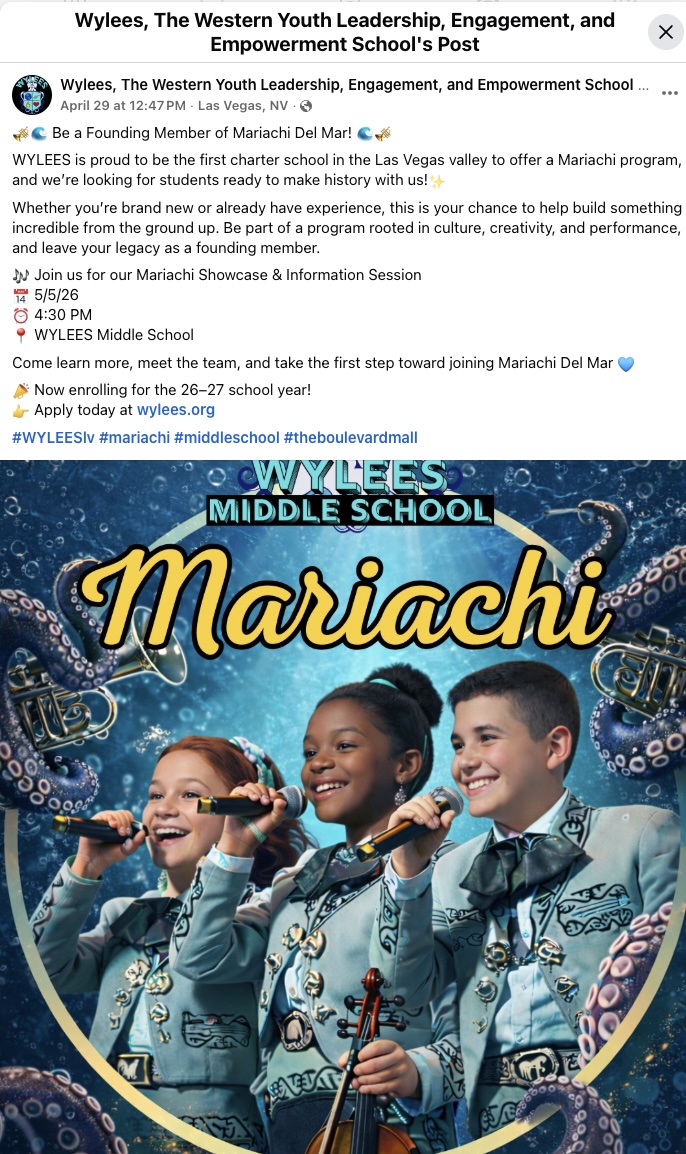
🎶 The Boulevard Mall in central Las Vegas, where the charter middle school is located, will soon be filled with the sounds of mariachi music.
Support Independent Elections Coverage and Journalism in Nevada
You’ve enjoyed unlimited access to our reporting because we’re committed to providing independent, accessible journalism for all Nevadans.
But sustaining this work — informing communities, holding leaders accountable, and strengthening civic life — depends on readers like you.
Nevada needs strong, independent journalism. Will you join us?
A gift of any amount helps keep our reporting free and accessible to everyone across our state and funds our elections coverage.
Choose an amount or learn more about membership