


How my fascination with Harry Reid became a book
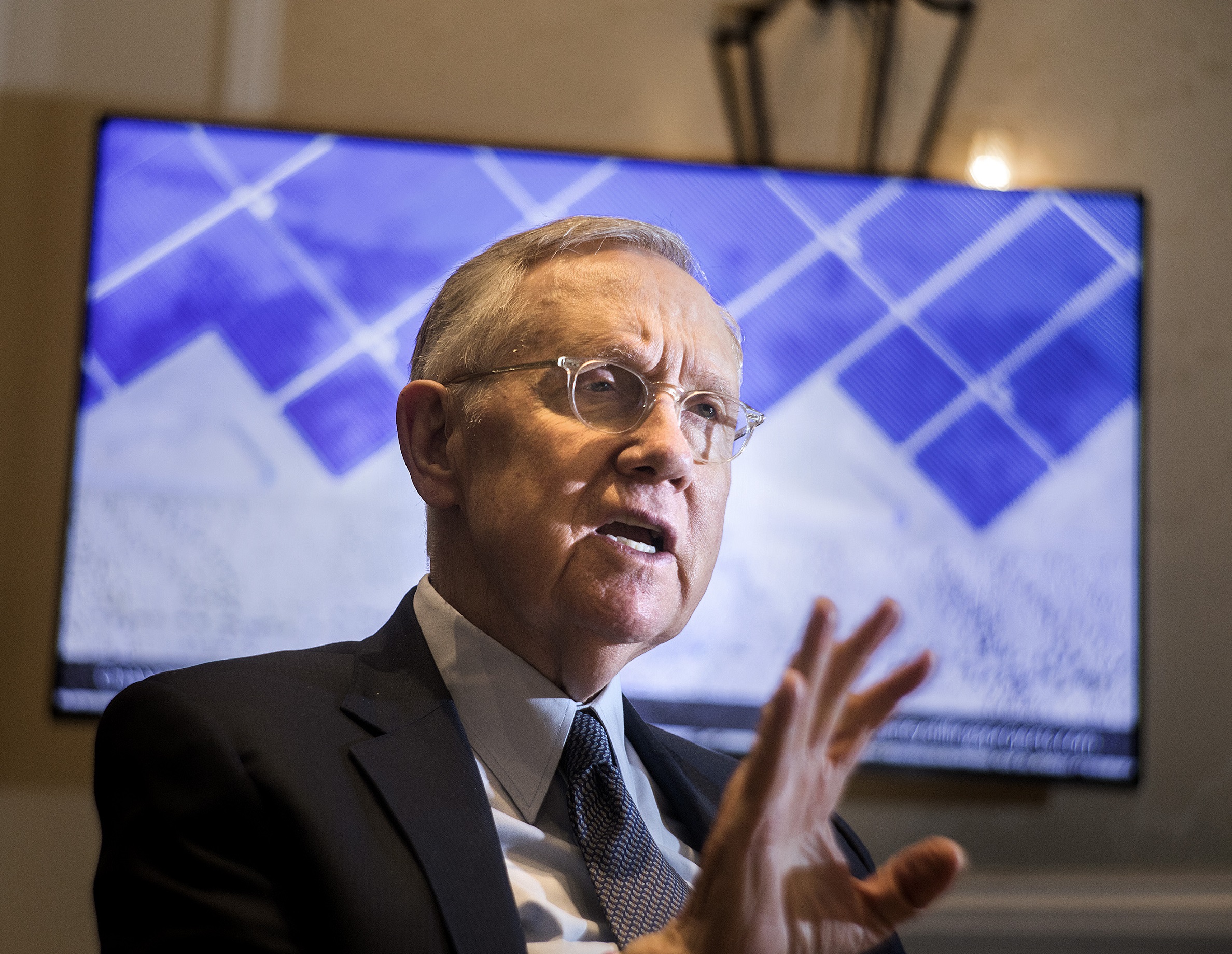
For as long as I can remember, I wanted to write a book about Harry Reid.
I had covered him from the moment I was thrust into the political beat at the Las Vegas Review-Journal a month before the U.S. Senate primary in 1986 after a reporter abruptly left the paper. I found it hard to believe that this charismatically challenged, milquetoast congressman had any chance to win (I hope my political instincts have improved since then), much less become the most powerful politician in Nevada history and a national figure who would define, for good and ill, what Capitol Hill would become.
I came to understand that there was so much more to him than his public persona, which belied a fierce killer instinct, a legislative and strategic mastery and a ruthless, Machiavellian drive for power and success. He was, if nothing, else, sui generis, with a compelling rags to riches (literally and figuratively) story, and a man whose tale of change mirrored that of the state he served.
It seems almost surreal to me that the book will finally be published today. This has been a labor of love and occasional hate, an odyssey with many obstacles to surmount but one that has produced something I hope will stand the test of time.
I had been lobbying people close to Reid to let me write his biography since around the turn of the new millennium. Some had been solicitous, but I got the sense that the senator, with whom I had tangled a few times, was not eager to allow me to tell his story. When his autobiography was published in 2008, I was crushed. I thought the window might have closed.
But I kept trying nonetheless. It was not until three years after Reid had left office, in late 2019, when I was at a conference in Houston that I was approached by two agents, Keith Urbahn and Matt Latimer, who believed in the idea and have never wavered. I still had to get Reid to agree and, of course, I needed a publisher. Reid finally relented, summoned me to his office at the Bellagio (he was working as a consultant for MGM Resorts International) and agreed to do the book.
"We have something in common, Jon," he told me. "We are both survivors." (I neglected to tell him I had survived despite his multiple efforts to kill my career, but I figured discretion was the better part of getting a book contract.) Priscilla Painton at Simon & Schuster was an early advocate for the project, and I was thrilled to have a contract signed by mid-2021.
Reid and I had already started a series of Zoom interviews — there would be two dozen — that would culminate in just a few months. He was already sick when we began, but I had no idea he would pass away six months after that first interview. Each one of those sitdowns was memorable, and no matter what had happened in our long association, I felt a bond of sorts developing, allowing me a window into who he was more than I already knew. (Landra Reid, his wife of six decades, sat in on many of those interviews, occasionally interjecting to correct him or amplify his memories. She became invaluable to the project.)

Reid's death just before the new year in 2021 was really just the beginning for the book in many ways. I had barely begun to write — Reid regularly admonished me to "just start writing" in the fall of 2021. The senator had given me access to his capacious archive at UNR, and I had just begun to take advantage of it. With the help of the marvelous staff at the Special Collections and University Archives department, I would find dozens upon dozens of gems, which, alas, I could never ask Reid about, including a raft of FBI files when the agency was investigating him.
I wanted to use almost everything I had found, but my more thoughtful and immensely helpful wife, Sara, suggested there was "book stuff" and "Jon stuff" in the archive. Nevertheless, after many trips to Reno and many, many interviews with Reid friends, staffers and colleagues, I was still having trouble making much progress in the writing.
Once again, Sara stepped into the breach. She wisely suggested that unless I took time away from my nearly all-encompassing duties at The Indy, I would never finish. I reluctantly agreed and during the summer of 2022, we lived outside of Paris and while Sara and my stepdaughter, Jordana, explored the City of Lights, I wrote and wrote and wrote. And wrote some more.
In the end, I wrote about half of The Game Changer during that sojourn abroad. It took me until May 2023 to submit the first draft, which I knew was significantly longer than the contract outlined but not nearly so long as I thought it should be, even with some of the "Jon stuff" excised.
Despite my half-facetious Robert Caro references, my wise editor, Mindy Marqués, insisted I cut the book by a third, which may not be as painful as childbirth but at times felt like I was lopping off my own limbs. But no pain, no gain — or at least no publication.
Finally, by the spring of 2025, nearly two years after my first draft, I had a final version and a publication date. So how do I feel about it?
Excited and relieved.
I had felt terror, too, for a bit because of the uncertainty of reviews to come. But friends have persuaded me that I should not worry about those, that it matters less what people say than what I have accomplished.
I hope so.
I do care what some people think, but I care more that this book presents as nuanced a portrait of a complex, accomplished and controversial man as possible. I also believe it tells a lot about Nevada and about the country, how Harry Reid affected both and how much some Democrats, here and in Washington, D.C., miss him now.
I don't think, even at Caro length, you can ever fully capture any human being in mere words. But what you can do, in this age of character counts and distressing superficiality, is provide as much evidence as possible, as many informed opinions as possible, as much documentation as possible to at least create a mosaic of a life.
In all the years I have written stories and columns, I have never been fully satisfied with anything I have put into words and shared with readers. But I am as happy with this finished product as I can be, knowing I did what I could, despite all the hurdles, to construct a story of the life of a man that — no matter how you feel about him — is a tale worth telling.
I hope you'll tell me what you think.
Support Independent Elections Coverage and Journalism in Nevada
You’ve enjoyed unlimited access to our reporting because we’re committed to providing independent, accessible journalism for all Nevadans.
But sustaining this work — informing communities, holding leaders accountable, and strengthening civic life — depends on readers like you.
Nevada needs strong, independent journalism. Will you join us?
A gift of any amount helps keep our reporting free and accessible to everyone across our state and funds our elections coverage.
Choose an amount or learn more about membership