
More than $130M was allocated for EV charger buildout in Nevada. Few were built.

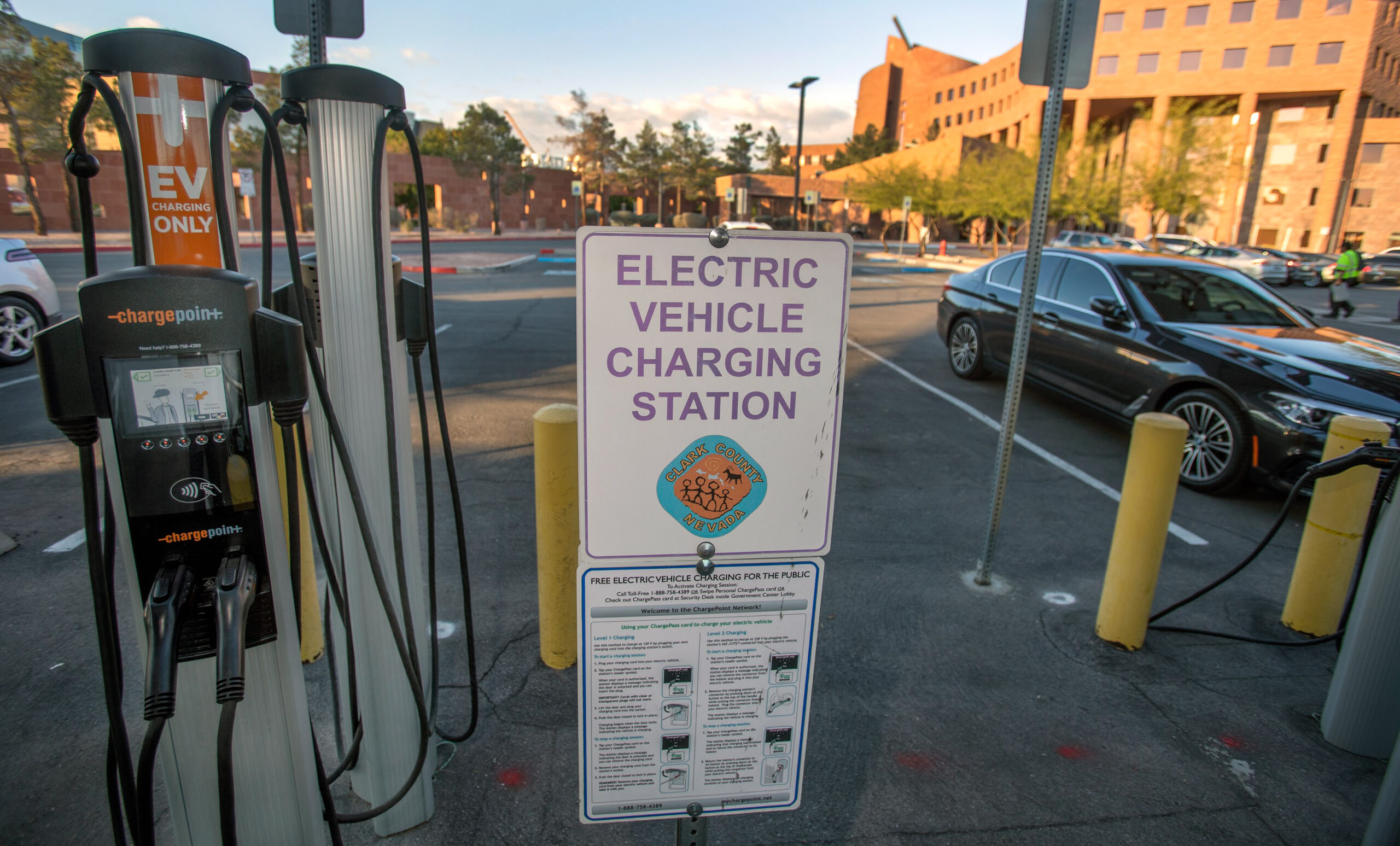
Scott Allison, a Las Vegas resident who drives an electric Kia, can travel about 280 miles before he needs to charge. He and his husband have flown to the Reno-Tahoe area to visit, but they're hesitant to drive all the way north given the state's spotty charging infrastructure.
If any of the rural charging stations are nonfunctional, he fears he would be stranded.
"When you've got so few that work, there's no redundancy," he said. "We need dependable chargers that we know are going to work. You can't just jump in the car and hope for the best."
There is no official state or federal site that tracks where charging stations exist and if they are operational.
What the unofficial sites show is that for Nevada's more than 65,000 electric vehicle (EV) drivers, attempting to drive in some of the more rural stretches of the state, such as U.S. Route 95 between Tonopah and Las Vegas or U.S. Route 93 between Las Vegas and Wells, is still a gamble.
In 2021, state lawmakers attempted to solve this problem by giving NV Energy the green light to build out more than $100 million of EV charging stations over several years, with a focus on underserved communities.
Coupled with tens of millions of dollars in federal grant money awarded to the state through the bipartisan infrastructure law, all signs indicated that anxiety EV drivers experienced traversing Nevada's more rural areas would soon be a thing of the past.
But more than a year after NV Energy's project was set to wrap up, the utility has spent just $12.4 million on the project. In an email, the utility said that some additional money is slated to be spent but that it does not intend to spend the full $100 million because of high infrastructure costs and less interest than anticipated from customers to develop charging stations on their properties.
Thus far, 16 charging sites have been built and two additional sites are under construction. Combined, the 18 sites will add nearly 350 charging ports across the state.
The results have not matched the lofty promise of 120 EV charging stations attached to 2021's SB448, an omnibus energy bill touted as a way to boost job production in the wake of the COVID-19 pandemic and electrify the state's highways while pushing through multiple NV Energy priorities.
"I've heard people lift [SB448] up as a model of policy to accelerate and help with the adoption of electric vehicles. It's frustrating to see that the reality didn't play out that way," said Assm. Howard Watts (D-Las Vegas), who supported the bill in 2021. The bill "set very clear metrics of 'we want to spend $100 million over the next three years.' It was a clear direction that this was something important."
Simultaneously, the Nevada Department of Transportation (NDOT) failed to spend $38 million in federal funds it was awarded in 2022 under the bipartisan infrastructure law before the funds were slashed in Congress' latest spending bill to just over $25 million.
Other states have moved much faster, allowing them to tap into all, or most, of their funds.
NDOT declined interviews with The Nevada Independent but agreed to answer questions via email.
"I can't state strongly enough how disappointing this is," Allison said in an email. "We need chargers in rural areas, and due to NDOT's desert tortoise pace, [have] lost a significant portion of these funds."
Green-lighted for $100 million, NV Energy fails to follow through
More than a decade ago under former Republican Gov. Brian Sandoval, the Nevada Electric Highway initiative was launched with the support of NV Energy and the state's department of transportation to electrify the state's highways. The goal was to double the number of public charging stations in the state and expand them to all major Nevada highways by 2020, with the first charging stations opening in 2016 in Beatty and Fallon.
Funding for the initiative came from NV Energy and the state's renewable tax abatements, federal grants, partnerships with electric companies and the Volkswagen Environmental Mitigation settlement.
But then the Nevada Electric Highway program went defunct in 2023, and progress on all fronts stalled.
As of 2024, only about 630 of the nation's nearly 77,600 EV charging stations were in Nevada.
So when state Sen. Chris Brooks (D-Las Vegas) introduced SB448, a multipronged bill that in part required a $100 million investment by NV Energy in EV chargers, particularly in historically underserved communities, it easily garnered bipartisan support from state lawmakers eager to spur job growth in the wake of the COVID-19 pandemic.
"We put words on paper in this building, and those words turn into laws that turn into actual actions," he said during a hearing on the bill. "Using words that will actually turn into actions is sometimes the hardest thing to do."
With nearly unanimous support from environmental and advocacy groups, as well as the governor's office, lawmakers authorized NV Energy to spend up to $100 million — costs the utility can ask the Public Utilities Commission of Nevada to allow them to recoup from customers — on the charger build-out.
Later that year, NV Energy filed documents with state energy regulators laying out bold plans.
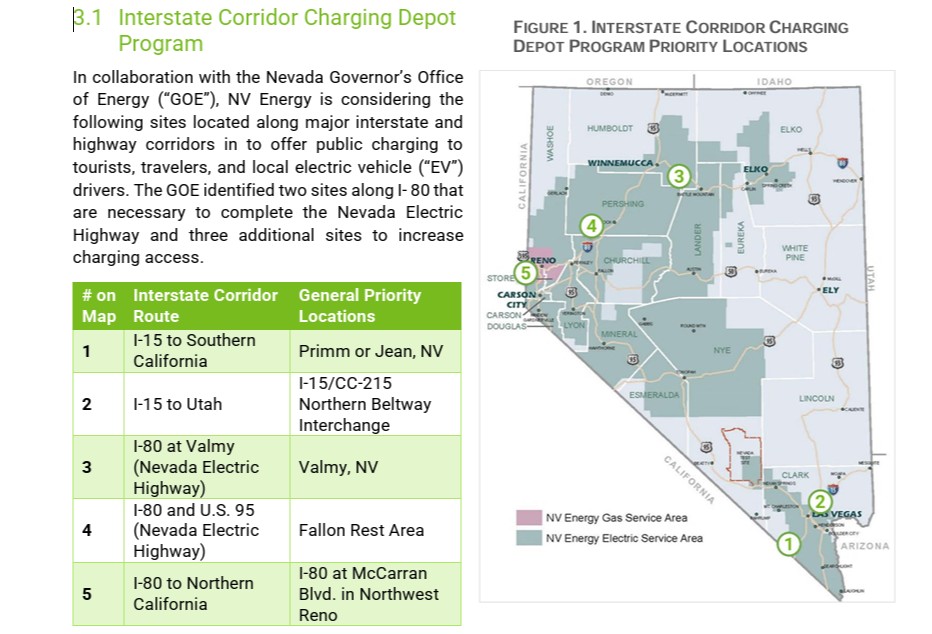
It would build 120 charging sites with more than 1,800 ports — accelerating transportation electrification, the plan said, that would "provide the greatest economic recovery benefits and opportunities for the creation of new jobs in the State."
The plan dedicated just over $90 million to five key areas: Charging for interstate corridors, urban areas and public agencies, electrification of transit and school buses, and outdoor recreation and tourism. It also forecast $8.7 million for plan development and deployment.
But by the end of 2025, the company had invested just $12.4 million in its plan with just 16 stations built. All but one are in Las Vegas or Reno. Work is wrapping up on two additional sites: an electric boat charging site at Lake Tahoe and a $5.7 million bus program with Clark County School District.
Another 14 stations under design as of 2024 were scrapped because of "budget constraints," according to NV Energy's recent filing with state energy regulators. The chargers would have significantly exceeded cost thresholds approved by state energy regulators; their construction would have passed on oversized costs to customers, according to the utility.
More than half of the $12.4 million ($6.8 million) was spent on outreach and education, technical advisory services, operations and maintenance and job creation and workforce development.
The utility did not track how many people were employed through its EV charger program. But the company reported 319 journeymen and apprentices received training through the Northern Nevada Electric Training Center and the Electrical Joint Apprenticeship and the Training Committee in Southern Nevada.
Brooks, the 2021 bill sponsor and an EV driver who has faced charging challenges driving across the state, said in a call with The Nevada Independent that he hasn't tracked the success or failure of the bill.
"I just unfortunately haven't paid a lot of attention to the details," he said. "I don't know where we should be looking for more progress. As a state, we are just not doing a really great job on charging infrastructure."
Many of the groups that once supported the legislation have expressed frustration and disappointment with how buildout, or lack thereof, has transpired.
"We were very supportive of SB448 back in 2021," Brian Turner, senior director at Advanced Energy United, said in an email. "While there has been some progress ... [it] has not lived up to its full potential."
NDOT stalls on spending federal funds
NV Energy isn't the only entity that has stalled on EV charger buildout.
In 2022, the Federal Highway Administration allocated funds to states to construct EV charging stations as part of its National Electric Vehicle Infrastructure (NEVI) program. Nevada was awarded $38 million.
But last month, E&E Politico reported that just a fraction of the $4.4 billion made available to states under the federal electric vehicle funding has been spent. Five states, including Nevada, have spent no money.
According to the NEVI Awards Dashboard, which tracks EV charging sites built with the federal funding, 10 states are fully built out. Eighteen states have at least one operational EV charging station built with the federal funds. And dozens of states have issued at least one solicitation for construction. Nevada isn't one of them.
In late 2024, NDOT said plans were to start construction by early 2025 on roughly 40 stations it intended to build, but the program stalled when the federal administration temporarily froze the funding. The funding was later unfrozen, only to be partially clawed back earlier this month.
More than $503 million nationwide was being clawed back from the federal allocations for EV chargers, including $12.6 million in Nevada. Despite the cuts, the department estimates it will have its first charging stations operational later this year.
"We in Nevada will continue advancing toward future construction of EV charging improvements using available authorized funding and following priorities outlined in the state's NEVI plan," NDOT spokesperson Meg Ragonese said in an email.
But it will likely still be awhile before drivers like Allison are comfortable road tripping across the state.
"It's crazy I can't go safely drive around Nevada in an EV," Allison said. "It's really disappointing."
Editor's note: This story was updated at 1:20 p.m. 3/3/26 to correct the name of the road running between Tonopah and Las Vegas. It is U.S. Route 95.
Support Independent Elections Coverage and Journalism in Nevada
You’ve enjoyed unlimited access to our reporting because we’re committed to providing independent, accessible journalism for all Nevadans.
But sustaining this work — informing communities, holding leaders accountable, and strengthening civic life — depends on readers like you.
Nevada needs strong, independent journalism. Will you join us?
A gift of any amount helps keep our reporting free and accessible to everyone across our state and funds our elections coverage.
Choose an amount or learn more about membership