
Nevada wants zero traffic deaths. The numbers tell a more complicated story.

Three deaths after a driver smashed into an intersection going 109 mph. An 11-year old girl struck and killed crossing the street. Siblings, 6 and 11, killed by a speeding driver with their mother in the driver's seat. Nine lives lost after a driver ran a red light at 103 mph and caused a six-vehicle crash.
For some Las Vegans, stories like these from the past few years have become a harrowing reality of living in the city.
"I'm terrified," said Las Vegas resident Ahkilah Brooks, who has stopped walking her 5-year-old daughter to school because of safety concerns. "I see this with my own eyes every single day. It's just constant, all the time."
Though experts have struggled to pinpoint a single reason, the number of deaths from traffic crashes in Las Vegas has been on an upward trend over the past 15 years, in spite of a state campaign to achieve zero fatalities and even as trends are going in the opposite direction in other states.
Data from the Las Vegas Metropolitan Police Department, which does not include Henderson or North Las Vegas, shows that fatalities are up more than 25 percent since 2016. In the broader Las Vegas Valley, numbers broke records in 2024 when Clark County saw 296 deaths. In 2025, that total for Clark County dipped to 237 deaths but remained high compared to pre-pandemic levels.
Andrew Bennett, head of the Clark County Office of Traffic Safety, said he's heartened by 2025's lower numbers, though he acknowledged that progress isn't always easy.
"We hope it's a trend, not an outlier," said Bennett, whose office helped pass AB6, a bill that increased penalties for accidents in school zones. "I would like to hope we're making some systemic changes, progress in traffic safety is slow."
Police have notched up the attention on the issue as well. Late last year, law enforcement in the Las Vegas Valley — North Las Vegas, Henderson and Metro police departments — announced a collaborative task force to tackle traffic deaths in the city. In a phone conversation, Robert Wicks, a spokesperson for LVMPD, said traffic fatalities were "a top priority" for Sheriff Kevin McMahill in 2026.
Enforcement is one step in reducing traffic fatalities, but experts, lawmakers and studies point to a complex issue that intersects with urban planning and road design, education and speed limits to curb the amount of people killed by vehicles each year.
Nevada is sixth in the nation for road fatalities by miles traveled. For every million miles driven on Nevada's roads in 2024, there were 1.49 deaths, according to a July study from National Transportation Research Group (TRIP), a nonprofit focused on researching traffic. Comparatively, Minnesota and Massachusetts had rates of 0.7 and 0.59 deaths per million miles traveled in 2024.
Traffic deaths in Nevada have also increased — more than 28 percent in the past decade. In 2024, the state had a high of 419 fatalities, a nearly 10 percent increase from 381 in 2023, according to data from the Nevada Department of Public Safety. So far, 2025's numbers have dipped, with preliminary figures showing a 10 percent decrease from the year before.
Meanwhile, roadway deaths around the country are on the decline. American traffic fatalities rose during the pandemic, with a high of more than 43,000 in 2021, and have been on the decline since, according to the U.S. Department of Transportation, though they have not sunk below pre-pandemic levels. The National Highway Traffic Safety Administration reported that the first half of 2025 saw an 8.2 percent decrease from the year before.
View our interactive map of car crashes in Clark County to see how many crashes have occurred in your neighborhood:
Curbing risky behavior: Distracted citizens, speed and drivers under the influence
Dr. Deborah Kuhls, a trauma critical care surgeon at UNLV's medical school, has called traffic safety, or the lack of it, a "public health crisis."
Kuhls, a trauma surgeon since the 1990s, said she's seen too many violent crashes to remember them all. She said the constant barrage of fatalities and serious injuries is what lingers in her mind, noting that car crashes are one of the leading causes of death for Americans younger than 44.
Human behavior is a killer on the road. TRIP research found that risky driver behavior appeared to be the leading factor in increased deaths after the pandemic. However, according to Kuhls, these decisions can be curbed with education and traffic enforcement.
"These are car crashes, not car accidents. They aren't random," Kuhls said. "The contributing factors are things we can control, they're behavioral."
Major contributors to car crashes include speeding, driving under the influence and distracted driving, Kuhls said, with speeding being one of the main causes for deaths and nonfatal accidents.
"It just allows all of the drivers who encounter something that they need to respond to less reaction time in order to avoid a crash," Kuhls said.
Equally memorable for her are the number of impaired drivers who come to realize what they've done while in the hospital.
"They wake up and come to their senses. What really haunts me is some of them will recognize what happened and that they were impaired, and they ask us, 'Did I kill someone?'" Kuhls said.
Kuhls said time of day is another factor in causing crashes, particularly for pedestrians who can be hard to spot at night, especially if they are wearing dark clothing or crossing the road outside of a marked intersection.
Brooks, who noticed how dangerous it was to drive in Las Vegas during a stint as an Uber driver, said the lack of care she sees from drivers worries and frustrates her. She cites distracted driving as a major concern.
"People are not paying attention, and people don't care," Brooks said. "They are watching TV on the phone, they are watching TikTok and scrolling while driving."
The trauma of a crash can be "life-altering" for bystanders, particularly for those who have had to perform CPR on victims or pull people out of vehicles, according to Jill Roberts, a nearly 20-year volunteer and chief executive officer for the Trauma Intervention Program (TIP) of Southern Nevada.
Unlike other tragic incidents that families can sometimes see coming, shock and confusion is a common response at the scene of a motor vehicle crash, Roberts said. Her organization sends volunteers to scenes of a tragedy at the request of first responders to provide emotional support to "family members, friends, witnesses and bystanders."
"One of the things that is unique to a motor vehicle fatality is the suddenness of the incident," said Roberts, noting the group was responding to fewer calls 10 to 15 years ago. "Most people who die in this way were high-functioning folks who were on their way to work or school — their family members never had a thought in mind that this would be the day their loved one would die."
Roberts said one particular incident has stuck with her: consoling a new mother in a waiting room at University Medical Center hospital; her husband died after being hit by a suspected drunk driver.
"When this happens, we don't try to stop them from crying or stop the anguish," Roberts said. "We encourage the tears, the hysteria and the emotions. Their life has just been upended."
Changing laws to achieve 'Zero Fatalities'
It's been more than 15 years since the Zero Fatalities initiative, an effort to bring Nevada's roadway deaths to zero by 2050, was introduced as a part of the state department of public safety. It's similar to the nationwide movement, the Vision Zero Network, which launched in 1997 and urges the onus of crashes be placed on systems such as roads and speed limits rather than holding an individual responsible.
Legislators aimed to address the issue during the 2025 regular and special legislative sessions, introducing several traffic safety bills. They included AB527, which allowed for cameras to be added to school buses, as well as the failed SB415, which would have allowed for automatic cameras to detect red-light violations.
Clark County School District reported that in the first three months of the school year, 142 children had been struck by cars in 2025, up from a last year's total of 120 for the entire school year.
Lawmakers have said there is bipartisan support to reduce the number of traffic deaths, but the right way forward is unclear.
During an annual Nevada Traffic Safety Summit earlier this fall hosted by the state safety department, state Sen. Rochelle Nguyen (D-Las Vegas), Assm. Howard Watts (D-Las Vegas), state Sen. Marilyn Dondero Loop (D-Las Vegas) and Clark County District Attorney Steve Wolfson spoke about policy measures and increasing funds for state police to help reduce fatalities and crashes.
The group showcased two strategies: one focused on preventative measures such as street redesign and modernizing traffic policies and the other on increasing penalties for traffic law offenders.
"We need to increase the penalties for DUIs. Deterrents," Wolfson said. "When we grow up as children and we do something wrong, we're punished. Most of the time, we learn from that punishment."
Others, like Watts and Nguyen, spoke about the necessity of enforcing existing traffic rules. While speed limits in Nevada remain as high as 80 mph on some roads, financial penalties are on par with other states, with more expensive penalties and longer sentences compared to states like Montana, California, Arizona and Utah. Mothers Against Drunk Driving, an organization focused on reducing drunk driving fatalities, rated Nevada among the top 10 states in the country for strong laws against driving under the influence in their latest report on the topic in 2019.
According to Nguyen, there also has to be funding allocated for police and highway patrol officers to carry out traffic laws. There is a shortage of troopers nationwide, with vacancy numbers as high as 45 percent in 2025, despite a pay raise by the Nevada Legislature in 2023.
"We can look at what other states have done to modernize policies to allow localities to lower speed limits. Right now, to lower speed limits, it has to come to the state Legislature every year," Nguyen said.
Bennett, who said he's been working with traffic safety for 15 years, said all tactics are necessary in order to bring down fatalities — increased penalties and road design improvements alike.
"Everything has to be systemic. We can't just look at one thing," he said.
Improving 'scary and harrowing' road design
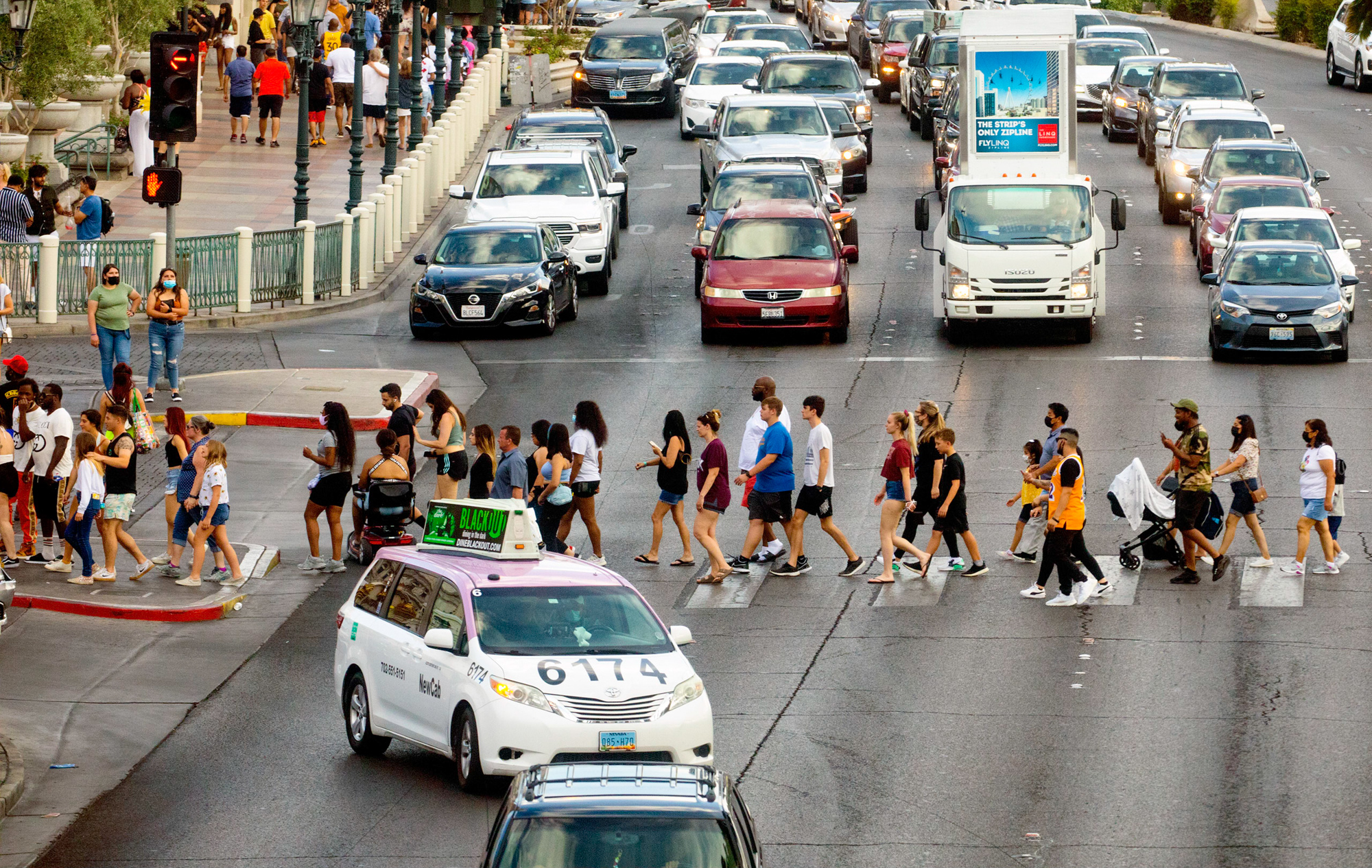
Infrastructure is a recurrent issue, for those in and out of vehicles. Much of Las Vegas was built in the post-World War II boom — it's a flat city, with wide roads intended for cars, features that can be conducive to speeding, according to experts. Sidewalks and protected bike lanes are something the city is "making progress on," according to Bennett.
Kuhls also said that many roadways in Las Vegas are not "complete streets," a concept designated by the National Complete Streets Coalition as an approach to creating roads that emphasize the safety of more than just drivers, "including pedestrians, bicyclists, motorists and transit riders." In comparison, "incomplete streets" are roads designed only for "cars in mind that are inconvenient and fatal for non-drivers."
According to research from Michael Lewyn at Indiana University in 2024, these streets might lack sidewalks and crosswalks with clear signals for pedestrians, be wide with multiple lanes, have a shortage of adequate or no bike lanes or be incomplete and end abruptly. Outside of gated or planned communities, incomplete streets are common in Las Vegas.
In an interview with The Nevada Independent, Watts said anyone driving in Nevada and Las Vegas "knows that things are moving in the wrong direction." Watts, whose district includes areas close to downtown Las Vegas, said many of his constituents talk about a lack of access to public transportation, as well as lack of safe streets.
"There's areas where there are no sidewalks," Watts said. "It's extremely scary and harrowing; people are looking for better infrastructure that allows them to bike and walk safely."
He also pointed out some bright spots, such as the redesign of Maryland Parkway, as an example of positive change in the community. The project aims to improve the pedestrian experience, promote mixed-use walkable development and revitalize green space around the Flamingo Wash.
Road improvements for pedestrians in Spring Mountain Road in Chinatown were also recently announced.
These efforts, Watts said, were a step in the right direction but he disagreed with Wolfson's assessment that increasing penalties was the solution.
"I think you can see that other states have similar or even more lenient laws," Watts said. "Penalties alone are not determining what we're seeing on the road. That's when we have to look at other things."
However, Watts also said funding for improved infrastructure, both for pedestrian safety and for public transportation, has lagged. Nationwide, the United States has a $146 billion backlog in necessary safety improvements, according to TRIP research.
"We really are underfunded compared to other cities our size," he said.
Eric Neugeboren and CJ Keeney contributed to this report.
Support Independent Elections Coverage and Journalism in Nevada
You’ve enjoyed unlimited access to our reporting because we’re committed to providing independent, accessible journalism for all Nevadans.
But sustaining this work — informing communities, holding leaders accountable, and strengthening civic life — depends on readers like you.
Nevada needs strong, independent journalism. Will you join us?
A gift of any amount helps keep our reporting free and accessible to everyone across our state and funds our elections coverage.
Choose an amount or learn more about membership