
No land? No problem: Why many Nevada data centers don't own the land they're asking to develop


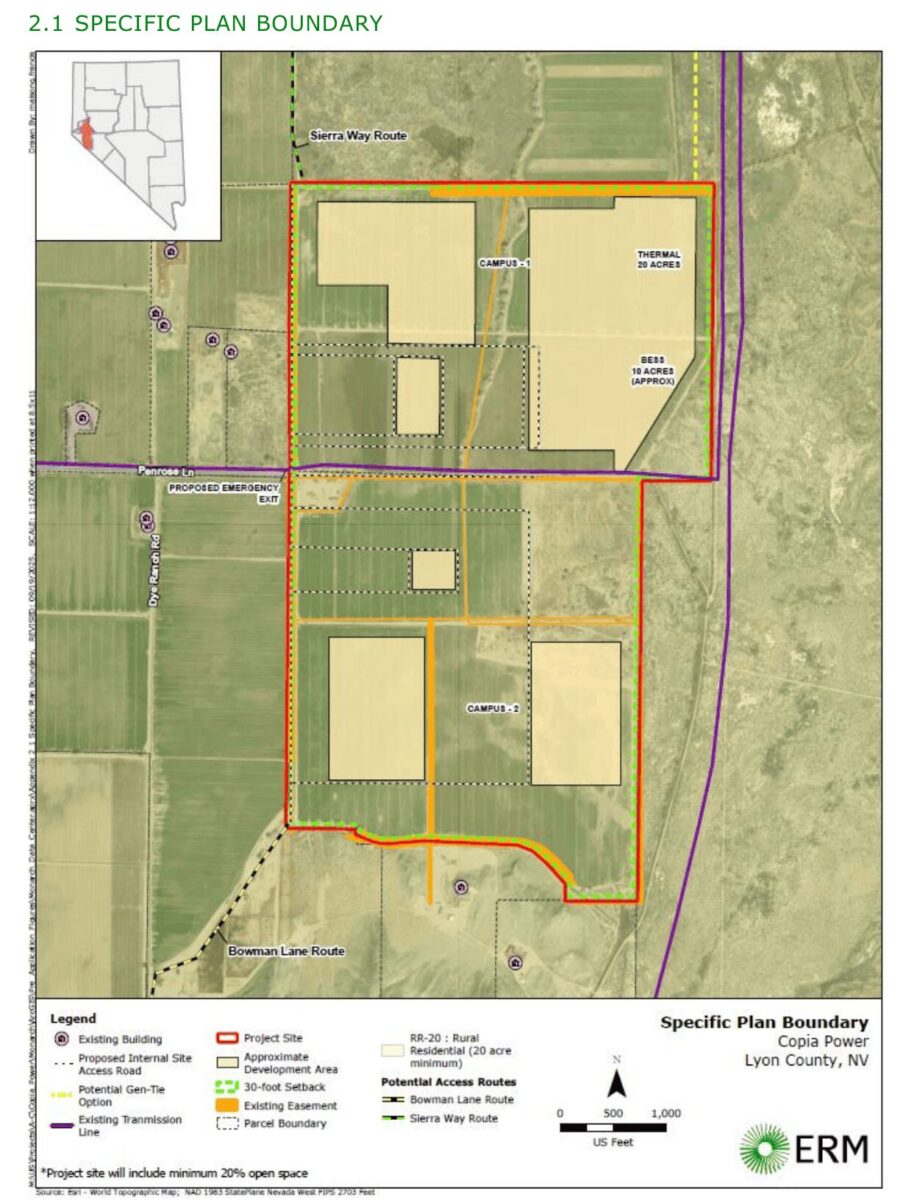
When Copia Power unveiled plans for the Monarch Data Center — a 4.6 million-square-foot complex spanning 505 acres in rural Lyon County — it did so without owning a single acre of the land the project would sit on.
That's not unheard of. Large-scale development projects such as data centers and industrial parks often move through the same general sequence: a developer secures the right to buy land, wins the government approvals that make the land usable for the project and only then closes on the purchase.
It means there's often a scant paper trail indicating a major project is in the works.
Monarch is now approaching a key point in that sequence: Lyon County commissioners are scheduled to vote Thursday on the zone change the project needs to move forward. At 1,000 megawatts, the project alone would draw power equivalent to roughly half of Hoover Dam's maximum generating capacity of 2,080 megawatts — drawing sharp opposition from area residents worried about the project's demands on local water, power and infrastructure.
Here's how the process actually works, and how Monarch has moved through it so far.
Locking up the land
Developers rarely buy land outright before they know whether they'll be allowed to build what they want on it. That's especially true when the land isn't zoned for what they have in mind.
The planned Monarch site is currently zoned RR-20, or "rural residential," with a 20-acre minimum lot size, which doesn't permit a data center campus outright. The site's master plan designation, once "agriculture," was changed to "specific plan" in December 2025 as an earlier step toward the more precise zone change still pending.
Instead, developers often sign an option agreement — a contract giving the developer the exclusive right to purchase property or land within a set window — typically contingent on securing the zoning and other approvals needed to build.
Copia Power holds an option agreement on land parcels owned by the Masini family, a longtime Yerington-area farming and ranching family, that make up the project's core and are currently up for a zone change. Copia has also secured similar option agreements on several other nearby parcels beyond the core site, a sign that even the footprint of a project can shift and expand well before any land actually changes hands.
Sara Bronin, a George Washington University law professor who founded the National Zoning Atlas — a project cataloging zoning rules for jurisdictions across the country — said the structure is common, speaking generally and not about Monarch specifically.
"The proponent of a project may try to delay certain types of investments or decisions until they know what will be approved," she said, adding that the developer sometimes arranges for a landowner to submit a zoning application on the developer's behalf, with a promise to buy if it's approved.
Jeremy Smith, director of regional planning at Truckee Meadows Regional Planning Agency, described it in blunter terms: it's about risk aversion.
"If they buy the land without the zoning entitlement having been processed and approved, then they're not guaranteed that it ever will be," Smith said. "So then they've just bought the land and they can't do what they want to do."
That also explains why the public record can look thin at this stage, with no land sales recorded, even as a project moves forward behind the scenes. The Lyon County Assessor's Office confirmed its records track parcels for tax purposes only and wouldn't reflect an unexercised option agreement, since no ownership transfer has occurred. The only public trace is the memorandum of option, a short filing noting an agreement exists without disclosing its full terms
Elsewhere, data center developers have taken a different approach, buying land outright at steep premiums. In Port Washington, Wisconsin, developers spent at least $125 million acquiring more than 1,500 acres for a data center project, with some sellers paying several times their land's fair market value, according to public records analyzed by Wisconsin Watch. It's not clear whether that site already carried the zoning those developers needed — which would make an outright purchase far less risky than it would be on land like Monarch's.
Zone changes
The zone change is where most of the public process happens, and where a common misconception creeps in: people often assume the project itself gets approved. It doesn't, exactly. Zoning attaches to the parcel, not to the applicant. But that doesn't necessarily mean each parcel needs its own separate approval process.
Smith said often a mechanism called a planned unit development (PUD) handbook can bundle several parcels — each potentially carrying different underlying zoning designations — into a single entitlement covering the whole project area. Entitlement is the general term for the package of government approvals that a project needs before it can be built.
Monarch has submitted the Monarch Data Center Specific Plan, alongside the zone-change request, that spells out exactly what's allowed to be built. The zone change and the specific plan get approved together as one package.
Smith also described zoning and master planning as a "two-map system." A master plan sets the broad land-use vision for an area — residential, industrial, commercial — while zoning controls the specifics, like density, within that vision. The two have to align, and changing one sometimes requires changing the other.
"It's kind of a nested thing," Smith said, though he noted the two changes are often bundled into a single process rather than pursued separately.
This zone change, which requires approval of a majority of Lyon County commissioners present, is Monarch's second hurdle. The first, a master plan amendment, encountered heavy public opposition and a six-month delay before it was approved in December 2025. Opposition has centered on the project's location in a stretch of rural Mason Valley surrounded by agricultural and rural-residential land, with critics raising concerns about impacts on nearby wells, ranchland and the Walker River, and a lack of consultation with the Walker River Paiute and Yerington Paiute tribes.
A year later, the planning commission voted 4-3 to forward a recommendation on Monarch's PUD zone change on July 14, 2026, to the county commission, who are scheduled to cast the final vote on Thursday, Aug. 6.
Smith said that gap between recommendation and final vote reflects real discretion. Decision-makers have to point to specific written findings — requirements laid out in staff reports — before approving a project, he said, and "they may have a difference of opinion … ultimately, they're the decision maker."
Closing the sale
Once the necessary approvals are secured and the zone changes in place, the developer typically exercises its option to purchase the newly zoned land, and the purchase closes. This is the point when the transaction finally becomes visible, with a deed recorded, a property reassessment and ownership formally changing hands.
If approvals are denied, the developer can typically walk away from the option instead, and the landowner keeps the land.
Smith cautioned that the sequence isn't universal, even for data centers specifically. Whether a developer options land or buys it outright often depends on whether the site already carries the right zoning.
"If it's already zoned industrial, then that's the expected use," he said — a more straightforward case than land that needs to be rezoned first and there's more uncertainty around government approvals.
Support Independent Elections Coverage and Journalism in Nevada
You’ve enjoyed unlimited access to our reporting because we’re committed to providing independent, accessible journalism for all Nevadans.
But sustaining this work — informing communities, holding leaders accountable, and strengthening civic life — depends on readers like you.
Nevada needs strong, independent journalism. Will you join us?
A gift of any amount helps keep our reporting free and accessible to everyone across our state and funds our elections coverage.
Choose an amount or learn more about membership