
Once rare in Nevada, winter bald eagle sightings now common

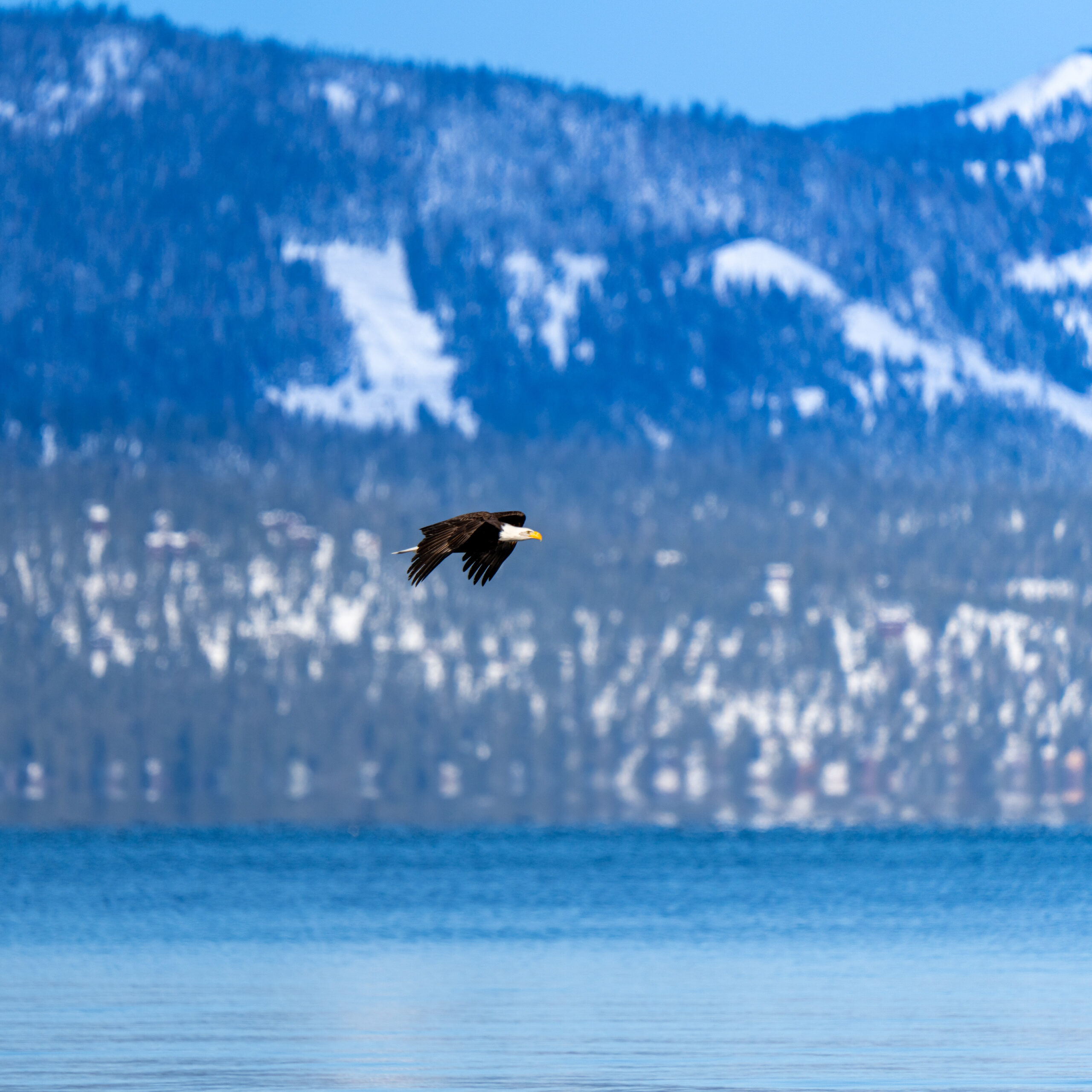
Fresh snow blanketed the ground and the temperature hovered around 20 degrees when Will Richardson stepped from his heated vehicle to walk onto Lake Forest Beach on Lake Tahoe's east shore.
Richardson, who was out despite battling a cold, has repeated the same early-January routine for years, first as a volunteer and up-and-coming wildlife expert, and now as executive director of the Tahoe Institute for Natural Science (TINS). His goal that morning was simple: count the number of bald eagles along the lakeshore as part of a broader effort to track bald eagle populations in northwestern Nevada, the Tahoe region and beyond.
TINS organizes a midwinter bald eagle count each January, relying on a team of volunteers to help a handful of staff track sightings of the majestic creatures that, despite being the national bird, were once nearly driven to extinction.
Habitat destruction, illegal shooting and pesticide use decimated bald eagle populations and, by the 1960s, less than 450 pairs of bald eagles were nesting in the lower 48 states.
Now, bald eagle sightings in the Tahoe Basin generally reflect broader trends in the birds' numbers, which have dramatically rebounded over the decades.
In 2007, a reported five bald eagle pairs nested across the entire state of Nevada, including two pairs in the Tahoe Basin. According to the Nevada Department of Wildlife (NDOW), about 10 breeding pairs were documented in 2019.
Over the last few years, eagle sightings in Tahoe generally number between the 20s and 40s. This year, 23 bald eagles were spotted in the basin by volunteers stationed at more than two dozen observation points.
"By doing this count, we get a much broader snapshot of what's going on all over," Richardson said as he stood on the iced-over shore of Lake Tahoe, swaddled in layers of fleece and down clothing. "We're curious what's going on at Tahoe, but we really want to know what's going on big picture."

Conservation success story
Records dating back to the late 1800s indicate bald eagles in and around the Tahoe Basin, but when monitoring began in 1979, only a handful of the birds were counted, according to Richardson.
Bald eagle numbers nationwide had plummeted, in large part from the use of DDT, a common pesticide after World War II. It was banned by the Environmental Protection Agency in 1972.
In the lower 48 states, the birds were listed on the federal endangered species list in 1978, and protections, combined with the ban on pesticides, helped populations rebound. By 1996, more than 5,000 breeding pairs were counted nationwide, and in 2007, they were removed from the endangered species list.
In 2019, the U.S. Fish and Wildlife Service estimated there were more than 316,000 bald eagles in the lower 48 states, excluding the Southwest, where no surveys were conducted. The birds' comeback is celebrated by conservation groups as "one of the world's great conservation success stories."
"It's just kind of this slow recovery," said Mark Enders, state biodiversity biologist. "It's still kind of happening, in a way."
The birds, which mate for life, are one of the rarest nesting raptors in the state, according to Enders. The birds prefer to nest in areas with large, open bodies of water surrounded by trees, which Nevada does not have in abundance, and the number of birds nesting in the state is likely to remain low, he said.
The number of birds that come to the state for winter feeding, however, is much more substantial.
From 2013 to 2018, 731 bald eagles were documented in the state. Bald eagles were the fourth most common raptor documented in Nevada during that time.
In the winter, the birds congregate around food sources such as large bodies of open water. Because Tahoe never freezes over, it attracts a wide variety of birds eagles can prey on and is a reliable food source.
Some years, eagles are slow to migrate to Tahoe, when other bodies of water, such as nearby Boca and Stampede reservoirs, fail to freeze over. In other years, the birds leave the basin early, making their way toward the Carson Valley to feast on the afterbirths from the calving season, an event that has grown into a tourism staple for the Genoa, Minden and Gardnerville areas as people flock to see the majestic birds.
Nevada's agricultural valleys are also rich in prey for the raptors, Enders said.
If bald eagles successfully nest in an area, that's an indicator of a functioning ecosystem, Enders said. With water clean enough to support birds and fish ,"that just trickles right up the food chain with bald eagles at the top."
An hour and a half after Richardson and his crew of volunteers arrived at Lake Forest Beach, nobody had yet spotted an eagle.
Volunteers optimistically scanned the lake with binoculars, pointing to a tiny speck of white far in the distance — snow in a tree, Richardson said — and a dark bird going by — a raven.
A few minutes later, the group let out a collective cry as a bald eagle flew by, heading southeast. Judging by its feather pattern and colors — it didn't yet have the signature white head and tail — it was roughly 3 years old, Richardson said.
Fifteen minutes later, an adult, this one with the telltale white head and tail, indicating it was at least 5 years old, also flew by.
"All right," Richardson said. "We didn't get skunked."
Support Independent Elections Coverage and Journalism in Nevada
You’ve enjoyed unlimited access to our reporting because we’re committed to providing independent, accessible journalism for all Nevadans.
But sustaining this work — informing communities, holding leaders accountable, and strengthening civic life — depends on readers like you.
Nevada needs strong, independent journalism. Will you join us?
A gift of any amount helps keep our reporting free and accessible to everyone across our state and funds our elections coverage.
Choose an amount or learn more about membership