
A lone wolf crossed into Nevada. Scientists are watching what happens next.

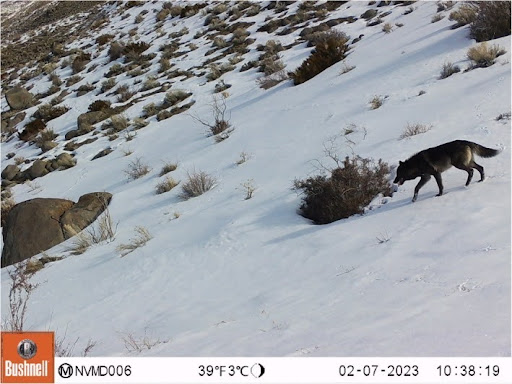
A gray wolf left the forests of Northern California in early February and traveled east into Nevada— a landscape where wolves have not established packs in more than a century.
The wolf, a young male disperser from California's Harvey Pack, was detected moving through the Truckee area before crossing into Nevada's Carson Range between Mount Rose and Mount Houghton. Biologists with the California Department of Fish and Wildlife tracked the animal using a GPS collar, part of ongoing monitoring as the species expands across the state. His short trip into Nevada appeared on the agency's recently launched public wolf location mapping system, which provides delayed and generalized updates intended to balance wolf recovery with livestock and community concerns.
Within two days of entering the Silver State, the wolf had reversed course and returned to California.
Brief movements like this can carry scientific weight. As gray wolf populations expand in California and the broader region, some researchers say Nevada may be entering the earliest stages of the recovery story. Even limited detections can help scientists and wildlife managers understand how wolves may use Nevada landscapes in the future. But for now, whether Nevada will remain a place where wolves pass through — or a place they eventually stay — remains an open question.
The California wolf comeback
Gray wolves remain federally protected under the Endangered Species Act across much of the United States, though their status and management vary by region as federal officials reevaluate long-term conservation strategies. Their gradual return to areas of their historic range has been closely watched by scientists, wildlife managers and rural communities alike.
Wolves began naturally recolonizing California in 2011, when a radio-collared wolf known as OR-7 crossed from Oregon, becoming the first confirmed wolf in the state in nearly 90 years. Since then, 12 confirmed packs have established across California. One of them, the Harvey Pack in Lassen and Shasta counties in Northern California, has produced multiple litters of pups since it was first documented in 2023.
As these packs grow, young wolves are expected to disperse from their natal territories in search of food, space, and mates. Nevada, long outside the modern range of wolves, now sits along the edge of that expanding frontier.
The Nevada wolf's brief appearance likely represents dispersal, a normal process in which animals leave established packs to explore new territory, according to Mauriel Rodriguez Curras, a postdoctoral researcher with the California Wolf Project at UC Berkeley.
"Dispersal is the movement of individuals from a population into unoccupied areas where they try to establish some sort of persistent or viable population," said Curras.

Most dispersing wolves are young animals, usually between one and two years old. On average, wolves disperse over distances of about 100 kilometers, though some wolves travel further as they explore unfamiliar landscapes, Curras said.
A camera trap image captured in northwestern Nevada in February 2023 provided one of the first modern wolf detections in the state, a finding described in a 2025 study published in Ecology and Evolution by Sean Sultaire, now affiliated with SUNY College of Environmental Science and Forestry and formerly a postdoctoral researcher at the University of Montana.
As sightings slowly accumulate, the question is shifting from whether wolves will reach Nevada to what happens if they stay.
Could wolves establish in Nevada?
For a dispersing wolf to remain in Nevada, the biggest ecological question may be whether the landscape can support enough prey. Wolves primarily hunt large ungulates such as deer and elk, though they are opportunistic predators capable of adapting to available food sources, including cattle. The key uncertainty, said Sultaire, is whether Nevada provides enough prey biomass to support wolves long term.
"Is there a prey base there?" Sultaire said. Based on mule deer numbers alone, available prey biomass appears "well below" what is typically seen in areas where wolves have successfully established populations.
That relative lack of prey could make it difficult for wolves to establish resident packs, but Nevada's feral horse population could be a potentially important prey source if wolves are able to use them regularly, Sultaire added. Studies from Europe, Canada, and the southwestern United States suggest that wolves can prey on free-ranging horses, particularly in areas where other prey is scarce, though such behavior appears to be relatively uncommon in North America.
Preliminary habitat analysis from the California Wolf Project suggests Nevada may contain pockets of suitable wolf habitat, particularly in higher-elevation mountain ranges where temperatures are cooler and tree cover is more abundant, Curras said.
"If they can find an area where they can generally avoid people, avoid conflict, and find a reliable source of food, they should establish pretty well," Curras said.
Still, predicting where wolves ultimately establish remains difficult. According to Curras, habitat alone rarely determines where wolves persist — human tolerance and management decisions often play an equally important role.
At present, habitat models cannot fully account for human behavior. "One of the biggest components we are missing is how important human social factors and governance are," Curras said, noting that tolerance for wolves can vary widely across landscapes and influence whether populations ultimately persist.
Across the West, wolf recovery has brought both management challenges and social debate. In neighboring states, expanding wolf populations have led to conflicts over livestock losses and how large predators fit into working landscapes.
Recent reporting in the Reno Gazette-Journal documented livestock depredation incidents tied to expanding wolf populations in California, including confirmed attacks on cattle in Northern California that triggered compensation payments to ranchers. The California Department of Fish and Wildlife has confirmed multiple incidents in recent years, fueling ongoing debate over predator management. In Oregon, the Oregon Department of Agriculture administers a similar program that compensates ranchers for wolf-related losses and supports nonlethal deterrence efforts.
In some cases, conflicts have escalated further: In California's Sierra Valley, wildlife officials euthanized members of a small pack after repeated livestock depredation incidents, drawing national attention and debate over how wolves should be managed as they return to the region.
In Nevada, where public lands dominate and livestock grazing remains widespread, how communities respond could play a major role in determining whether wolves remain occasional visitors or become part of the state's wildlife community.
Will wolves come to stay?
Whether wolves ultimately establish in Nevada remains uncertain. Nevada currently has no established wolf populations, said Ashley Zeme, a public information officer with the Nevada Department of Wildlife, adding that the agency continues to monitor wildlife populations and regional movements.
This kind of uncertainty is typical in the early stages of wolf recolonization, when researchers are still trying to understand how dispersing animals might use new landscapes, Sultaire explained.
"I think that it is going to be more of a corridor-dispersal type situation," Sultaire said, suggesting wolves are more likely to pass through Nevada as they explore new territory than settle there long-term. Still, he said he would not be surprised if a pack established temporarily if conditions proved suitable.
For scientists studying carnivore recovery, these early movements offer a preview of ecological changes that could reshape predator-prey dynamics in the region.
Monitoring tools such as GPS collars, camera traps and delayed public location updates — already used by California wildlife officials — could eventually play a similar role in Nevada if dispersing wolves appear more frequently.
The detection, Sultaire said, provided an early signal that wolves dispersing from California could continue moving into the state, even if Nevada ultimately proves to be lower-quality habitat.
"We don't think we detected the only wolf that has been coming through," Sultaire said, noting that detecting rare movements across large landscapes remains challenging.
For now, the young wolf that crossed the Sierra Nevada was only a visitor. His journey may be an early sign that Nevada is no longer outside the story of wolf recovery in the West.
"It's always cool to see carnivores restored to areas of their former range, even if it's in low densities," Sultaire said. "They could certainly provide some kind of ecological function there."
Alanna Garcia is a master's student in the Natural Resources and Environmental Science Department at UNR. Her work focuses on black bear ecology and movement in Nevada. She wrote this story for the Hitchcock Project's Science & New Media course during spring 2026 in the Reynolds School of Journalism.
Support Independent Elections Coverage and Journalism in Nevada
You’ve enjoyed unlimited access to our reporting because we’re committed to providing independent, accessible journalism for all Nevadans.
But sustaining this work — informing communities, holding leaders accountable, and strengthening civic life — depends on readers like you.
Nevada needs strong, independent journalism. Will you join us?
A gift of any amount helps keep our reporting free and accessible to everyone across our state and funds our elections coverage.
Choose an amount or learn more about membership