
A massive data center in rural Nevada is one step closer to being built


Lyon County commissioners voted 3-1 Thursday to approve a zoning change needed to build the massive Monarch Data Center near Yerington, clearing a hurdle for a data center development even as many other jurisdictions in the state look to pause or re-assess data center buildout.
Reno, Nye County and Humboldt County have all passed moratoriums on new data center approvals this year, while Clark County, Churchill County and the cities of Sparks and Fernley are weighing code changes of their own. But Lyon County is taking a different approach, continuing to move Monarch through its approval process even as it works separately on its own countywide rules for the industry.
Read more: How has your city or county regulated data centers? Here's the latest in Nevada.
Commissioner Dave Hockaday cast the dissenting vote and Commissioner John Cassinelli — who cited a potential conflict given his role with an economic development authority — abstained.
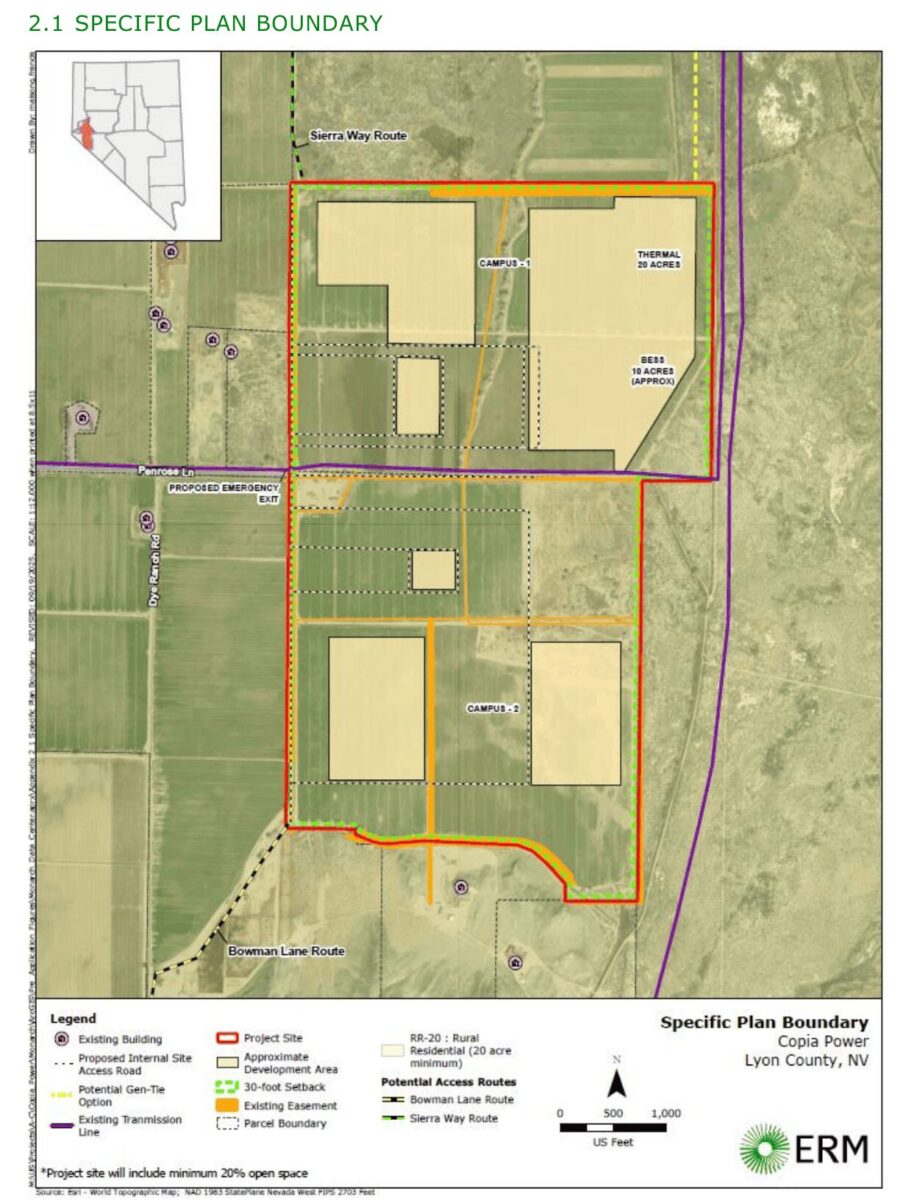
Copia Power proposed the 4.6 million-square-foot, 1,000-megawatt data center campus be built on roughly 505 acres in Mason Valley. The project also includes a 500-megawatt natural gas backup plant and battery energy storage system.

Dozens of residents spoke against the project during the meeting, continuing a pattern of opposition present at every stage of the approval process. A smaller group of building-trades and business representatives urged commissioners to approve it for the jobs and tax revenue it would bring.
Thursday's approval is only tentative. Copia still has to bring a final design back to the board before construction can begin, and the project still needs separate state approvals, including from the Nevada Division of Environmental Protection and the State Engineer. Copia also needs to complete its purchase of the land. Copia did not respond to a request for comment.
Read more: No land? No problem: Why many Nevada data centers don't own the land they're asking to develop
The vote follows a December vote by the board changing the site's land-use designation from "agriculture" to "specific plan" — the step required before a zone change could be sought — after tabling it in August 2025 over concerns about the project's primary access road. The Lyon County Planning Commission recommended the zone change, from rural residential to a planned unit development, in early July.
The pitch
Copia's presentation was led by Jeff Page, a longtime Mason Valley resident and former county manager who was retained by Copia to research the company and speak with other communities where it has built.
During board discussion, Hockaday — the lone no vote — said the vast majority of findings in development documents prepared by county staff seemed to be framed as positive when, in his reading, most of them cut against the project, including the finding on whether the design adequately serves public services, traffic and community enjoyment.
"I don't see any positives in the other ones," he said.
Commissioner Robert Jacobson flagged a discrepancy on water use, noting Copia's application materials estimate total water consumption, across all uses, at under 100 acre-feet per year, while the staff report separately cites a figure of under 800 acre-feet per year, a 60 percent reduction from current agricultural use on the site. Both describe the same air-cooled, closed-loop system.
Cullen McGinnis, volunteer engagement coordinator for the Sierra Club's Toiyabe Chapter, raised a related concern during public comment. He said Copia has been vague about exactly when its cooling system would shift toward more water-intensive operation and hasn't specified a temperature threshold for doing so. The staff report describes the system as not being "entirely" air-cooled, without elaborating further.
Commissioners also pressed on power supply. Hockaday asked how NV Energy could provide the full 1,000 megawatts Monarch has requested, noting other companies in the region have reportedly been told they can't get service until 2032.
A Copia representative pointed to NV Energy's most recent integrated resource plan, filed with state regulators in April. The representative said it commits the utility to supplying 2,550 megawatts to data centers over the next several years. Until Monarch's share of that capacity comes online, the company would self-supply power through its own gas plant and battery storage, phasing in the data center's buildout as grid integration happens.
Chair Scott Keller asked whether the gas plant, initially described as backup power only, would end up running continuously once connected. Copia said it could run 24/7, though it usually wouldn't.
Page has also worked with Lyon County commissioners, on behalf of Copia and EDF Winston Solar, regarding the county's renewable energy ordinance, according to county emails obtained through a public records request. That ordinance, passed in June 2025, set standards including setback requirements for solar and battery storage facilities in the county, while also adding a board-discretionary exception that allowed those setbacks to be reduced for planned unit development projects.
Opposition and support
Opposition centered on tribal consultation and the site's location. The Walker River Paiute and Yerington Paiute tribes have passed formal resolutions opposing the project, according to the Sierra Club's Toiyabe Chapter, which said afterward it believes Monarch may be the first data center proposed in Nevada to rely primarily on groundwater in an already over-appropriated basin. The chapter said in a statement it would "pursue every available legal avenue" to challenge the project going forward.
Other residents raised a wider range of technical and practical objections: the potential for waste heat — heat vented off the buildings as a byproduct of cooling the servers, which some worried could raise nearby temperatures and stress irrigation and fire risk — seismic and soil-liquefaction risk on the site, traffic during construction, and health effects from noise and air emissions. Several speakers argued inconsistencies in Copia's presentation undermined public trust in the project.
On the other side, Eloy Jara, business manager for Laborers' Local 169, said the project would bring significant construction work to the area. Kris Thompson, a former project manager at the Tahoe Reno Industrial Center in Storey County, told commissioners comparable data center campuses there generated millions of dollars a year in property tax revenue even after abatements.
Broader data center rules for Lyon County
Thursday's vote comes three days after the county held a workshop on its first data center-specific ordinance.
As drafted, the ordinance would apply to new construction, major expansions of existing data centers, and conversions of existing buildings. The ordinance will not apply to Monarch, County Manager Andrew Haskin confirmed, because the rules in place at the time a project is approved are what apply to it going forward.
Commissioners weren't satisfied with several of the draft's standards as written. Hockaday called the draft's 150-foot residential setback "absolutely unacceptable" at the workshop, comparing it to the county's solar ordinance's half-mile requirement, and argued data center setbacks should be doubled or tripled.
Cassinelli had separately pushed back on the ordinance's water-cooling language at the workshop, calling a "prohibited... but conditionally allowed" framing contradictory and proposing an annual water-consumption cap instead.
NV Energy Vice President Jeff Brigger told commissioners at the workshop that the utility has requests for roughly 22,000 megawatts of new demand statewide, most of it from data centers, against a 2025 peak demand of about 8,500 megawatts. He said a proposed cost-allocation framework would shift infrastructure costs onto large customers rather than existing ratepayers.
The board voted unanimously to send the draft back to staff for revisions, directing increased residential setbacks, revised water and cooling provisions and clearer guidance on the Nevada Division of Environmental Protection's role in air quality permitting. No date has been set for the revised draft to return.
This story was updated at 1:45 p.m. on 8/10/26 to clarify whether proposed ordinance would affect Monarch data center.
Support Independent Elections Coverage and Journalism in Nevada
You’ve enjoyed unlimited access to our reporting because we’re committed to providing independent, accessible journalism for all Nevadans.
But sustaining this work — informing communities, holding leaders accountable, and strengthening civic life — depends on readers like you.
Nevada needs strong, independent journalism. Will you join us?
A gift of any amount helps keep our reporting free and accessible to everyone across our state and funds our elections coverage.
Choose an amount or learn more about membership