
'Excessive' water users in Las Vegas are getting big fines. Now there's a lawsuit.

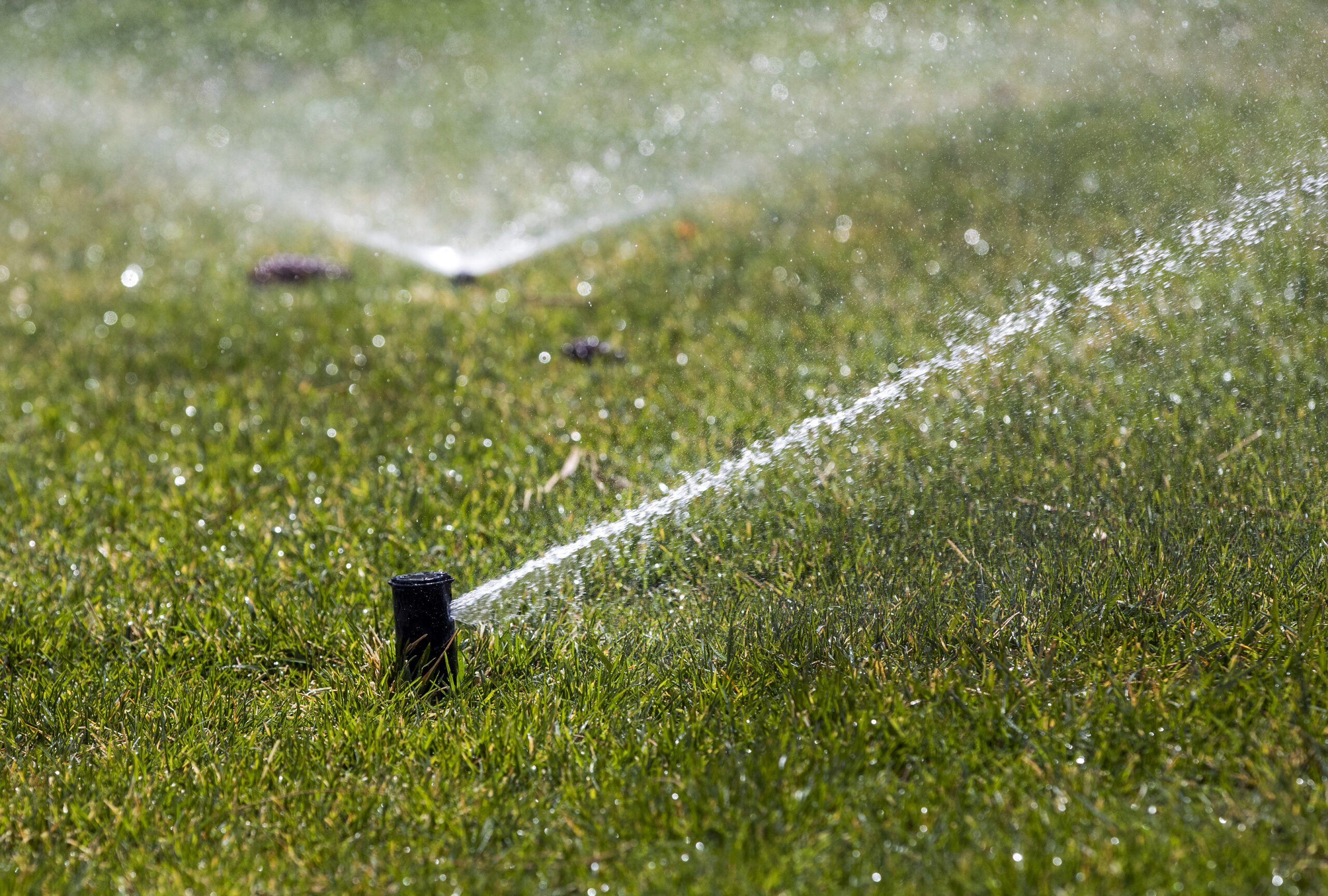
Anthony Marnell III, chairman and CEO of Marnell Companies and a fixture of the Las Vegas gaming industry — he developed the M Resort himself — had a leak in his pool.
He spent substantial funds to fix it, and the following year, his water use at his 1.31-acre Southern Highlands estate had dropped by nearly half.
His water bill didn't follow.
Marnell paid more in 2023's billing period than he had in 2022 with the leak still active — $1,500 versus $1,400 — because of a new $750 excessive use charge (EUC) penalty on his account.
Marnell isn't the only Vegas-area resident hit with the fee, and now he's the lead plaintiff in a class-action lawsuit filed last month challenging the legality of the charge, arguing it's structured more like an unauthorized tax than a cost-based fee.
Since January 2023, the Las Vegas Valley Water District has charged residential customers a flat $9 for every 1,000 gallons they use beyond a seasonal threshold — roughly five times the district's base tier rate, and nearly 1.5 times its top-tier rate. The charge has generated more than $96 million for the water district cumulatively since the charge took effect, according to the lawsuit, which cites the district's own budget workshop materials — a small fraction of the district's roughly $483 million in operating revenue last year.
Yet the district says excessive use fees and other strategies are now more necessary than ever as Nevada absorbs new federal cuts in its Colorado River allocation, which supplies about 90 percent of the district's water.
Read more: Nevada to lose a third of its Colorado River water over the next two years. What happens next?
The district said the charge has saved roughly 10,000 acre-feet of water annually since 2023 — savings it compared to the rising cost of new supply, pointing to a $750 million line item in its current capital budget for a 25,000 acre-foot project with the Metropolitan Water District. It said revenue also funds leak-repair assistance and conservation incentives for customers.
Others reject that framing. Laura McSwain, president of the Water Fairness Coalition, a nonprofit that has joined this and other lawsuits challenging water district policies, said Nevada is already using less than its Colorado River allocation and argued the district is taking credit for a good rain year, not its own policies.
"That's ridiculous," she said of the Colorado River justification. "They raised the white flag at the get-go. They offered up 50,000 acre-feet to give away in the negotiations when the negotiations were still going on. That is not a position of strength. There was no reason for us to give up any water. We should have been inspiring people to do more on their end."
What the charge does
The excessive use charge took effect in January 2023, following a public meeting and hearing the prior year, according to water authority spokesman Bronson Mack.
At an October 2022 hearing, water district General Manager John Entsminger told the board that the charge was designed to apply to roughly 10 percent of residential customers each season.
According to meeting minutes, only three members of the public addressed the proposal that day, and all three supported it — including a representative of the Las Vegas Democratic Socialists of America who submitted a petition with 80 signatures urging adoption.
The wave of opposition came after the charge took effect and residents began seeing the impact on their bills.
The average Las Vegas household uses about 10,000 gallons a month, or roughly 330 gallons a day, Mack told KTNV in 2023. The district's standard rate structure has four tiers, rising from $1.61 per 1,000 gallons for the first 167 gallons a household uses per day to $6.33 per 1,000 gallons above 667 gallons a day. The excessive use charge functions as an additional layer on top of that structure — what water district Deputy General Manager of Resources Colby Pellegrino called in essence, "a fifth tier."
Seasonal thresholds vary from about 14,000 gallons a month in winter to 28,000 gallons in summer. Anything above the threshold is billed at the flat $9 rate per 1,000 gallons used.
Asked how that $9 figure compares to the actual cost of delivering water, Pellegrino said in an interview that the district has no official published cost-of-service study.
"We make revenue projections based upon the rate structure that we have," she said, adding that she did not recall the specifics behind the original $9 calculation.
That gap matters to the lawsuit, which argues the water district's enabling statute only authorizes charges tied to the cost of providing service and a rate with no documented cost basis may exceed what the district is legally allowed to charge.
The district's own 2025 figures, provided by Mack, show the charge touches a relatively narrow slice of customers in any given month, even as tens of thousands are hit at least once a year. The district sent an EUC to 68,210 residential customers, or 16.5 percent of its residential base, in at least one billing period last year. Just 1,610 customers, or 0.39 percent, were charged in every billing period, and on average, 4.5 percent of residential customers were billed in any given month.
'Operation Armageddon'
The complaint cites internal water district and Southern Nevada Water Authority emails, which Samuel Castor — an attorney representing several of the plaintiffs — said were obtained through public records requests. The water authority is the regional wholesale agency that secures and treats the region's water supply, including its Colorado River allocation, before delivering it to the water district and other local utilities
The emails trace the charge's origins to 2021, when Southern Nevada Water Authority's Enterprise Conservation Division, not the water district itself, began developing what it called a seasonal excessive use surcharge.
When water district staff circulated internal bill-impact projections in July 2022, Doa Ross — currently the deputy general manager of engineering and operations for the water district and authority — responded that it was "going to be crazy," according to an email cited in the complaint.
Weeks later, a water authority staffer sent water district colleagues an email under the subject line "Operation Armageddon," proposing to extend a version of the surcharge to non-residential accounts — golf courses, resorts and other large commercial users — so that, in the staffer's emailed words, "only the resorts/golf courses will get hammered, not the higher users within other sectors."
The water district would not comment on the emails, citing the pending litigation, though Pellegrino confirmed the excessive use charge applies only to residential accounts.
Artificial turf and vanishing birds
Marnell is joined by four other named plaintiffs on the complaint. That includes Gina Kent, who cares for children with special needs requiring more frequent bathing and laundry, and who said a June-July 2023 bill topped $725 even though her usage that period was within her normal range. The difference was a roughly $325 excessive use charge.
Diane Henry, another plaintiff and a 35-year homeowner whose yard holds a certified National Wildlife Federation habitat designation, included as an exhibit in the complaint, says the water district offered no exemption process when she and neighbors sought one in 2024. She has since watched several bird species that used to visit her yard disappear, according to the lawsuit.
Pellegrino confirmed no conservation-based exemption process exists. "It's our job to charge everyone the same," she said.

Austin Okuda, a Vegas-area homeowner not party to the suit, described a similar arc in an interview with The Indy.
She and her husband bought their half-acre property in 2018 in part for the yard space — Okuda homeschools the couple's eight children, and they wanted room for kids to be outside. Water bills used to run $150 to $300 a month. After the excessive use charge went into effect, summer bills climbed toward $900, prompting the family to remove their grass entirely and install a pool and artificial turf instead.
"That was a lot of money to pay out over the course of five months, and then you just feel helpless," she said.
The legal theory
The complaint pleads nine causes of action, arguing the water district never received legislative authority to impose the charge. Central to that argument is Dillon's Rule, a legal doctrine holding that a government entity created by the state can only exercise powers the Legislature specifically gave it — anything not expressly granted, or clearly implied, is off-limits.
In 2015, Nevada softened that rule for cities, giving them somewhat broader authority. Water districts were not included in that change. The complaint notes the Nevada Supreme Court has already applied that standard against the water district once before, striking down a separate district connection charge in 1985 for imposing a charge that wasn't tied to costs specifically identifiable with the customers being billed.
One claim asserts the excessive use charge is an illegal fee, untethered from the actual cost of delivering water. The lawsuit contends that if it isn't a fee, the charge is an unauthorized tax — the complaint's theory being that any government charge is legally a cost-based fee or Legislature-approved tax, and the excessive use charge was adopted as neither.
Another, more novel claim alleges an unconstitutional consolidation of power, centered on John Entsminger's simultaneous leadership of both the water district and authority.
Kurt Schwabe, a professor of environmental economics and policy at the University of California, Riverside who is not involved in the litigation, offered a more granular read when asked about the $9 charge.
Converted into the units water agencies typically use, he said, $9 per 1,000 gallons works out to nearly $3,000 an acre-foot — the standard unit water agencies use to measure large-scale supply. By his estimate, that's actually higher than what economists call the "backstop price," the long-run cost of tapping the most expensive reliable water supply a region could fall back on if every cheaper option ran out, typically ocean desalination.
He drew a sharp distinction between a price justified by scarcity and one justified by cost of service — and said most public water agencies, at least in California, are legally limited to the latter. Schwabe found it notable that the water district had no published cost-of-service study behind its $9 figure, pointing to California rate-setting lawsuits in which agencies that did the work to tie tiered rates to actual current and projected costs have generally survived legal challenges, while agencies that didn't have lost.
Schwabe also pushed back on the assumption that high water use maps cleanly onto high income. He noted lower-income households with large lots or large families can also be big water users, so an average obscures a wider distribution.
High-income households do tend to have less elastic demand, which he said requires a bigger price jump to change behavior — but the $9 fee is a large enough number that it could plausibly cross that threshold, drawing a comparison to how U.S. drivers largely shrugged off rising gas prices until they crossed $4 a gallon.
Elsewhere in the valley
Nevada's tiered water-rate structure recalls a 2015 California case in which an appeals court struck down the city's tiered rates because it could not show each tier reflected its actual cost of service.
The underlying question there — whether a rate structure is cost-justified or closer to a penalty — is the same one now before a Clark County judge.
Neither of the water district's neighboring utilities has followed its lead. Henderson and North Las Vegas each confirmed to The Indy that they have no equivalent excessive use charge, and both cited the same authority — their city charters — as legal grounds to create one if they chose to. Henderson said its tiered rates already "encourage residential customers to conserve water and use this resource responsibly."
Support Independent Elections Coverage and Journalism in Nevada
You’ve enjoyed unlimited access to our reporting because we’re committed to providing independent, accessible journalism for all Nevadans.
But sustaining this work — informing communities, holding leaders accountable, and strengthening civic life — depends on readers like you.
Nevada needs strong, independent journalism. Will you join us?
A gift of any amount helps keep our reporting free and accessible to everyone across our state and funds our elections coverage.
Choose an amount or learn more about membership