
Las Vegas had only one trauma center. Why did the fight for another one turn ugly?


Clark County was set to get another Level I trauma-designated hospital in January of last year. However, during a board meeting, the Southern Nevada Health District struck down the proposal from the privately funded Sunrise Hospital and Medical Center.
In a state that falls near the bottom of national rankings for healthcare services, the Southern Nevada Health District's decision raised some eyebrows.
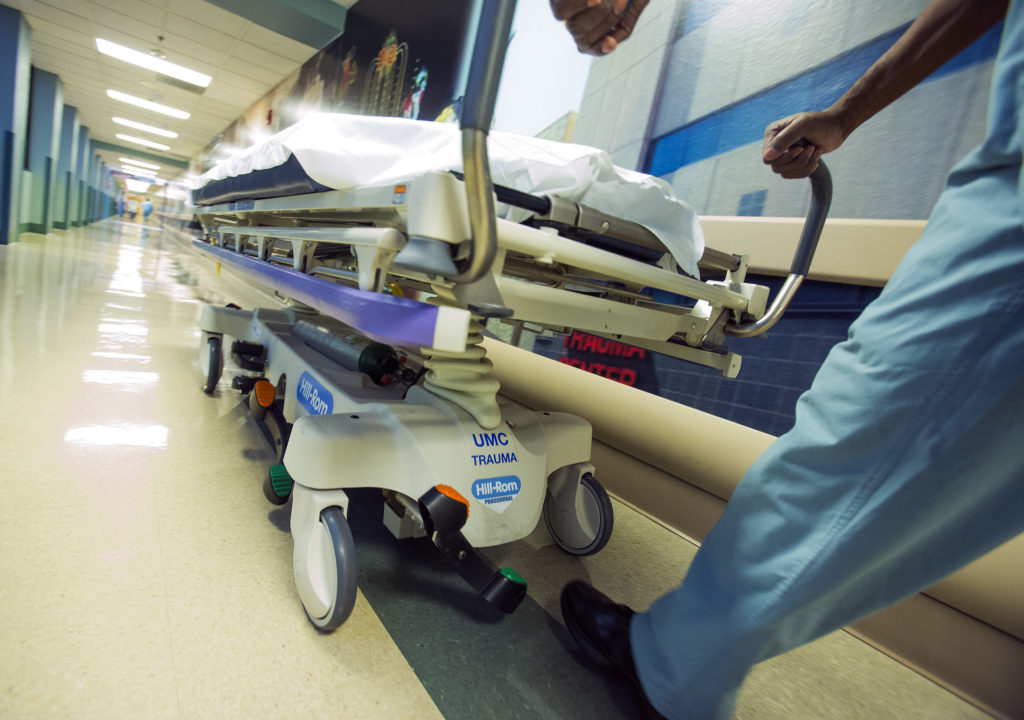
The designation is an important step for hospitals. It's a prestigious label that can bring funding, resources and added investment to a hospital, as well as the region, according to experts. However, the Southern Nevada Health District argued it was not necessary, leaving Las Vegas with only one Level I hospital: University Medical Center (UMC) Southern Nevada Hospital, which got that designation in 1998.
But this spring, after a judge's ruling — and intervention by the state of Nevada — Sunrise's trauma center was designated Level I, which means the hospital reached certain criteria such as around-the-clock trauma readiness, as well conducting trauma related medical research. It also means it can charge trauma activation fees, which are patient fees that are supposed to cover the added cost of a hospital operating at a trauma-ready level 24/7.
Supporters of the Sunrise designation — which includes lawmakers, law enforcement personnel and hospital staff — point to a patient-to-doctor disparity in Clark County, as well as a general healthcare shortage in Nevada as to why it is needed. Cities and metropolitan regions of a similar size to Las Vegas often have two Level I Trauma centers, sometimes more.
However, critics say there was no need for more trauma resources and that the proposal will harm the taxpayer-funded medical care provided by UMC away. In particular, they are worried about additional costs falling on community members who already pay for healthcare at UMC through their tax dollars. The parent company that owns the hospital, HCA Healthcare, has also been sued by physicians for overcharging patients, and executives from the company testified in front of Congress this spring on their pricing practices.
The Southern Nevada Health District is appealing Judge Michael Cherry's ruling that Sunrise should be allowed to continue its process to become Trauma I certified. If a judge rules in favor of the appeal, the region will once again be left with just one formally designated Level I trauma center.
Jennifer Sizemore, a representative of the health district, said the department could not comment on pending litigation.
The designation process
Up until recently, UMC was the only Level I trauma designated hospital in the region, and it continues to be a gold standard of medical care in the area, according to experts. However, that is unusual.
Many metropolitan areas that are comparable in size to Clark County's population — around 2 million people — including Houston, Austin, Portland and Salt Lake City, have two Level I trauma centers. Kansas City, which spans two states and is roughly the same size as Clark County, has four.
Other regions, such as Cleveland, have fought local hospitals from becoming Level I certified. The president and CEO of MetroHealth, a public hospital in Cleveland, said the designation of another trauma clinic in the region would "drive up healthcare costs" and "disrupt" the existing healthcare ecosystem.
The path for a hospital to become trauma certified starts with a verification from the American College of Surgeons (ACS) to ensure a facility is capable of providing the necessary services. Then the formal designation is a "geopolitical" process that falls to local municipalities.
After Sunrise received its certification in February 2024, it sought the approval of the Office of Emergency Medical Services, which recommended the designation, as well as the Regional Trauma Advisory Board and the Trauma Medical Audit Committee, which both ruled against the designation.
The final board meeting to hear Sunrise's trauma application in January last year was more than 3 hours long — 16 people spoke in favor of the designation and six argued against it. A recorded video shows a gaggle of medical staff in scrubs and doctor's coats in the room.
After public comment, the board struck down the designation in a 7-4 vote. The yes votes came from North Las Vegas Councilmember Scott Black, Boulder City Mayor Joe Hardy, gaming representative Scott Nielson, as well as Henderson City Councilmember Jim Seebock. The other seven members, largely comprised of Democratic elected officials, voted to deny the application. This included County Commissioners Tick Segerblom and Marilyn Kirkpatrick, Dr. Frank Nemec, Bobette Bond, a representative from the insurance agency connected to Culinary Union Local 226, as well as several local city council members.
That's when Sunrise filed a suit looking to overturn the health district's decision.
Todd Sklamberg, the CEO of Sunrise, said he was taken aback by the board's decision. He said there was no effect on the existing trauma system and pointed out that Sunrise had been meeting the requirements of a Level I center for the past four or five years without the designation.
"Having another center that is focused, committed and dedicated to providing the highest level of trauma care just enhances us as a community," Sklamberg said in an interview with The Indy. "I think we did our due diligence in demonstrating our need to the community."
Cherry ruled that the health district's decision against Sunrise was "speculation" and "conjecture" without concrete proof that the trauma Level 1 designation would hurt the hospital system in Clark County or UMC.
"The Board of Health's decision was based on hypothetical future impacts to UMC," Cherry wrote in his ruling. "Including speculative concerns about finances, patient volumes, or system destabilization, were not supported by data, expert analysis, or evidence demonstrating actual or likely harm."
After Cherry's ruling, the State of Nevada awarded Sunrise its Level I trauma designation.
"I was confused why it didn't pass that initial time"
More than a year later, some people still question the health district's initial decision, including Rick McCann, the former president and founder of the Nevada Association of Public Safety Officers. McCann has previously lobbied for HealtHIE Nevada and Spectrum Accountable Care Solutions, two private health care companies. A longtime advocate for law enforcement-related causes in Nevada, he spoke in support of the Sunrise designation in January.
"There is no question in my mind that this was a simple matter of competition," McCann said. "There was a huge pressure from UMC."

To McCann, the decision was a no-brainer. The hospitals' catchment areas — regions that designate where patients are sent to by emergency medical services if they are sick, hurt or injured — would not change with the designation, nor were there any immediate financial impacts to UMC, which he praised for its medical care.
"What's the problem with having more than one?" McCann asked in an interview with The Indy. "More is better, especially when I have a cop who's got a bullet in them."
Sklamberg pointed out that Sunrise has experience dealing with mass casualty events — the hospital treated more than 250 in the aftermath of the Oct. 1 shooting in 2017 when a gunman opened fire during a music festival in Las Vegas, killing 60 people and injuring 500 others.
Critics of the designation say too many trauma centers in the valley could mean that the existing medical system would be thrown off balance. A person with close knowledge of the designation, granted anonymity to speak freely about the matter, said that taxpayers in Clark County residents already paid for UMC, and that UMC was handling trauma patients without additional help.
"We don't have a trauma shortage … We already have the capacity. No one in the community asked for this," they said in an interview.
Trauma activation fees, costs that are added to cover the additional financial burden of providing trauma care readiness, can range from a couple thousand dollars to tens of thousands of dollars. Currently, UMC and Sunrise are allowed to charge the activation fees, and Sunrise was allowed to charge activation fees as a Level II hospital, though those fees are typically lower than those for Level I.
Stacy Sasso, executive director of the nonprofit healthcare group Health Services Coalition, said trauma centers are lucrative because of these fees and could undermine "the financial stability of existing trauma centers."
In an email statement, Mason Van Houweling, CEO of UMC, said that the private hospital group that owns Sunrise, HCA Healthcare, has "a disturbing pattern" of charging exorbitant fees and reiterated that there was no need for additional trauma centers in Las Vegas. Van Houweling said UMC's minimum fees started at $13,067.
According to reporting from the Miami-Herald, HCA has been known to charge high trauma activation fees, with some as much as $50,000, and studies show that Sunrise has historically charged higher fees than other private companies. In a statement, Regina Vaccari, a public relations executive speaking on behalf of Sunrise, said that the cost was not determined by Sunrise, or their trauma designation, but by a patient insurance plan.
"Government programs like Medicare and Medicaid determine how much they reimburse hospitals, and insurance plans negotiate rates," Vaccari said in an email. "In all events, including trauma, we are committed to maintaining financial assistance programs that make care accessible and affordable for our patients."
Medical landscape of Clark County
Nationally, Nevada ranks 46th in the nation in medical care, according to the healthcare nonprofit The Commonwealth Fund. Access to medical care in Clark County is improving, but it still lags behind other major metropolitan cities, according to Chris Cochran, a UNLV professor of public health.
"The old joke used to be, 'You know where you go to get the best healthcare in Las Vegas?' And they would say, 'McCarran Airport.'" Cochran said. "It's getting better, but you can't expect things to change overnight."

There are 14 hospitals of varying capacities and capabilities in Clark County, according to the American Hospital Directory. Some of them only have 10 beds, while others, such as UMC and Sunrise, have hundreds.
According to UNLV public health professor Neeraj Bhandari, there is little evidence that adding competition and a higher level of care to a region's medical landscape would hurt consumers in Las Vegas from what he's observed in other markets.
"A high ranking top-tier trauma center would be useful," Bhandari said. "If you have more choices available, you have more doctors and more providers available, more resources available, then not only would that demand be satisfied and more people would find services in a timely way, but I also think prices may come down."
However, Bhandari said the trauma level designation could impact UMC through Medicaid allocations. Sunrise currently has the highest number of Medicaid patients in the valley, according to Sklamberg, and Bhandari said that a Level I trauma designation could improve its standing with the federal government and increase subsidies.
Resources are scarcer than they were before — President Donald Trump's budget last year cut federal Medicaid funding by 15 percent, $1 trillion over the next 10 years. These cuts, alongside high inflation costs, could harm hospitals financially, according to the American Hospital Association.
With fewer resources comes increased competition and more jockeying for funds. According to Bhandari, hospital systems and medical care networks are similar to politics in some ways.
"There are all sorts of stakeholders pulling in different directions," Bhandari said. "Incumbents would always be interested in protecting their turf."
Support Independent Elections Coverage and Journalism in Nevada
You’ve enjoyed unlimited access to our reporting because we’re committed to providing independent, accessible journalism for all Nevadans.
But sustaining this work — informing communities, holding leaders accountable, and strengthening civic life — depends on readers like you.
Nevada needs strong, independent journalism. Will you join us?
A gift of any amount helps keep our reporting free and accessible to everyone across our state and funds our elections coverage.
Choose an amount or learn more about membership