
Nevada scientist among those logging 'lost' species as fewer endangered species are listed


Long before Las Vegas' Fremont Street was a gambling hub festooned with neon lights, Oreocarya insolita, a shin-high wildflower with white blossoms, bloomed each spring in the creosote scrub brush.
But a confirmed sighting of Oreocarya insolita hasn't been logged in the Las Vegas area for nearly 100 years. And as far as scientists know, it grows nowhere else in the world.
Across Nevada, 20 modern animals, from towering American bison to diminutive Pyramid Lake pebblesnails, that once called the region home have been extirpated. Some species continue to live in other areas; others were endemic to Nevada and are now extinct. Nearly 50 more of the state's plants and animals, listed on the federal endangered species list or recognized as threatened, aren't far behind. Another nearly 600 plants and animals have a half dozen or fewer population groupings in the state.
And, there could be more that scientists don't know about.
"Nevada is a state where so much exploration still needs to be done for biodiversity," said Matthew Forister, UNR entomologist. "We really don't know the status of Nevada's biodiversity in terms of which species are stable or extinct or lost."
Forister and a team of scientists from around the world are now tracking species that are on their way to being extinct — plants and animals they refer to as "lost," meaning they haven't been seen in years, but scientists aren't quite sure if they are yet extinct.
They're logging their findings in a new scientific journal, the Journal of Lost Species, co-edited by Forister. The goal is to document species that exist in a gray area between endangered and extinct, those that haven't been sighted in a decade or more.
"Everything deserves a memory," Forister said.
"Scientists from around the world are warning we're in an extinction crisis," added Noah Greenwald, endangered species co-director at the Center for Biological Diversity, a nonprofit focused on endangered species protections.
The journal's launch coincides with a record-low number of endangered species listings by the federal government. The U.S. Fish and Wildlife Service (USFWS) is in charge of deciding what plants and animals are placed on the federal endangered species list, but under President Donald Trump the service is on pace to list the fewest number of species since the Endangered Species Act was enacted in 1973.
The service is also undergoing massive staffing cuts.
Since 2024, Nevada's arm of the USFWS has lost 38 percent of its staff, according to data obtained through a public records request by the Center for Biological Diversity and shared with The Nevada Independent. The USFWS employed 134 people in Nevada in 2024, according to the center. It now employs 85.
Nationwide, the agency saw its staffing drop from 9,957 to 6,333 employees between 2024 and 2026, according to records from the center.
Combined, the staffing reductions and lack of endangered species listings represent a particularly dire time for plants and animals at risk of extinction in Nevada and nationwide, according to Greenwald.

Waiting for a listing
Since the Endangered Species Act was enacted under Republican President Richard Nixon, an average of 34 species has been listed per year by the USFWS.
The service identifies itself as providing "national leadership in the recovery and conservation of our nation's imperiled plant and animal species, working with experts in the scientific community to identify species on the verge of extinction."
Those efforts, according to the service, have "prevented the probable extinction of hundreds of species across the nation and contributed to the recovery of many others."
But two years into Trump's second term, his administration has placed just three species — all in the southeast — on the endangered list. Other species, such as Nevada's Fish Lake Valley tui chub, are still being considered.
During his first four-year term, Trump's administration protected 22 species.
"Only listing three species in almost two years is just drastically lower than any other administration," Greenwald said.
For comparison, Democratic administrations such as Bill Clinton's in the early 2000s listed well over 500 species in eight years. Even prior conservative administrations, such as George W. Bush's, listed 62 species in eight years.
"The process of having listings be so significantly slowed down, I think it is leaving room for a lot more ambiguity, and that's something that's not good for industry or for conservation," said Jamey McClinton, administrator of the Nevada Division of Natural Heritage. "That increases the imperilment for a lot of species that are being petitioned because they're living in limbo."
Nationally, there are about 400 species awaiting listing, including more than two dozen in Nevada.
According to the Division of Natural Heritage, Nevada is 11th in the nation for total species diversity. It also has the third highest number of species at risk, with more than 1,100 plants and animals considered at high risk of disappearing from the state.
Earlier this year, the federal administration issued a rule making it easier to destroy the habitat of an endangered species. Habitat destruction of the endangered Dixie Valley toad has been one of the core issues in discussions about geothermal development and groundwater pumping near the hot springs that support wetlands where it lives in Churchill County.
Another rule allows economic factors to be considered when designating critical habitat for endangered species.
Earlier this month, 20 states plus the District of Columbia — all but one led by Democratic governors — sued the Trump administration over its weakening of the Endangered Species Act.
'Not an anonymous disappearance'
As co-manager of the largest and longest-running butterfly monitoring study in North America, Forister, the UNR scientist, is used to studying species in states of decline.
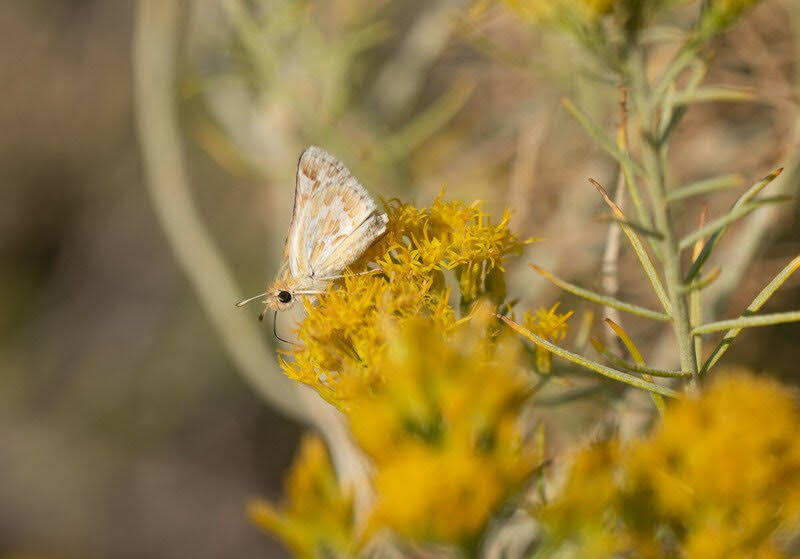
Some Nevada butterflies, such as the bleached sandhill skipper, are waiting for federal protections; others, such as the Mount Charleston blue butterfly, have already been listed. Research from the UNR lab has shown that butterfly populations across Nevada are declining by about 25 percent every 20 years.
"Then I had this revelation," Forister said. "We weren't doing enough to keep track of these things."
According to Re:wild, the conservation nonprofit Forister and other scientists are partnering with, there are more than 4,300 "lost" species worldwide that haven't been documented in a decade or more. It's these plants and animals the Journal of Lost Species will focus on.
"The number of species where we don't know where they are in the last 10 years is colossal," he said.
In the scientific community, there is an established protocol for documenting new and extinct species, Forister said. But lost species exist in a sort of gray area. Historically, scientists put species that haven't been observed in a long time into a "bin" of being data deficient.
"It's really different in terms of motivation and communication in calling something 'data deficient' than to call it 'lost,'" he said. "If it's lost it's like, 'Holy cow, let's go look for it.' 'Data deficient' is important, but it is not that inspiring."
"Even if it goes extinct, we've done the right thing and documented it. It's not an anonymous disappearance."

'Extinct' designation carries regulatory implications
In Nevada, some species, such as the passenger pigeon, were extirpated from the state decades ago — the last recorded observation of a passenger pigeon in Nevada was in Humboldt County in 1867, and they went extinct nationally in the early 1900s.
Most of the extinct species in Nevada — the Raycraft, Ash Meadows and Pahrump ramp poolfish, for example — disappeared around the 1940s and '50s because of groundwater pumping, habitat destruction and the introduction of nonnative species.
Other species, such as the humpback chub, Chinook salmon and Colorado Pikeminnow, disappeared decades ago when dams within and near Nevada were constructed. The Owyhee Dam in eastern Oregon, for example, was the "final straw" for Chinook salmon making their way into Nevada, McClinton said. The Hoover Dam, likewise, was the nail in the coffin for the Colorado Pikeminnow and humpback chub's existence in Nevada.
But other species, such as the Great Basin ramshorn, a small springsnail, were extirpated from the state as recently as the early 2000s, according to McClinton. The Center for Biological Diversity in early 2024 petitioned the USFWS to list the limited populations still found in a handful of locations in other states as endangered, but the agency has not yet done so.
Even when a species is believed to be gone, it takes a long time for biologists to categorize it as extinct, McClinton said, because the designation carries regulatory implications.
"Both the state and the feds will remove species from their protected lists if they are declared to be extinct," she said. "This is exactly where [the Journal of Lost Species] comes into play."
The journal will give species that haven't yet been declared extinct a space to exist — even if it's just online.
"Biological diversity is inherently precious and valuable. These species evolved to survive in these unique habitats with no interference from humans. They're part of what gives these places their unique character," McClinton said. "Part of what makes it so fun to recreate in Nevada is never knowing if what you're looking at is globally unique."
Support Independent Elections Coverage and Journalism in Nevada
You’ve enjoyed unlimited access to our reporting because we’re committed to providing independent, accessible journalism for all Nevadans.
But sustaining this work — informing communities, holding leaders accountable, and strengthening civic life — depends on readers like you.
Nevada needs strong, independent journalism. Will you join us?
A gift of any amount helps keep our reporting free and accessible to everyone across our state and funds our elections coverage.
Choose an amount or learn more about membership