
Rural Nevadans hate data centers. So why are their local governments doubling down on them?

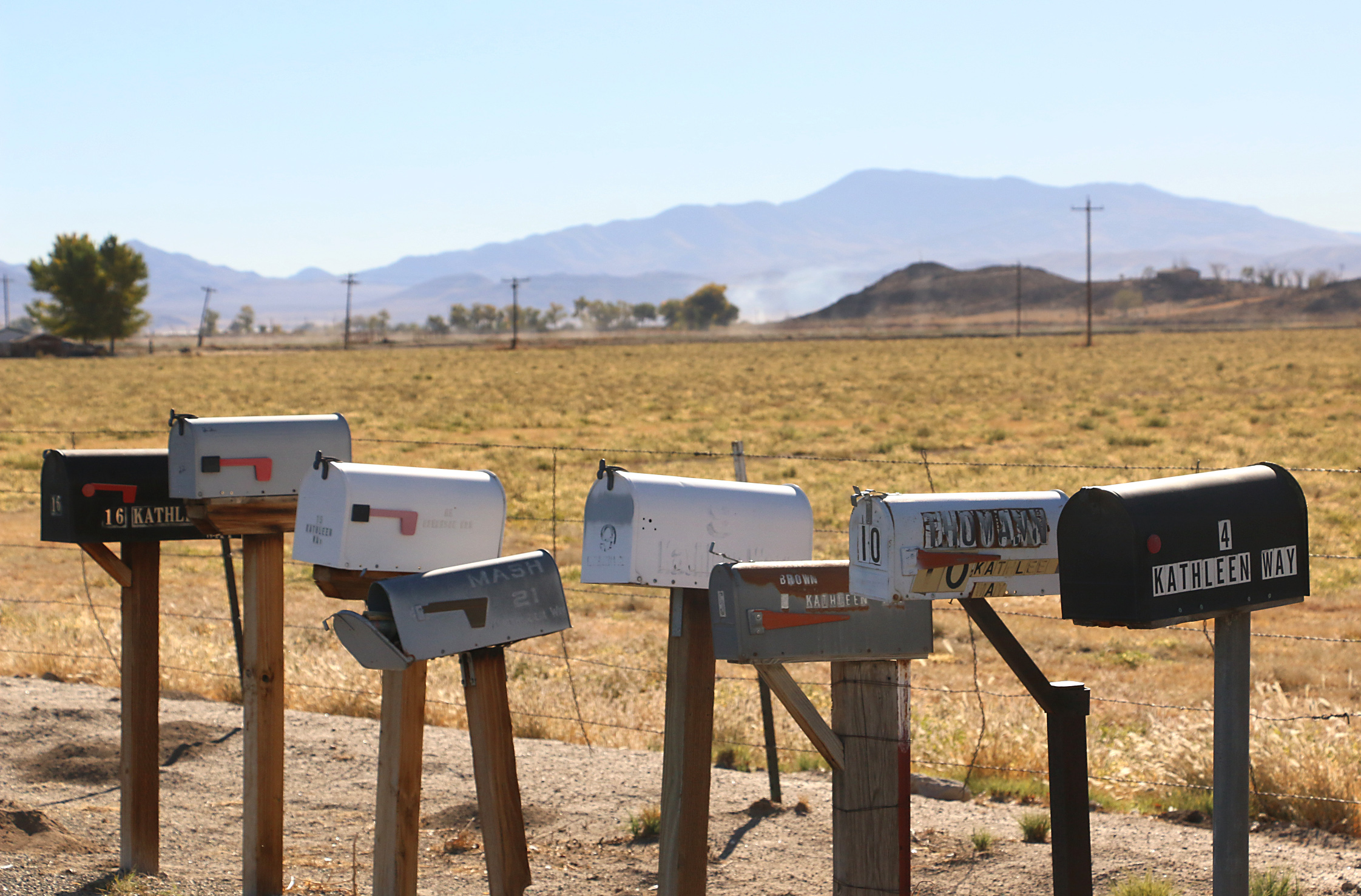
The debate over where data centers should be built in Nevada has exploded over the last year, with people across the state uniting against their construction in neighborhoods and urban areas.
So when Lyon County's board of commissioners earlier this year advanced a company's request to move forward with construction of the Monarch Data Center on 500 acres of farmland just outside the county's seat, it raised a new question in the argument over where data centers do and don't belong.
Should they be built on land historically dedicated to agricultural production?
Rural Nevadans have overwhelmingly turned out at public meetings to say "no."
"We don't want a data center here," David Janakos told the Lyon County commissioners in August. "Our town of Yerington has been lined up for a project we've never asked for."
Until recently, Nevada's data centers have for the most part been tucked away in industrial parks. But research compiled by the Pew Research Center shows that more than two-thirds of roughly 1,500 data centers planned nationwide are slated to be built in rural areas and that nearly 40 percent of planned data centers are in counties that currently don't have any.
In counties that are struggling financially, this could mean new revenue streams.
"If you look at the tax revenue an industrial property brings in, it's significant," Lyon County Manager Andrew Haskin said.
Doug Busselman, government affairs director at the Nevada Farm Bureau, said the Lyon County's board of commissioners' move to allow construction of a data center on farmland is an outlier — for the moment. But it doesn't mean Nevada's farmland and ranchland aren't vulnerable to being snapped up for development by data centers or other large industries.
"There's no such thing as a good data center and no such thing as a bad data center," he said. "It's making sure you put the data center where it belongs and it fits in with the community."
Lyon County is already pivoting from an economy based on agriculture to one centered more on industry. Yerington, the county seat, is an agricultural hub and home to one of the nation's leading onion producers, but in Fernley, the county's largest city, many residents commute to work at the nearby Tahoe-Reno Industrial Center in adjacent Storey County.
Now, the county is on tap to have eight data centers built within its borders over the next several years, in part because of other infrastructure and industry development.
The broader Northern Nevada region is ranked as one of the top locations in the world for data center construction. The massive Greenlink transmission line is being built through Lyon County, and NV Energy is constructing a substation as part of the project that is poised to be one of the largest in the world.
Data center developers are looking to capitalize on that development, but it creates a tension between agriculture, industry and residents — a tension that has played out time and time again, according to Fred Steinmann, director of UNR's Center for Economic Development.
"This is kind of the latest iteration of that."

Money 'moves the needle in rural communities'
Long a bedroom community and agricultural hub, Lyon County ranks dead last in the state for revenue per capita.
According to data collected by Lyon County's comptroller, industry-heavy counties such as Storey and mining-heavy counties such as Eureka generate roughly 20 times the revenue per resident that Lyon County does. Even counties closer in population to Lyon outpace it — Nye County and Carson City generate two to two-and-a-half times the revenue per resident that Lyon County does.
Nevada limits how much property tax can grow year over year. Because counties' revenue from farmlands generally comes from property taxes, it stifles the coffers of counties such as Lyon that have historically been driven by agriculture. Industry, however, not only pays property taxes, but sales and use taxes as well as business license fees.
As development has proliferated around it, Lyon County has surged to become the third-largest county in the state by population. And as people move into the county, they require resources, whether that's maintained roads or law enforcement.
"If residents aren't willing to pay 100 percent of the costs, you need industry to generate those revenues," Steinmann said. "Growth does not pay for itself."

Patrick Donnelly, Great Basin director for the Center for Biological Diversity, said the data center surge in rural communities shows that developers are looking to capitalize on "small rural communities that are heavily influenced by relatively modest amounts of money. These are communities that are not used to infusions of millions of dollars."
Steinmann said the issue is more nuanced.
The same amount of money "moves the needle in rural communities" much further than it would in an urban area, he said.
Like in other industries, data center developers are looking for reasonably priced land that has access to the grid, transportation infrastructure and an available workforce, Steinmann said.
Lyon County checks a lot of those boxes.
It's strategically located near the Tahoe-Reno Industrial Center and has access to Interstate 80 and Highway 50, both of which run east to west, and Highway 95, which runs north to south.
"Very few counties can point to all four directions," he said. "Lyon County is just kind of strategically positioned to be of interest to industry."
According to a press release from Tract, a developer of data center campuses that last year acquired more than 1,000 acres of land in Lyon County, the Northern Nevada region "a compelling growth alternative to the Bay Area. Growth in the market is now starting to expand outward from the core data center activity in the Tahoe Reno Industrial Center."
That means moving into areas such as Lyon County, which has long struggled to recover from the 2008 recession. In 2011, Lyon County was ranked nationally as the third most economically depressed county of its size in the nation. That year, the county also had the highest unemployment and foreclosure rates in the state.
"Lyon County works hard to create a business-friendly environment that makes it easy and attractive for companies like Tract to locate here," Haskin said in Tract's press release."
But not everyone feels that way. When Lyon County commissioners voted to move forward with permitting for the Monarch Data Center, roughly 200 residents showed up, largely voicing their disapproval. Many of their concerns were over water and power usage.
NV Energy has already acknowledged it doesn't have enough power lined up to support the influx of data centers coming to Nevada.
And in 2023, data centers used an estimated 17.43 billion gallons of water, according to a 2024 UC Berkeley report drafted for Congress. And, the report cautioned, that number is likely to double by 2028.
But, data center proponents note, that's substantially less water than agriculture.
In 2023, American agricultural producers consumed 81 million acre-feet of water, according to the U.S. Department of Agriculture. One acre-foot of water is equal to roughly 325,851 gallons of water.


'There are two sides to this story'
Just 2 miles from the 500 acres outside Yerington slated to become the Monarch Data Center, NV Energy is in the process of building its massive Walker River Substation as part of its controversial Greenlink high-voltage transmission line that will span the state. Nearby plans also include a sprawling series of utility-scale solar projects, including Winston Energy, a 400-megawatt solar and 400-megawatt battery storage project.
The area is an "energy hub," Michael Paul, permitting manager at Copia Power, the company seeking to develop the 500 acres in Mason Valley, told the Lyon County Planning Commission earlier this year.
In a December email to Lyon County Commissioner David Hockaday, Brian Masini, owner of the 500 acres, wrote that, "From the day the new substation and greenlink announced their projects, things changed in the area. For years we have received inquiries from Solar, but then both AI and developers began to show interest."
That interest, Masini wrote, was tempting because, "at this point in time the old way of farming is just not economically feasible in Mason Valley."
Mason Valley, and nearby Smith Valley, previously faced curtailment orders by the state, although they were eventually litigated in favor of the farmers.
"There are two sides to this story," Masini wrote in his letter. One "that wants progress in economic sustainability, better schools, better hospitals, better recreation facilities, and opportunities for everyone."
The other side, he wrote, "just says 'no.'"
Support Independent Elections Coverage and Journalism in Nevada
You’ve enjoyed unlimited access to our reporting because we’re committed to providing independent, accessible journalism for all Nevadans.
But sustaining this work — informing communities, holding leaders accountable, and strengthening civic life — depends on readers like you.
Nevada needs strong, independent journalism. Will you join us?
A gift of any amount helps keep our reporting free and accessible to everyone across our state and funds our elections coverage.
Choose an amount or learn more about membership