
'They're trying': State hopes to reverse course on poor pregnancy care. Progress is slow.

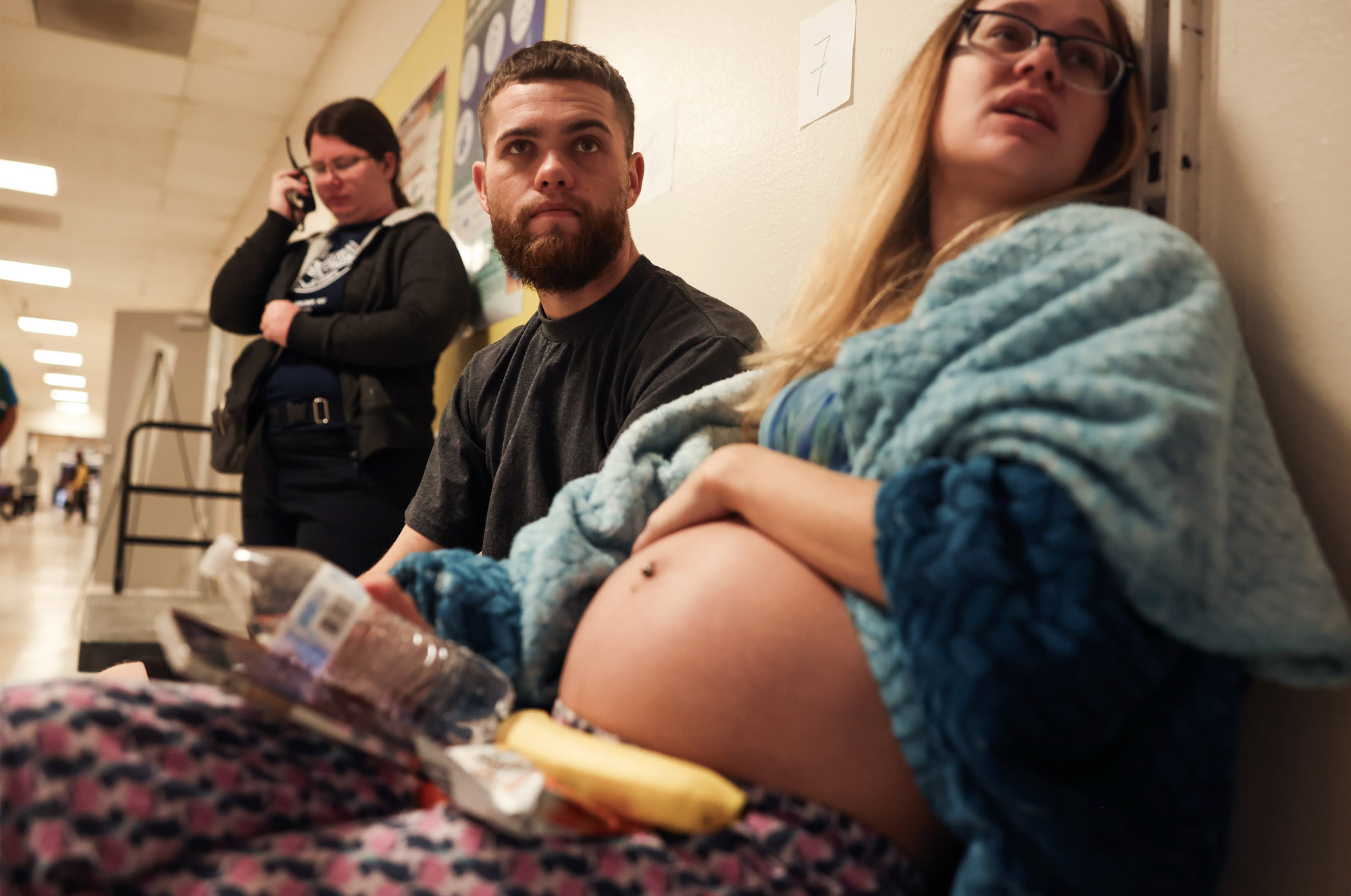
Haley Nartker gave birth to both her children at home in Las Vegas, flanked by midwives. It wasn't her original plan, she said, but she found herself feeling dismissed by the obstetrics doctors she saw during her first pregnancy.
"I became kind of cynical of obstetrics care in Las Vegas," the 24-year-old mother of two said. She said she believes in the medical establishment and vaccines but that she chose "this more alternative thing" for her pregnancies because she was so disillusioned after multiple visits to different doctors.
Nartker isn't alone. Nevada has particularly weak perinatal care — health care that supports women before, during and immediately after pregnancy. This kind of care improves the chances of having a healthy pregnancy and baby.
But Nevada's rates of maternal mortality and preterm birth, meaning birth before 37 weeks, are on the rise, at the same time that rates of postpartum checkups and breastfeeding are declining.
These trends aren't Nevada-specific. Data released last month by the Centers for Disease Control and Prevention (CDC) shows that across the U.S., more women in 2024 than in 2021 reported receiving care later in pregnancy or not at all. Getting late or no prenatal care raises the risk of maternal mortality, which is twice as likely among Black mothers than white mothers in Nevada.
Doctors and advocates who spoke with The Indy said pregnant women in the state suffer from a particularly complex set of issues. One in every two births in the state are covered by Medicaid. Nearly half of its counties are maternity care deserts, a classification based on the number of birthing facilities, obstetric providers (or OB-GYNs) and the share of insured women.
Experts say these poorer outcomes are in part because the state was so late in coordinating a strategy to boost access to perinatal care. The result is a disjointed approach that contributes to the state's rural-urban disparities in care, its doctor shortages and its lack of protocols on perinatal health treatment.
"There's a lot of really good people in the state," said Dr. Brian Iriye, managing physician at Las Vegas' High Risk Pregnancy Center and former president of the Society for Maternal-Fetal Medicine. "They're trying," he said, but added that Nevada is so far behind and its approach so disorganized, it's hard for the state to make up the difference.
Late to the game on perinatal care
While acknowledging Nevada has been slow to act on the lack of perinatal care access, many advocates are grateful current leaders are being more proactive.
The Legislature's Health and Human Services Committee recently focused an interim meeting on perinatal care, which Assm. Tracy Brown-May (D-Las Vegas), the committee's chair, said was a sign of how momentum was building on the issue.
Meanwhile, Nevada's Medicaid program is expanding its perinatal health coverage to align with practices common in other states. These changes included expanding postpartum health coverage to 12 months after giving birth, adding enhanced case management for high-risk pregnancies and covering certain elected cesareans.
Nevada Medicaid administrator Ann Jensen said the state is also working on getting federal approval for presumptive eligibility for pregnant women, meaning women can receive care before their Medicaid applications are processed, a policy already followed by 36 states.
"It's a very slow ship to turn," Jensen said. "I think we're taking the right steps."
Nevada started examining perinatal outcomes such as maternal mortality "not that long ago," said Dr. James Alexander, chair of the OB-GYN department at UNR School of Medicine. That lag has made it difficult to spot trends in care.
Today, all 50 states have maternal mortality committees, which review mothers' deaths within one year of giving birth. But Nevada's was one of the last to launch, formed by the Legislature in 2019. The equivalent committees in neighboring states such as California, Utah and Arizona launched in 1995, 2006 and 2012, respectively.
"Is it that there's more issues there than we ever realized? Or is it that there is a very real increase in rates?" asked Alexander, who's a member of Nevada's committee. "We never really looked systemically before."
Along with the state's slowness in setting up infrastructure responsive to perinatal health needs, experts say the state lacks a central authority handling issues related to maternal and infant health care.
"There's a lot of different opportunities, but, boy, they're not always synthesized or coordinated," said Alexander.
At its maternal health-focused legislative meeting last month, lawmakers heard a presentation from a Department of Public and Behavioral Health representative who named at least 20 programs in an overview of the state's strategy on perinatal care.
Shayla Holmes, Lyon County's director of public services and a rural representative on a state board known as the Perinatal Health Initiative, said it's this sort of approach that has caused her to notice communication lapses across agencies and programs. The state's perinatal leaders are great, but "when you start working with different divisions at the state, they frequently are unaware of what the other ones are doing," said Holmes. "Stuff ends up getting piecemealed out."
Advocates from across the health care field have repeatedly called for Nevada to form a Perinatal Quality Collaborative, a state-level network of leaders in perinatal and maternal health who oversee health care processes, help standardize care and evaluate what changes are needed to prevent infant deaths.
It's one of just three states nationwide without its own collaborative. North Carolina and Rhode Island formerly had collaboratives, but active operations are currently paused for both due to funding reductions and organizational shifts.
Despite being listed as existing on the national network's website, Division of Public and Behavioral Health spokesperson Daniel Vezmar confirmed to The Indy in a written statement, "Nevada does not currently have a Perinatal Quality Collaborative. Numerous statewide groups have identified this as a key need in the state."
States with quality collaboratives have seen dramatic improvements in infant and maternal outcomes. California, for instance, saw a 12 percent reduction in severe complications related to preeclampsia — a life-threatening blood pressure disorder associated with pregnancy — in a yearlong program run by its collaborative. Similar progress has been achieved by the groups in Louisiana, Colorado, Illinois and Florida.
Iriye said he's testified at the Legislature four times to call on Nevada to create a collaborative, including most recently in February. Lawmakers pledge to create one every time, he said, yet never do. "I'm hopeful, but I was hopeful the last three times, too," he said.
In the 2023 legislative session, Assms. Michelle Gorelow (D-Las Vegas) and Clara Thomas (D-Las Vegas) introduced AB179 to create a statewide Perinatal Quality Collaborative. It died in the Assembly's Ways and Means Committee. Gorelow told The Indy she hadn't received a satisfactory explanation from her former peers as to why.
Doctor shortages another problem
An additional problem for the state's perinatal health care system is provider shortages. Dr. John Packham, a professor at UNR's medical school and co-director of the university's Nevada Health Workforce Research Center, said shortages are getting worse as doctors age into retirement.
Nevada ranks 46th nationwide for its per-capita share of OB-GYNs, with about 54 providers per 100,000 residents in 2025 compared to a national average of about 80 providers. It also has fewer doctors than the rest of the nation in nearly every pregnancy-related field, from midwives to lactation specialists.
Packham described doctor shortages as another example of Nevada's delays and struggles to build out a well-equipped health care system, particularly in specialized medicine.
"It's endemic across health care in Nevada," he said, blaming this in part on the state's shaky medical education system.
For decades, UNR was home to Nevada's sole medical school. Touro University in Henderson opened an osteopathic-specific medicine school in 2004, and in 2017, UNLV opened the state's second general medical school.
Research shows doctors are more likely to remain in the state where they study medicine or complete their residency, making it especially important for Nevada to build out medical training infrastructure.
The shortages are especially dire in rural areas, in a state where a 2023 March of Dimes report found 1 in 10 women have no birthing hospital within 30 minutes.
"The population in rural areas is increasing, but the providers and the services haven't increased at all," said Holmes, the Lyon County public services director.
Advocates are hopeful a federal grant to expand rural health, passed through last year's One Big Beautiful Bill Act, could mitigate these issues. In December, Gov. Joe Lombardo, a Republican, announced Nevada would receive $180 million in 2026 in the first year of the five-year grant.
Applications are open for projects using the funding, but the state's outlined goals for the money include boosting recruitment and establishing a rural physician residency program.
And just last month, a joint OB-GYN residency program run by UNR and Renown Regional Medical Center received accreditation from the national graduate medical education board.
The four-year program will begin supporting three residents in July 2027. Alexander, the UNR professor, heads the program and is hopeful about future expansion. But he said he knows it is still an inadequate step.
"We're just desperate for providers, for physicians, for health care for women, especially in rural areas but also all throughout our state," Alexander said.
Support Independent Elections Coverage and Journalism in Nevada
You’ve enjoyed unlimited access to our reporting because we’re committed to providing independent, accessible journalism for all Nevadans.
But sustaining this work — informing communities, holding leaders accountable, and strengthening civic life — depends on readers like you.
Nevada needs strong, independent journalism. Will you join us?
A gift of any amount helps keep our reporting free and accessible to everyone across our state and funds our elections coverage.
Choose an amount or learn more about membership