
As Las Vegas morphs into a major league city, sports philanthropy ramps up too


MGM Resorts International CEO Bill Hornbuckle didn't have to make an over-the-top sales pitch to convince Las Vegas Raiders owner Mark Davis to donate toward development of Southern Nevada's first comprehensive stand-alone children's hospital.
"I laid it all out on how there's a desperate need in this community," Hornbuckle said of his lunch meeting this summer with Davis. The gaming executive and his wife, Wendy, agreed a year ago to oversee a philanthropic outreach to find donations for the $1 billion hospital being built by Intermountain Health.
"I went through some of the numbers. I explained how we have to send 2,000 kids everywhere out of state for treatment because we don't have a facility like this," Hornbuckle recalled. "Mark literally said, 'Stop. I'm in.'"
A few weeks later, the Raiders announced a $25 million gift, the largest philanthropic donation in the National Football League team's history. Davis and fellow owners Egan Durban and Michael Meldman each contributed $5 million. The team provided $10 million, the largest single charitable contribution in team history.
For Southern Nevada's charitable community, the emergence of professional sports adds a new player to the lineup.
A few weeks after the Raiders' announcement, Intermountain announced gifts of $50 million from developers Heidi and Larry Canarelli and a $150 million pledge from philanthropists and venture capitalists Felicia and Ben Horowitz.
Hornbuckle jokingly compared the Raiders' $25 million pledge to a football game's opening kickoff.
On Oct. 26, during a red-carpet event that featured a drone show and fireworks, ground was ceremonially broken for the hospital site inside the Harry Reid Technology Park. The facility is expected to open in 2030.
Hornbuckle said hospital backers can now turn their efforts toward funding research and treatment programs, while seeking grants and other donations to hire doctors and other specialists, "the kinds of things first-class children's hospitals do. We're in that league already."
Bob Brown, CEO of Opportunity Village, one of Southern Nevada's most well-known charitable organizations, said an expanded donor network fills gaps in funding for the organization that serves adults with intellectual and developmental disabilities.
He said the Las Vegas business structure has changed from its days as a casino-centric community where the gambling halls were operated by individual investors and donations flowed directly to nonprofits. Today, casino ownership, for the most part, is by corporations with few individual gaming operators.
"You have to look at the market. Nevada ranks 49th out of the 50 U.S. states when it comes to charitable giving," Brown said, citing a study by WalletHub that showed the state only ahead of New Mexico. "The sports franchises have all made a huge difference. It's great, but is it enough? No, it's never going to be enough."
Brown said Opportunity Village and other charities are wise to make connections with the owners and top officials for the sports franchises. For example, Athletics President Marc Badain is a member of the organization's board, a position he also held when he previously worked with the Raiders.
Davis, he said, provided a "substantial donation" to Opportunity Village for the organization's Betty's Village project in northwest Las Vegas. During the Golden Knights' inaugural season, the team donated $1 from every season ticket sold to Opportunity Village.
"It was a great way to enter the market," Brown said.

'We're their team'
Raiders President Sandra Douglass Morgan said in an interview that the NFL team has taken community giving efforts beyond those spelled out in the legislative mandated agreements attached to SB1, which provided $750 million in public funding for Allegiant Stadium. The donation to Intermountain, a company whose name is on the team's training facility and corporate offices in Henderson, was separate from other fundraising and community events produced annually by the team.
"Mark and I obviously talk about business but one of his mandates when he hired me was to make sure Las Vegas knows we're their team," Morgan said. "He's very passionate about the Raiders being involved in the community."
In less than a decade, Las Vegas has become home to three major league professional sports teams — Raiders, the National Hockey League's Vegas Golden Knights and the WNBA's Las Vegas Aces. A fourth, Major League Baseball's Athletics, will arrive in 2028. Meanwhile, the NBA is in the final stages of awarding Las Vegas an expansion team.
A representative for the Aces did not respond to a request for comment.
The Raiders and Golden Knights — which is now in its 10th season — have established community support programs with designated mandates.
Kim Frank, president of the NHL team's charitable foundation, said the organization focuses on three "core pillars" — education and youth sports; military and first responders; and health and wellness — in order to avoid redundancy and streamline the process.
The Knights get a multitude of requests, but the foundation created a structure that prioritizes initiatives so they align with the specific categories. For example, homelessness is categorized under health and wellness.
Last year, the Knights foundation gave $2.5 million to more than 120 charities and organizations.
"The arrival of the Raiders, the A's and the NBA team, as well as the Aces has broadened the scope for charitable efforts in the region," Frank said. "More teams can only help. It works better for the community."
Until the Raiders arrived, the Knights had Southern Nevada to itself.
"We were not only introducing ourselves to help the community, but also what we are as a sports team and what pro sports is all about," Frank said.
In 2025, the Raiders provided more than $2.4 million in charitable contributions through direct corporate giving, in-kind ticket donations and signed memorabilia for local and national nonprofit organizations to be used in various fundraising efforts.
Morgan said special events, such as the annual Silver & Black Gala, which is held on the Allegiant Stadium playing field, raised $3 million last year with 100 percent of the proceeds funding mental health services, programs and resources directed toward Southern Nevada youth organizations.
She said the $10 million donation for the hospital was the largest ever given by the team.


A's on deck
Community benefits were a key component of legislative approvals in 2016 and 2023 of $750 million in public money that went toward the $1.9 billion Allegiant Stadium and up to $380 million for the $2.1 billion A's ballpark, respectively.
The teams negotiated lengthy community benefits agreements with the Las Vegas Stadium Authority, which described areas to be included for monetary and in-kind contributions that support philanthropic efforts throughout Clark County. Efforts at the baseball stadium will kick in once it opens in roughly 17 months.
The efforts called on the teams to target all areas of charitable and civic endeavors.
For A's Vice President of Community Stephanie Gaywood, the immediate goal is establishing roots in Las Vegas prior to the team's arrival in 2028. Gaywood has been with the A's since 2018 when the team was Oakland.
While she is building a community presence in Las Vegas, Gaywood is also handling community efforts in Sacramento, where A's are playing one more season.
"Our goal is to integrate into the community fabric authentically," Gaywood said. "We could do a very large gift. But for us, it's truly grassroots. We're aligning ourselves with our fans and with the community so they feel like they are a part of the process."
She said the A's arrange for players to appear around town, such as during June when the team played six regular season games at Las Vegas Ballpark and in May when they will host six more games at the 10,000-seat downtown Summerlin stadium.
The A's also have been working with the Public Education Foundation since 2023 on different events as a way to establish ties and connections to the Las Vegas Valley.
The team celebrated the 2026 Little League World Series championship won by Henderson's Paseo Verde Little League, bringing the players out to Las Vegas Ballpark and sponsoring other celebrations in Southern Nevada.
"For now it's just about building relationships, but building the right relationships and earning the trust of our nonprofit partners by doing community work for them," Gaywood said.
It's expected the stadium, which will host at least 81 A's home games a year, will also serve as a venue for concerts and special community events.
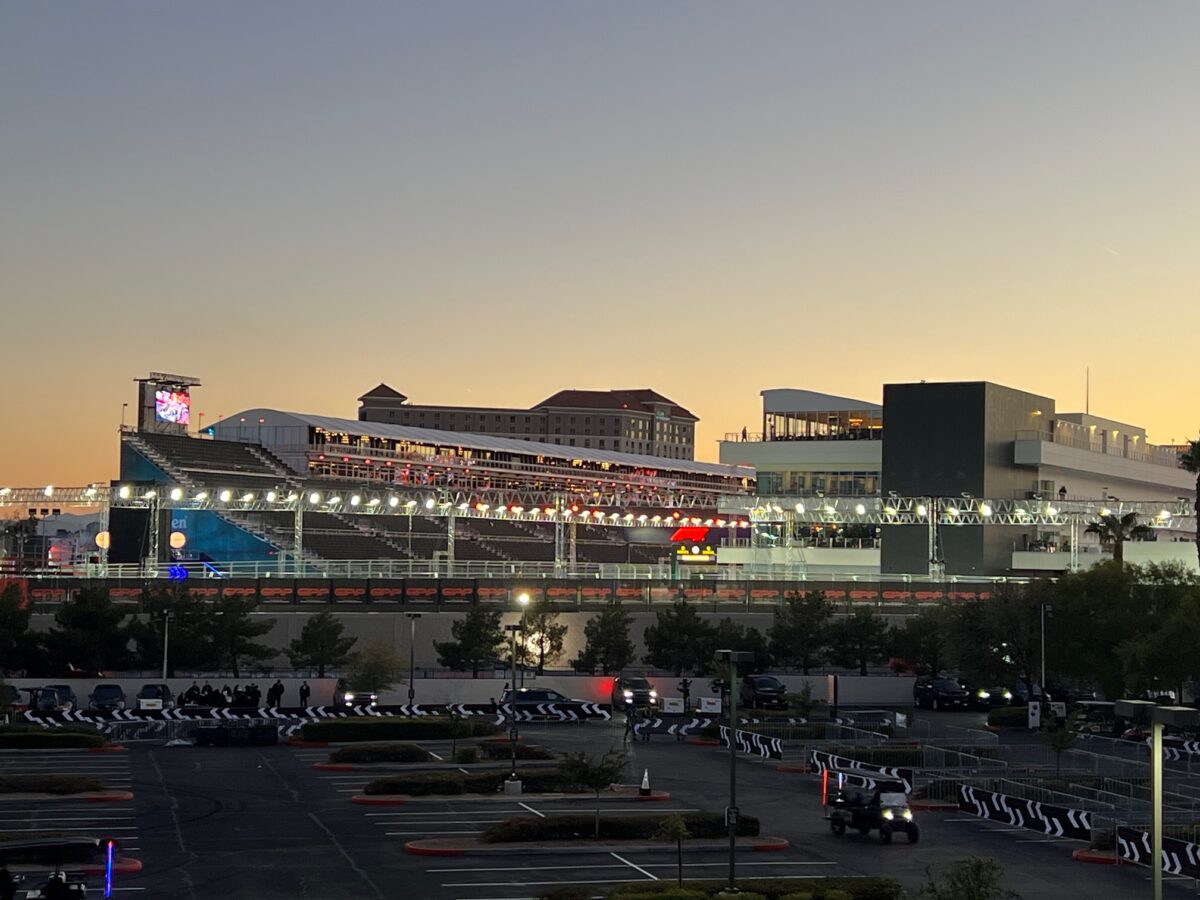
Grand Prix Plaza gets into the game
This week, the Formula One Las Vegas Grand Prix marks the fourth straight year it takes over much of the center Strip.
While the racecourse build-out lasts a couple of months and the race itself covers just three days, officials don't want to see Grand Prix Plaza, the $500 million complex off Harmon Avenue that serves as the centerpiece, sit vacant for much of the year.
Race organizers have made Grand Prix Plaza available for community groups, allowing them to utilize the four-level complex, which has several dining areas including a rooftop party deck, for charitable events and fundraisers.
Las Vegas Grand Prix Senior Vice President Lori Nelson Kraft said a primary focus is with the Clark County School District students who are part of the Science, Technology, Engineering and Mathematics (STEM) program.
"So many of the jobs in motorsports focus on needing a STEM background," Kraft said. "We want to demonstrate to the community that we were invested 365 days of the year."
Support Independent Elections Coverage and Journalism in Nevada
You’ve enjoyed unlimited access to our reporting because we’re committed to providing independent, accessible journalism for all Nevadans.
But sustaining this work — informing communities, holding leaders accountable, and strengthening civic life — depends on readers like you.
Nevada needs strong, independent journalism. Will you join us?
A gift of any amount helps keep our reporting free and accessible to everyone across our state and funds our elections coverage.
Choose an amount or learn more about membership