
Many Nevada evictions are OK'ed by unelected hearing masters. A new lawsuit could change that.


When eviction cases wind their way through the Las Vegas courts, the outcome isn't always decided by a judge. Sometimes the case is solely determined by an unelected hearing master — and legal aid attorneys are now challenging the practice.
In a petition filed on Sept. 4, lawyers with Legal Aid Center of Southern Nevada challenged the exclusive use of these hearing masters to make rulings in summary eviction cases without a judge's oversight, arguing that the practice — unique to the Las Vegas Justice Court — is unconstitutional.
"If you live in Henderson or North Las Vegas your hearing will be in front of an elected justice of the peace that you have the power to vote for or not vote for on your ballot," said Bailey Bortolin, the director of Advocacy and Strategic Initiatives at Legal Aid Center of Southern Nevada. "Access to justice should not depend on ZIP code."
The petition focuses on the implementation of Nevada's oft-criticized summary eviction law, which establishes an expedited eviction process that shifts the legal burden for filing in court from the landlord to the tenant — an only-in-Nevada option. For decades, tenants' rights advocates and lawmakers have attempted to amend the summary eviction process, but to no avail.
About 78,000 summary eviction cases were filed in Nevada in 2025 with more than 53,600, or about 68 percent, taking place in the Las Vegas Justice Court.
Christopher Peterson, the legal director at the American Civil Liberties Union (ACLU) of Nevada, told The Nevada Independent that the ACLU of Nevada plans on filing a brief in support of the petition.
Peterson noted that Nevada's summary eviction process is particularly favorable to landlords and tricky for tenants to navigate. There are times when inaccurate notices are posted on the wrong door and the need for a tenant to file first in eviction court also leads to due process concerns, he said.
Not having access to an elected judge compounds the problems inherent in the structure of Nevada's summary eviction law, Peterson said. He noted that the decisions made by someone who is not an elected official and therefore cannot be held accountable by voters if they're not doing their job properly goes against how Nevada's system of government is supposed to work.
"This sort of abuse of the hearing master system is a way, whether or not they acknowledge it, of shirking their responsibilities to make the hard decisions," Peterson said in an interview. "These are very serious cases that impact the lives of Nevadans every day, and they [tenants] have a right to have a judge that went through the formal process and was elected here to hear their cases, and that's not what's happening."
In the filing, Legal Aid Center of Southern Nevada asked the Nevada Supreme Court to cancel the justice court's 2016 administrative order that established a new department for summary evictions — one presided over exclusively by unelected hearing masters — and suspended a Supreme Court rule requiring judicial oversight. The petition also asks for the state Supreme Court to ensure all summary eviction cases within the lower court are overseen by an elected justice of the peace.
Bortolin noted that the justice court only suspended the judicial oversight rule for summary evictions, even though unelected hearing masters assist in other case types. Hearing masters are not elected judges but are attorneys appointed by justices of the peace to "perform certain duties that the Nevada Supreme Court has approved."
Representatives from the Las Vegas Justice Court did not immediately respond to questions about the number of hearing masters in its employment and the types of cases they oversee.

The petition was filed on behalf of tenant Darchelle Garnett, who became embroiled in a legal dispute with her landlord after being served with an eviction notice in July. The notice also included late fees that Garnett's lawyers say exceeded what state law allows.
Attorneys wrote in the petition that despite evidence proving Garnett's legal defense, an unelected hearing master, Daniel Westmeyer, held a summary eviction hearing that lasted less than five minutes and granted a delayed summary eviction on Aug. 20. Four days later, another unelected hearing master, David Brown, handled a different eviction notice for Garnett related to a service animal and found extenuating issues that prompted him to take no further action, meaning that the landlord would either need to file a formal eviction to proceed or file a new summary eviction.
In short, the attorneys argued that Garnett deserved to have her case supervised by an elected judge rather than unelected hearing masters who they said made different findings based on similar sets of facts.
The filing follows a July 20 request made by Legal Aid Center of Southern Nevada asking the chief judge of the justice court to follow the Supreme Court rules on having judges hear summary eviction cases within 30 days. The court did not take any action.
Peterson said the goal of the petition and amicus brief in support is not to remove hearing masters from the summary eviction process altogether, but to ensure there's involvement of elected judges. He noted that at the federal level, judges appoint magistrate judges to help assist with caseloads, which makes sense.
"The problem here is that when tenants are going for justice to the Eighth Judicial District, they don't have a choice. They're automatically funneled into these hearing masters' spots that were not elected," he said. "And they are not entitled to having the person who was elected actually make the final decision. That is deeply concerning."
As part of the petition, attorneys wrote that the justice court's administrative order violates the state Constitution by creating a new judicial department without legislative authorization and vesting unelected hearing masters with final decision-making authority.
Lawyers argued that a red strikeout of a Supreme Court requirement on the justice court's website "perpetrates a due process violation" by telling the public that they have no right to seek reconsideration of a decision from an unelected official even though the higher court says they do.
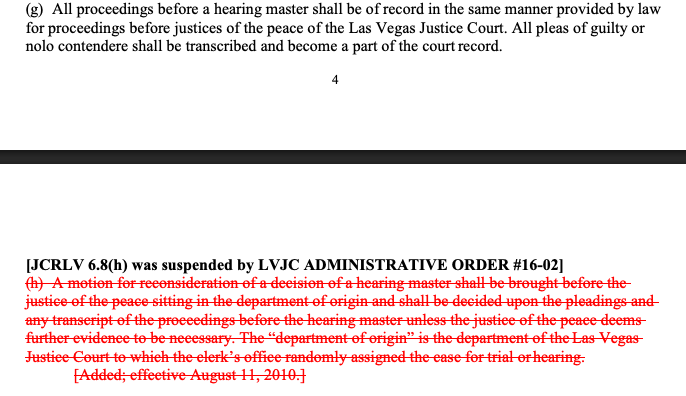
In the filing, the legal aid attorneys added that the suspension of the state Supreme Court's rules is "unlawful" and the Supreme Court alone possesses the constitutional and statutory authority to create rules governing court proceedings.
"Certainly, unelected judicial officers may assist elected judges by completing tasks authorized by statute or Supreme Court adopted rule," attorneys wrote. "And even then, under Nevada's Constitution's guarantee of procedural due process, unelected judicial officers' actions must remain subject to judicial review by an elected judge."
Support Independent Elections Coverage and Journalism in Nevada
You’ve enjoyed unlimited access to our reporting because we’re committed to providing independent, accessible journalism for all Nevadans.
But sustaining this work — informing communities, holding leaders accountable, and strengthening civic life — depends on readers like you.
Nevada needs strong, independent journalism. Will you join us?
A gift of any amount helps keep our reporting free and accessible to everyone across our state and funds our elections coverage.
Choose an amount or learn more about membership