
Nevada ranchers fight the Navy to save a generational livelihood — and a piece of the West

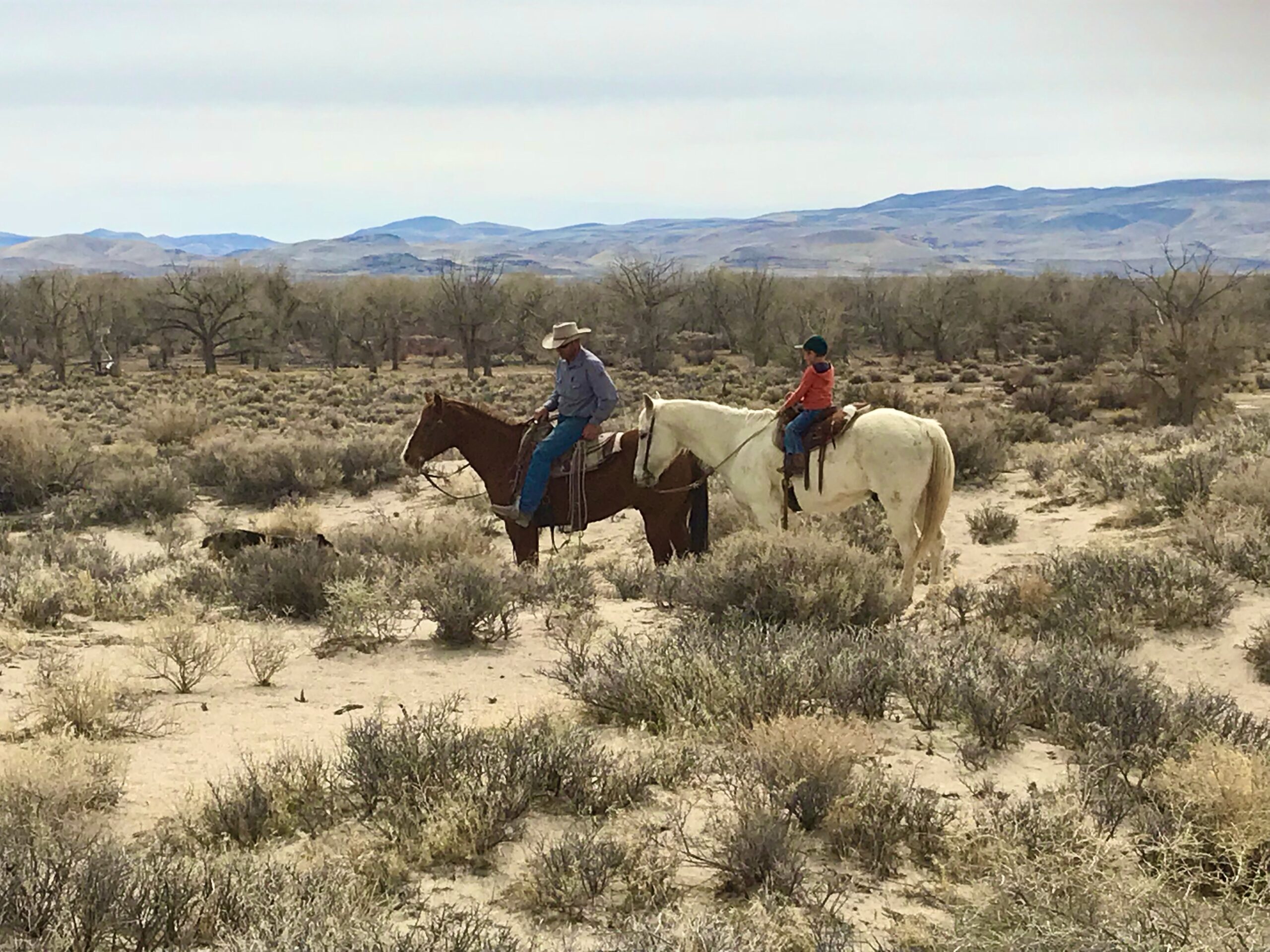
Nevada cattle ranchers are taking on the highest reaches of the federal government over their rights to graze cows on public lands. They're fighting this battle not with guns, but with the help of Nevada leaders across the political spectrum.
At the center of the fight are the Snows. Justin Snow is a fifth-generation rancher whose dad bought a permit about 40 years ago that allowed the family to graze cows on federal land. This decade, Justin and his wife, Adrienne, got a loan to purchase the permit from his parents, the same way many Americans take out a mortgage to buy a house. They still owe money on it, but the "forage" — the grass and other feed on the public land — belongs to them.
From sunrise to sunset each winter, the Snows ride horses across what's called the Lahontan allotment, where they graze their cattle.
"All winter we haul water, pump wells and haul water," Justin Snow said. "When it's below freezing, we're breaking ice all day across that allotment, so the cows can get a drink."
He calculates that the cows eat 122 tons on the land per month. Besides the cost of his loan, he only has to pay a per-cow cost of $1.36 — like a property tax — amounting to a few hundred dollars to use the land. If he had to buy that much alfalfa, it would cost him $25,000 each month. But the benefits aren't only financial.
"The cattle tend to do so much better in those open spaces," Snow said. "There's less sickness. They can be a true animal at that point."
For about a decade, the Navy has been eyeing the land on which the Snows graze their cattle. The military has said it needs more space at the Fallon Range Training Complex (FRTC), where real-life TOPGUN pilots practice combat. Finally, in late 2022, Congress gave the Navy its shot, sparking years of conflict.
Now, the Snows and other ranchers say they may have to shutter family operations going back generations, unless the Navy voluntarily revisits the deal it has offered them — or Congress forces it to negotiate.
In response to a request for comment from The Nevada Independent, a spokesperson for Naval Air Station Fallon (NAS Fallon) provided an extensive statement affirming the need to expand in order to protect national security, while emphasizing the Navy's commitment to working with everyone involved.
"We recognize that land in Nevada is more than acreage on a map — it represents generations of hard work, family legacy, and a deep-rooted way of life," the spokesperson wrote. "We do not take light of the disruption this expansion causes to local ranching families, and we are committed to treating every affected landholder with fairness, dignity, and respect throughout the transition."
This battle is unlike anything the state has seen before. It represents one of the largest military land expansions in decades and could determine how grazing rights are valued — and affect the culture and economy of the West — for years to come.
"This is going to set a precedent for the whole Western United States," Snow said. "I have people from California calling me, Montana. Everybody's looking over the fence to see what's going to happen, because this is huge."
'Everybody's up in arms'
Conversations about the Navy's expansion began roughly 10 years ago.
"At first, I was just pissed," Snow said, speaking about those early talks. So were other stakeholders.
"It's kind of a typical deal that stuff happens, everybody's up in arms, and then everybody just kind of forgets about it," he said.
The problem crystallized when Congress passed the National Defense Authorization Act (NDAA) in 2022 with the support of the Nevada delegation. The NDAA is a rare "must-pass" bill in Washington, D.C. — meaning it's one of the few legislative vehicles in which anything regularly gets done. In this case, one of the things it achieved was giving the green light to modernizing the Fallon training complex.
Buried in the 1,772-page law were provisions authorizing the Navy to claim public land for aerial training, bombing and other purposes. It instructed the Navy to help grazing allotment holders replace their lost feed with new allotments, if possible. If not, "the Secretary of the Navy shall make full and complete payments to Federal grazing permit holders for all losses suffered," a directive based on a 1934 law, the Taylor Grazing Act.
Patrick Donnelly, the Great Basin director at the Center for Biological Diversity, is no rancher advocate. But he says they could have seen this coming.
"What do people think is going to happen when the military takes over a bunch of public land?" he asked. "The public gets shut out and people get screwed."

Director of the Nevada Department of Agriculture, J.J. Goicoechea, who now chairs the group that meets regularly to discuss the naval expansion, said he was worried about the ranchers from the beginning.
"We were very concerned that there wouldn't be any compensation," he told The Nevada Independent. "We were happy with the language that at least it gave us, 'Hey, you have to be compensated.' In hindsight, we probably need to dial that in a little bit tighter on what exactly that compensation means."
Adrienne Snow was blindsided when the bill went to President Joe Biden's desk. She had been working with some Senate staffers on another project when they mentioned it casually.
"I said, 'I don't know what you're talking about,'" she recalled. "It was the next morning that the county manager messaged [Justin] and said, 'Hey, this is happening today.' … What that really felt like to us is we didn't know our house was back up for sale. And somebody just knocked on our door and said, 'Hey, I want you to know the offer was signed today, and I got you a great deal. I don't have a number for you yet.'"
Initially, the ranchers hoped they'd be able to coordinate a grazing schedule with the Navy, since hunters will retain some access to the land. But the government refused. Then, they hoped they might receive a replacement allotment. They were told nothing was available. They'd need to accept money instead.
According to Sen. Jacky Rosen's (D-NV) office, payouts to ranchers were new territory. It took good faith negotiations to write the law. But even those who helped design it didn't realize how ambiguous it was.
"I helped secure the Fallon Modernization deal to meet our national security needs with the understanding that the Navy would work in good faith to make sure Nevada ranchers whose grazing permits would be impacted would be justly compensated," she wrote in a statement. "Ranchers like the Snows have been on this land for generations, and it's clear from my conversations with them that the Navy's compensation offers are missing the mark."
Liquidating their cattle
Based on expectations for generational losses, the Navy agreed to pay compensation covering 100 years. While calculating its offer, the Navy's forensic accountant asked the Snows to open up their books to determine the value of their business. But the Snows did not want to give all their financial information to someone who was negotiating against them.
"Ranchers take their money every year that they make and they immediately reinvest it," Justin Snow said. "Our taxes don't show that we make a lot of money because that money is immediately spent. We're upgrading the ranch. We really thought that [the accountant is] going to take those numbers and she's going to try to dissect them and say, 'Well, you guys don't make any money anyway, so this isn't really that worth that to you.'"
Goicoechea said he doesn't blame the ranchers for keeping their financial information private. He would have done the same thing.
The Snows got their offer in late 2024. Justin told his 84-year-old dad about it.
"I'm like, 'Well, they offered us $1.48 million,'" Justin recalled. "He's like, 'Oh my God, you got to take that.' He's like, 'That's a lot of money.'"
But an offer that might sound good at first was actually a relatively small sum. Based on the premise that the Navy is supposed to pay for 100 years of future losses, its offer equates to $14,000 per year.
"It is a considerably lower amount than I think all of us assumed it would be when we're talking about the generational loss that is associated with these ranches, and we need to keep in mind these are not willing sellers," Goicoechea said. "They want a ranch."
In a report last year, congressional lawmakers stated they were "increasingly concerned about the Navy's treatment and proposed compensation for livestock grazing permittees." They also reminded the Navy that the law was meant to compensate them "for the generational loss of their operations at full market rates."
In his statement to The Nevada Independent, the NAS Fallon spokesperson said that the Navy is working within the law, using a four-step valuation process that accounts for the lost permit and forage, improvements and business value. He said the process relied on localized information from "regional ranch sales, USDA table[s] of cattle pricing history, and industry-standard data."
The Snows said a better calculation would involve the government's own numbers. Each year, the U.S. Department of Agriculture (USDA) insures the forage in case the Snows aren't able to feed their cows with it. The Department calculates its value at more than $800,000 per year.
They also said the Navy failed to factor in all of the reasons the permit is valuable. For instance, permits must be tied to a base property — the family ranch, which, unlike the public land, the Snows actually own. Together, the permit and the ranch are more valuable. Plus, the higher costs they pay to feed their cows in the summer are offset by the lower winter costs on public land. And their cattle are adapted specifically for that parcel.
"If you put some new cattle out there, it takes four to five years for them to become fully adapted," Justin Snow said.
The ranches monthly operational costs exceed $14,000 several times over — the Snows recently had to buy a new tractor for half a million dollars. A single bull costs $10,000. Buying a new ranch would take several million dollars at minimum.

Last year, with no deal agreed to, the Navy fenced off about half of their allotment, Justin Snow said. The section the government took was the best part, where all the stock water wells they had built were located. The cows couldn't graze there. A 5-mile trip onto the remaining land became a 100-mile trip.
The operation was no longer viable, the Snows said, and they had to sell two-thirds of their cows, even as they continue paying for their permit.
"This is a 100 percent loss, because it's not feasible to continue operating like that," Justin Snow said. "There will be no ranch. The kids will not have that. Grandkids won't. Great grandkids. It's gone. … We may have to uproot and leave Nevada. We've been here for 46 years. We don't want to leave."
Jack Payne, another rancher soon to be affected, said it's as if the Navy is taking out three spokes of a wagon wheel.
"I'm telling the Navy, you can't come in and reimburse me for the three wagon spokes you took out," Payne said. "You got to reimburse me for the whole wagon wheel that collapsed. And of course, they just look at you like you got owls coming out of your head when you say something like that."
The ranchers say the Navy's accountants don't know what they're talking about.
"None of the people on the Navy's team are experts in grazing cattle," Adrienne Snow said. "If I, for instance, all I did was sell homes in small town USA, but you hired me because I am legally a real estate agent to come in and frame out a seven- to eight-figure commercial development deal. I do not have the background or the skill set to do that."
She added that the Snows have hired experts and attorneys and cited figures with congressional support, but the Navy will not listen. The law was written so that the Navy had to meet various requirements to move on to the next step of modernization. But cattle ranchers have far less ability to keep fighting and paying for lawyers than the U.S. government.
No neutral source would say exactly how the payments to the ranchers should be calculated. All of those who spoke to The Nevada Independent suggested that the Navy's offer was an egregious lowball, but that the Snows might not get the number they want either.
Goicoechea suggested that the value of the forage assigned by USDA doesn't necessarily represent a fair 100-year payout, but is nonetheless a factor to consider.
"That's another starting point, if you will," Goicoechea said. "There's got to be negotiation. I don't want to get in the middle of it. … I think they need to come back and they need to try to come somewhere in the middle, somewhere between what they did offer, and what that forage is actually worth to a producer, and then to that local economy, and to the state of Nevada."
The NAS Fallon spokesperson told The Nevada Independent that the Navy is committed to maintaining open lines of communication and addressing problems when possible. But the Navy has not provided another offer.
'Fight as hard as they can'
The solution seems most likely to come from Congress.
"Politicians are sneaky," said Chuck Kendricks, another rancher whose allotment will soon be affected. "But I have to admit, Jacky Rosen has jumped right on this and said, 'No, no. You're going to have to reimburse these ranchers for what you're taking.'"
Rosen has been working on an amendment to the upcoming defense funding bill that would provide additional guidance on how payouts to ranchers such as the Snows will be calculated.
"While I've had productive conversations with Navy senior leadership, it's become apparent that we need legislation to clarify how these payments are calculated and ensure Nevada ranchers are made whole," Rosen wrote in a statement to The Nevada Independent. "I'm currently working to include language in the FY27 national defense bill that would significantly increase payments to the ranchers who are impacted, and I've made it clear to the Senate Armed Services Committee that addressing this issue is a top priority as the Senate and House go to conference on the bill."
The amendment is meant to allow flexibility in negotiations, though Rosen's office expects it will raise the Navy's baseline offer. The amendment includes factors that must be considered in calculating payments, including the diminished value of the rancher's own properties and water rights, investments in permanent improvements to the land, problems with their existing loans and other losses.
As the Navy has repeatedly argued that it's meeting its legal requirements, other lawmakers are taking a more neutral stance.
"I respect the fact that people want to fight as hard as they can," Rep. Mark Amodei (R-NV) told The Nevada Independent. "I guess it's good news that we're just fighting about money right now instead of whether they're going to get to do it or not."
Other pathways to a solution seem less likely. The ranchers have started trying to talk to high-up members of the Trump administration, with little luck. In April, Justin Snow attended a roundtable with Interior Secretary Doug Burgum. He tried to convey that this was the federal government's big opportunity to support American ranchers.
"I don't think he took it like how I wanted him to take it," he said.
"He sure acted like he was paying attention, taking notes, and at the end of that meeting, he told his people, 'I want this fixed,'' Snow recalled. "And then we never heard back from him again."
Finally, this month, Snow reconnected with an adviser to the interior secretary, Tyler Kellogg. In Snow's recollection of the conversation, he said Kellogg characterized administration officials in Washington as out of touch with issues in the West.
Kellogg did not respond to The Nevada Independent's request for comment. A spokesperson for the Interior Department referred questions to the Navy, saying that the Navy is responsible for the grazing valuation process. The White House did not respond to a request for comment, either.
Back in Nevada, the government is reexamining the option of giving the ranchers new allotments.
"I think now that they are looking at that potential math, they are trying to scramble and find alternative options that they were not that eager to find previously," Adrienne Snow said.
Payne said that the land in question is not as desirable as what the Navy is taking. Plus, the allotments are far away.
Goicoechea wishes the ranchers could receive new forage. But he thinks logistical problems make that unlikely.
"They do have some allotments that could be filled, but unfortunately, and I'll be candid, nothing is going to change, and in two years, we'll have this same conversation because they don't have the staff at the [Bureau of Land Management] level or at the Forest Service level," Goicoechea said. "It's a feel-good statement that we're going to fill these vacant allotments, but it can't happen until we get critical staffing in place."
100,000 acres or 1,000 cows
The next ranchers whose land is included in the next portion of the Navy's expansion have already received notifications that their allotments will be closed off within two years. Soon, they will get their offers. They aren't optimistic.
Rancher Donald Brown's family has been grazing on the land longer than almost anyone. His family secured their permit about eight decades ago. That legacy could soon end.
"We're just all kind of waiting to see what happens with the Snows, and that'll give us an idea if we even have a chance of fighting to get anything or if they just take it or if they'll lowball us or what," he said.
Jack Payne told The Nevada Independent he expects his ranch will be cut by about 100,000 acres, or 1,000 cows. He still has a mortgage, based on the number of cattle on it. He said he got the loan from the Small Business Administration "because of the number of jobs we create, and the food and fiber we produce for this country."
If he gets an offer like what the Snows received, he said, "It's not going to be enough to even pay off the bank, and then we've got to go try to buy a replacement ranch somewhere."
In the process, he'll lose the stability he worked years for.
"Before I bought this ranch, we ran cattle in Arizona, California, Idaho, Oregon, Nevada," Payne added. "I missed a large chunk of my children's childhood growing up because I was going all over the country taking care of our cattle. … Now we were fortunate enough to get ourselves in a position to buy this ranch, which is an hour from our hometown."
But the problem goes beyond a few ranchers. The rodeo culture that draws tourists to Nevada could be endangered. With beef prices at a record high due to the high costs of cattle farming, the turmoil the ranchers are facing could have ripple effects across America.
Some of the ranches may be irreplaceable.
"Try to buy a ranch in Nevada right now — you can't even hardly do it," said rancher Kendricks, who values his allotment's plentiful water supply and fertile ground for farming. "You can't even find a ranch like I have in Nevada for sale."
Ranchers and their advocates described repeated stonewalling by the Navy. Kendricks can't even get the Navy to talk about a number, though he expects he could receive his offer as soon as this month.
"They have strung us out so much, it's unbelievable," he said. "I hate to sound negative, but after eight, nine years, it does get old. It's hard on the family. … We do support the Navy. … Like I told that commander, I said, 'I want you guys to practice bombing and be the best there is. But you have to make sure that we are taken care of.'"
Support Independent Elections Coverage and Journalism in Nevada
You’ve enjoyed unlimited access to our reporting because we’re committed to providing independent, accessible journalism for all Nevadans.
But sustaining this work — informing communities, holding leaders accountable, and strengthening civic life — depends on readers like you.
Nevada needs strong, independent journalism. Will you join us?
A gift of any amount helps keep our reporting free and accessible to everyone across our state and funds our elections coverage.
Choose an amount or learn more about membership