
Nevadans get few details into data centers receiving tax breaks — and it might be illegal

Editors' Note: This is one of two stories The Indy is publishing about economic impacts and lack of transparency around Nevada's data center tax abatement program. Read the other here.
In the more than 10 years since Nevada lawmakers approved a tax break program for data centers, the state has OK'd a projected $457 million in cumulative abatements for massive projects tied to companies such as Google and Apple.
The benefit? Promises of about 300 permanent jobs, $1 billion in new tax revenues and more than $6.6 billion in economic activity.
However, the Governor's Office of Economic Development (GOED) — the state agency that approves the deals — does not track whether the data centers have lived up to their economic activity and tax revenue promises. Instead, it only releases information on jobs, wages and capital expenditures, which are some of the requirements for the company to keep receiving the tax relief.
Although this public information exceeds what is available in many other states, the department does not have data on the industry's actual economic output and tax revenues — it said it is not allowed access to company-specific tax revenue information — and in an interview with The Nevada Independent, its director only disclosed what the company projected when it received the abatement.
It's one of many ways the public has been left with incomplete information about the actual financial costs and benefits of the increasingly controversial data center industry, according to an Indy analysis of 10 years of GOED meetings and abatements issued to data center companies.
GOED is also giving companies considerable sway over what information the public can access — which public records law experts said appears to violate state law.
A copy of a tax break agreement obtained by The Nevada Independent shows that as long as a data center company is meeting tax abatement rules, it can singlehandedly determine whether the public can access its audits.
However, that broad latitude appears to contradict Nevada law, which says any audit is public record after it is complete and any appeals have been completed. Companies can only request certain information be kept confidential if it is "a trade secret or other confidential proprietary information of the business."
"It seems to flip the statute itself on its head," said Jake Valentine, a lawyer with the American Civil Liberties Union of Nevada.
Exceptions to state public records law include the section on audits, which GOED said gives its "position legal grounding." These exceptions include other parts of Nevada law where public access to records is allowed in some, but not all cases.
In an interview with The Indy, GOED Director Tom Burns said the agency always follows Nevada law.
"We're complying with the advice we've got from our [lawyer]," Burns said.
GOED officials also emphasized that the public already has access to company-specific audit findings through reports that the agency must release every two years.
However, The Indy uncovered errors and inconsistencies in these reports.
For the past decade, these reports said the data centers are audited at the two-year mark, which the Department of Taxation said after this story was published is what "normally" happens. But GOED officials have said the reports were incorrect, and that the initial audits are at the five-year mark, which they said is because program requirements do not kick in until the fifth year.
Carli Smith, a GOED spokesperson, said the language "could have been worded clearer," but that the audit results listed are accurate.
There is no time frame mentioned in state law, but multiple GOED officials incorrectly told The Indy that the five-year timeline is part of state law. GOED later confirmed that the audit time frame is part of contract language, not state law.
Additionally, these public reports operate under a significant lag time. There are no audit findings available for data center tax abatements approved since 2018. GOED said this lag "is structural," and that abatements approved in 2018 "would only now be reaching audit eligibility."
While the economic benefits of data center tax breaks are largely still based on projections, the costs are more concrete.
From fiscal years 2017 to 2025, data center tax abatements led to a gross reduction of $537 million in local government sales and use taxes, according to a Nevada Independent analysis of reports from the state controller's office — nearly triple the reductions of any other type of tax break.
Although these companies generate revenue, the public doesn't know the full extent, and GOED does not get access to specific companies' tax revenues, Burns said. The department added that it has no legal authority to amend the disclosure of this information.
Still, Burns added that there can be ample benefits for local governments, primarily through property tax payments on land that abated data center companies still have to pay in full.
"Because of the size of the buildings … they tend to be very good payers," he said.
State Sen. Dina Neal (D-North Las Vegas), a vocal skeptic of tax abatements, criticized the incomplete information about economic effects.
"It's almost like you're auditing some, not all," she said in an interview. "What is the true contribution?"
Neal, who voted in favor of the abatement program more than a decade ago, also condemned the wide latitude given by the state to data centers in determining what audit information the public can access.
"We're talking about giving power to a corporation over the interest of the state," she said. "If you can choose and select what we know and understand … then I think it opens the door for a question for us to say 'is that a power that should remain?'"
Nevada data centers
Data centers are central to the artificial intelligence boom but have spurred widespread backlash over their lack of permanent job creation — though they do provide a boon to the construction industry — and significant water and energy use.
An online tracker shows about 70 data center locations with operations online or incoming. Colocation data centers, where a company houses data from multiple businesses, are particularly common in Nevada.
Local governments — which hold decision-making authority on whether data centers can reside on their land — have so far shown little resistance to data center growth. The City of Reno last year rejected a proposal to increase regulations for data center permitting, and Lyon County rezoned certain land in December to make way for a data center.
Recently, NV Energy conceded the data center wave and subsequent power demand will likely cause the state to fall short of mandated clean energy goals.
Other states are eyeing stricter environmental requirements for data centers.
"We want consistent and clear reporting," said Olivia Tanager, the director of the Sierra Club Toiyabe Chapter.

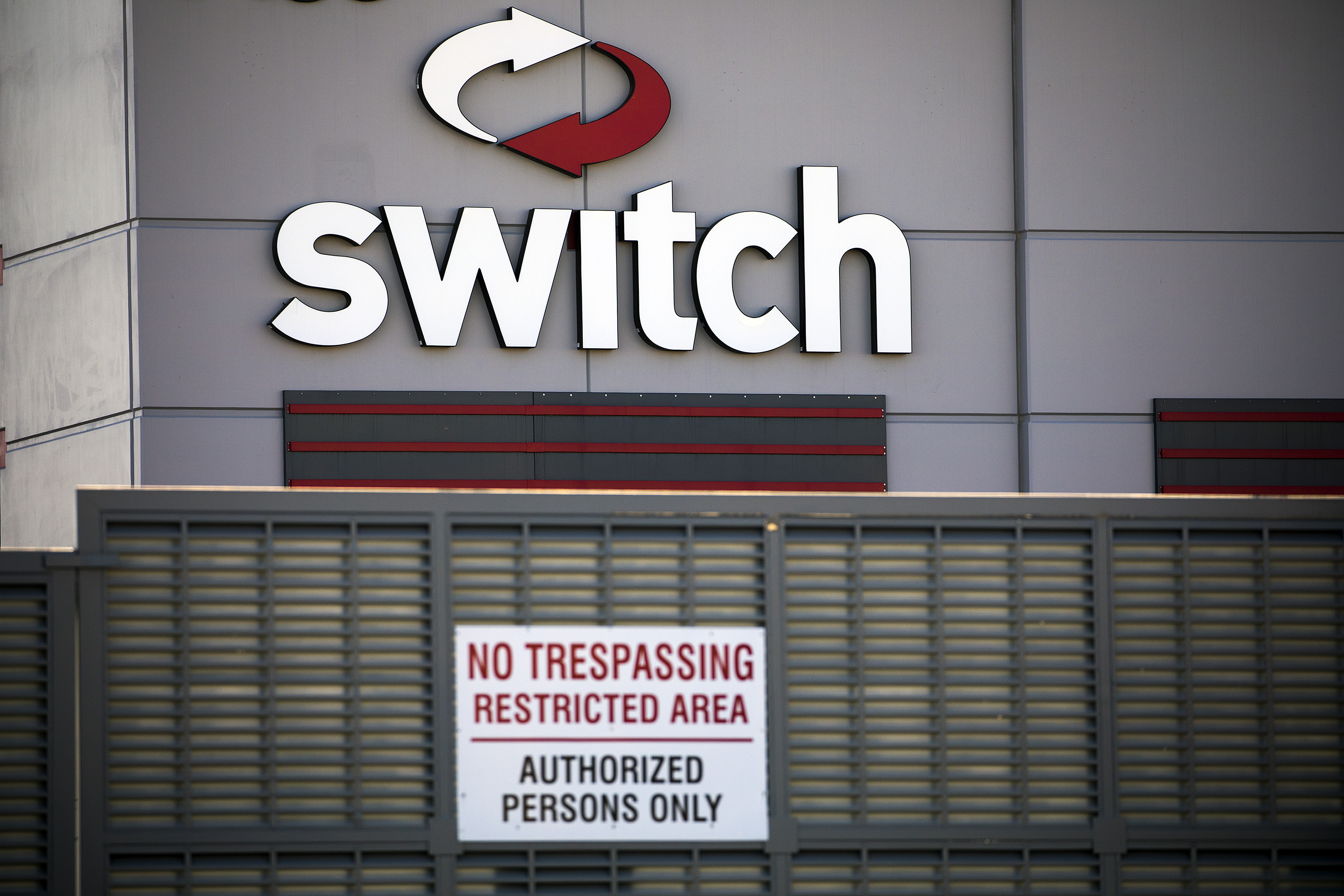
The data center tax incentive program came via a 2015 bill pitched as a way to allow recession-scarred Nevada to compete with neighboring states such as Arizona (whose governor this year called for the elimination of its program) on attracting data centers. It was specifically aimed at wooing Switch — whose facilities host other companies' data servers — to Northern Nevada; there was no mention of artificial intelligence during the bill process.
Under the bill, data centers are able to get a 75 percent abatement of the tax on personal property, such as business equipment, due across a 10- or 20-year period, depending on the specific tax break. They also are subject to a sales and use tax of 2 percent. A 2019 law prohibited data center businesses that are expanding from receiving abatements on a tax to support local schools.
Every two years, GOED is required to provide information about the compliance of companies receiving tax breaks, including data centers. This includes information on jobs created, capital expenditures and average wages — more than what many other states disclose.
Critics say it still leaves the public in the dark.
"The bar is pretty low," said Kasia Tarczynska, a researcher at Good Jobs First, a national research center that scrutinizes government economic development programs. "There's just so much more that the economic development office could be doing because the subsidies are so big and the industry, it's just so powerful."

"Really, really expensive"
In February, The Indy filed a public records request for all completed audits of data centers that have received tax breaks.
GOED declined the records request, with a spokesperson saying that the requested records "aren't, by statute, public records" and that the only available records are for companies "deemed not compliant" with abatement rules.
Although the relevant Nevada law is listed as an exception to public records law, there is no explicit language giving companies the ability to determine what gets released.
"It definitely goes against the Nevada public records act," said Valentine, the ACLU lawyer. "The Nevada public records act states that everything is a public record unless statute deems otherwise."
Patrick File, a media law professor at UNR, told The Indy that gaining access to certain public records can be a painstaking process because the only way to challenge the government's decision is through a lawsuit.
"It seems to balance in favor of the government making it difficult to access records, where they know that if you want to challenge their interpretation of the law, you're going to have to get a lawyer and sue them," File said.

Instead, the agency said as long as a company is compliant with the terms of the tax abatement agreement, it does not have to disclose audit reports to the public. It added this position is "plausibly supported" by Nevada law, and all it has to release is the information included in the tax break reports it releases every two years.
These operate on a significant lag time. In the latest report, the only audit information available are for data centers whose tax breaks were approved in 2015 and 2016. The biennial nature of the reports also means that if an audit concludes right after the report goes out, its contents won't be known until the next report is published two years later.
These reports do not include certain audited information, such as share of construction workers who live in Nevada and health insurance plan information. Nevada law does not require the disclosure of any other information.
Also, the audit results listed for Switch's data centers are combined with other abatements that Switch has received, making it impossible for the public to know how many jobs the specific data center abatement created.
GOED officials said that even though these findings are combined in the biennial reports, the audits occur separately.
Additionally, these reports have consistently noted that data centers have been audited at the two-year mark. However, the tax break agreement itself says audits only happen at the five and 10-year marks.
GOED officials provided contradictory information to The Indy.
A spokesperson said the frequency of the audits was "recently clarified" in consultation with the Department of Taxation, which is the agency responsible for conducting the audits.
Other GOED officials said there was never a change in audit frequency, but this does not appear to hold up. For example, one data center approved in May 2016 was shown to have had a completed audit with no jobs created in a January 2021 report. This should have meant the company was noncompliant with abatement requirements if the audit happened at the five-year mark.
The Department of Taxation said the "audits are normally performed" at the two, five, eight and 10-year marks.
No matter the frequency, what the public knows about the efficacy of these kinds of tax abatements is still minimal — even compared with other tax abatements offered by the state. As part of the massive tax incentive Tesla received, it had to be audited initially at every quarter, and now, every year.
"If the state wanted to do it, they could release the documents quite more often to provide clarity about what's going on because these subsidies are really, really expensive," said Tarczynska from Good Jobs First.
Updated on 4/2/26 at 3:34 p.m. to add new information from the Department of Taxation about audit frequency.
Support Independent Elections Coverage and Journalism in Nevada
You’ve enjoyed unlimited access to our reporting because we’re committed to providing independent, accessible journalism for all Nevadans.
But sustaining this work — informing communities, holding leaders accountable, and strengthening civic life — depends on readers like you.
Nevada needs strong, independent journalism. Will you join us?
A gift of any amount helps keep our reporting free and accessible to everyone across our state and funds our elections coverage.
Choose an amount or learn more about membership