


OPINION: Remind me again why we still elect judges?

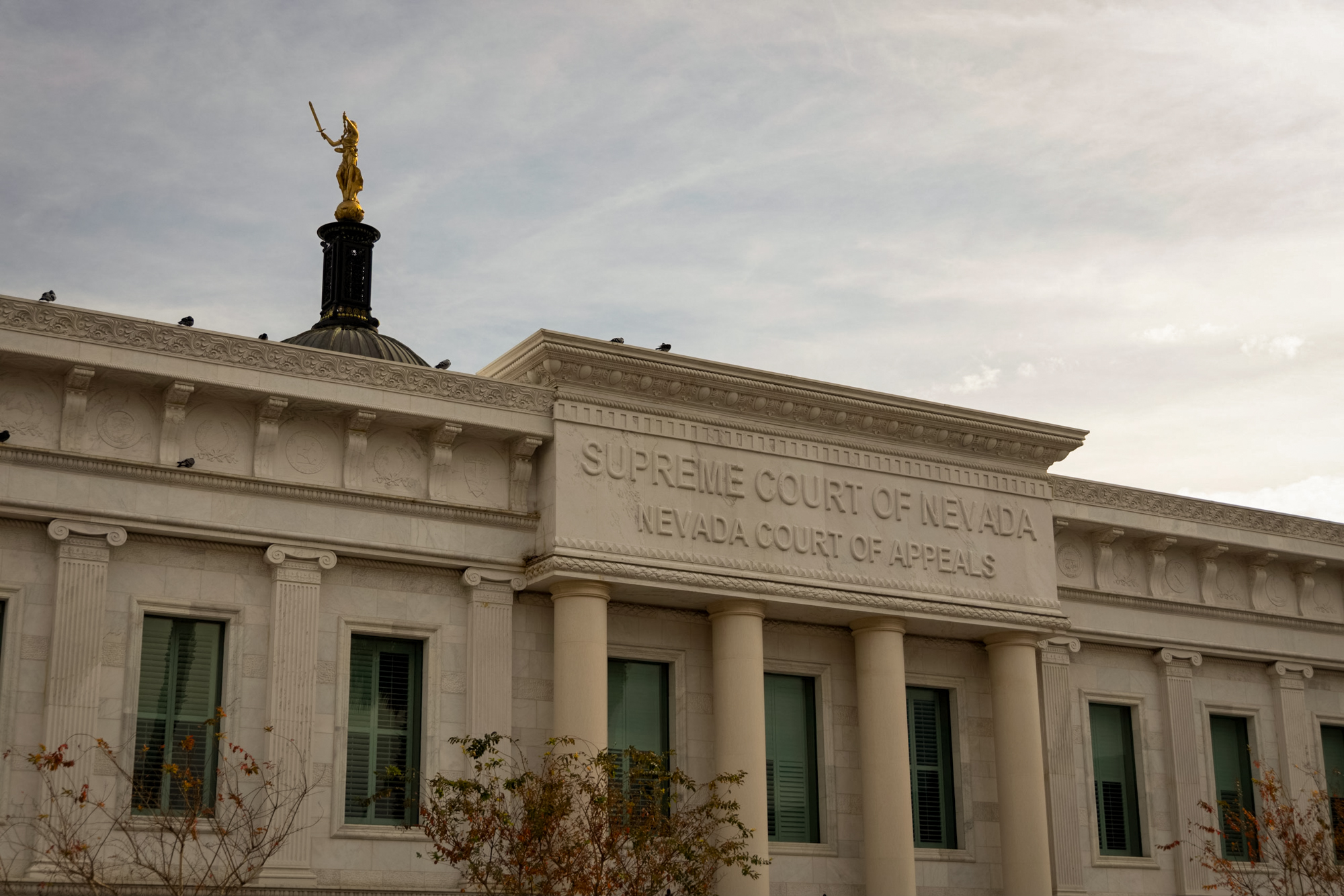
If you wanted to become a District Court judge in Southern Nevada this year, apparently all you had to do is be the only person to apply.
That, at least, was how two District Court seats were filled after incumbents declined to file for re-election. As for the rest, according to The Nevada Independent, only 31 percent of Nevada's District Court seats were contested. Despite 155 candidates filing for election to the state's judiciary, most of the candidates will run unopposed.
As Chief Deputy District Attorney Jake Villani put it in the Las Vegas Review-Journal, "That's not an election, that's a sign-up."
Fair enough. But why should it be one? Do you know who's currently serving on the Nevada Supreme Court or the Court of Appeals? What do you know about the 82 judges serving in the state's 11 judicial districts? How about the judges serving on the state's family courts, justice courts or municipal courts? Do you have any idea which cases go before which court? Do you know the difference between a justice and a judge?
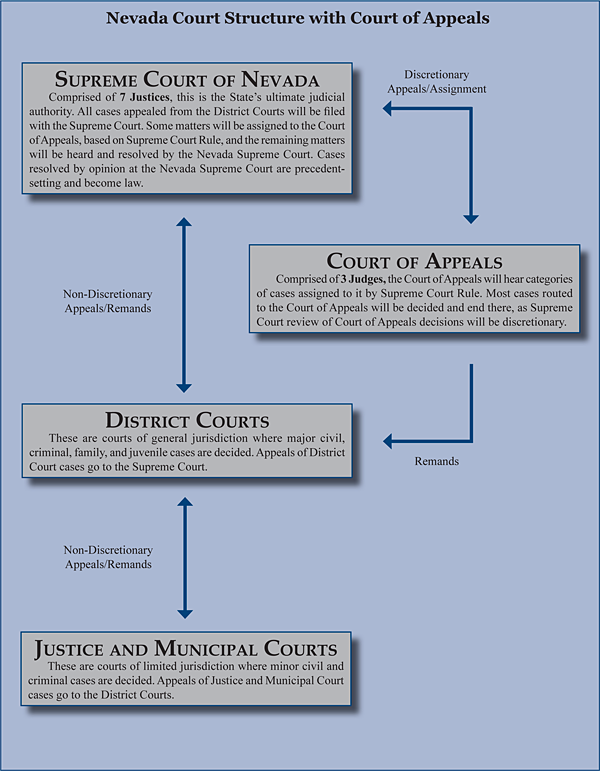
Unless you're an attorney — or married to one — the answer is probably not.
So why do we elect judicial officers?
The answer lies in the decades immediately preceding Nevada's founding. In those days, appointed positions in American governments, whether federal, state or local, were distributed according to the spoils system. Friends, family and partisan supporters of elected officials looked forward to plum taxpayer-funded appointments to various offices, regardless of competence or merit.
Until the modern merit system was developed following President James Garfield's assassination in 1881 by Charles Guiteau — Guiteau claimed that he was driven to murder because he deserved a consulship in Europe in return for his support of Garfield — reformers sought to find other ways to hold the judicial branch accountable. The most popular method, which first passed in Mississippi in 1832 and was adopted by every state that joined the union between 1846 and 1912, was to let voters, not partisan politicians, elect their own members of the judicial branch.
Since Nevada gained statehood in 1864, our state also adopted this then-progressive reform.
But that was 162 years ago. Since then, Americans have seen several occasions when electing judicial officers has arguably caused more harm than good.
According to the Brennan Center for Justice, for example, a 2025 Wisconsin Supreme Court election featured more than $100 million in campaign spending. Elon Musk channeled more than $12 million through two of his PACs; he also handed out three $1 million checks to supporters of Brad Schimel, his preferred candidate who previously served as a Republican attorney general. Though Musk's efforts were ultimately unsuccessful — Susan Crawford won by 10 percentage points in a state that President Donald Trump won in 2016 and 2024 — they still drove Crawford and her allies to spend more than $46 million to win an election that never should have been subject to partisan politicization in the first place.
Meanwhile, in North Carolina — where, unlike Wisconsin or Nevada, justices run on partisan political affiliations — the state Supreme Court blocked certification of a Democratic justice's election win. Though the ruling was ultimately overturned by a federal judge six months later, it's only one of a recent series of politicized rulings issued by Paul Newby, the Republican chief justice, since he assumed leadership over the North Carolina Supreme Court in 2023.
Closer to home, meanwhile, remains the unending saga of Michele Fiore's ignoble service as justice of the peace.
Despite the fact that Fiore had lived in Nye County for only a month and had no legal background, Nye County commissioners appointed the gun-toting, tax-dodging conservative one-time actress who believes cancer is a fungus to serve as a justice of the peace in 2022 — a decision voters elected to support in 2024.
A month after her election, however, she was indicted for stealing money from a PAC and charity that were raising funds for a statue memorializing fallen Las Vegas Metropolitan Police officers. A week later, the Nevada Commission on Judicial Discipline suspended Fiore. She was subsequently convicted of federal fraud charges, a charge she unsuccessfully attempted to appeal.
Then Trump issued Fiore an Order of Donald for her heroic feats in service to the First Family — I kid, but on the square. Less than a week after her appeal was overturned, Trump pardoned the combative former Las Vegas City Council member, an obvious reward for her outspoken support of him immediately after Jan. 6.
That put the elected but suspended justice in an interesting theoretical legal position. On the one hand, she was suspended without pay following her conviction. On the other hand, her conviction had been overturned, in a manner of speaking. Having received a pardon from her federal charges, would she be eligible to serve as a justice of the peace once more?
Ultimately, the Nevada Commission on Judicial Discipline decided to split the baby — they wouldn't return her to the bench but she would resume getting paid while being suspended from service. Naturally, she's running for re-election.
Though it's tempting to shrug our shoulders and, to borrow a phrase from H.L. Mencken, conclude that Nye County voters deserve to get what they want good and hard, all Nevadans deserve a fair and impartial judicial branch, one that reflects Alexander Hamilton's dictum that it should possess judgment, not will. The way to get closer to achieving this goal is to stop electing justices — most of whom voters know nothing about — and instead carefully select them according to merit.
Fortunately, Nevada is already most of the way there.
In 1976, voters approved an amendment to the Nevada Constitution that permits the governor to appoint judicial officers, but not at random and not at whim. Instead, the Commission on Judicial Selection was created to, among other things, identify three suitable candidates for each vacancy in the judicial branch for the governor to select from.
Separating the process of identifying suitable candidates from the governor's ability to nominate constrains the governor's ability to appoint judicial officers according to personal or political loyalty. That's why, according to the Brennan Center for Justice and the American Bar Association, Nevada's system would be considered the current gold standard for maintaining a fair and impartial judicial system — if we simply removed the need to elect judicial officers after their initial appointment.
If we're feeling creative, we can even add a few innovations.
For example, the commission on judicial selection could also gain responsibility, with nonpartisan local support, for identifying suitable candidates for justice and municipal courts, just as it's already responsible for identifying suitable candidates for District Court vacancies. Doing so would help ensure that county commissioners couldn't, for example, nominate a clearly unqualified pardoned criminal to serve their local judiciary at taxpayer expense.
For those of you who might distrust gubernatorial appointments of justices, that's understandable. Unfortunately, placing appointments in the hands of the Legislature would be problematic since it would be far too tempting for partisan politicians to gerrymander unlikely majorities in that house; additionally, Nevada's part-time Legislature is only guaranteed to meet every two years anyway.
There is, however, another alternative. All statewide elected officials — the governor, lieutenant governor, attorney general, treasurer and controller — could serve as a vacancy-approving committee. Since statewide elected officials serve the entire state, not an arbitrarily drawn district, their elections reflect the collective voice of all Nevadans. Additionally, including the attorney general in the process would ensure that our state's chief law enforcement officer has a chance to bring their unique perspective to the problem.
Another reform recommended by the Brennan Center for Justice would be to ensure that judicial officers serve only one, lengthy term. With that reform in mind, appointing judicial officers for nonrenewable 12-year terms — which aligns with current term limits for elected legislators — would ensure continuity in Nevada's third branch of government without falling prey to the issues caused by lifetime appointments in the federal judicial system.
Any or all of these reforms would go a long way toward simplifying our ballots, depoliticizing our judiciary and ensuring that qualified individuals serve on every court in Nevada. At the very least, these reforms would ensure that the next justice or judge you meet didn't get the job by dint of being the only person to apply.
David Colborne ran for public office twice. He is now an IT manager, the father of two sons and a recurring opinion columnist for The Nevada Independent. You can follow him on Mastodon @[email protected], on Bluesky @davidcolborne.bsky.social, on Threads @davidcolbornenvor email him at [email protected]. You can also message him on Signal at dcolborne.64.
Support Independent Elections Coverage and Journalism in Nevada
You’ve enjoyed unlimited access to our reporting because we’re committed to providing independent, accessible journalism for all Nevadans.
But sustaining this work — informing communities, holding leaders accountable, and strengthening civic life — depends on readers like you.
Nevada needs strong, independent journalism. Will you join us?
A gift of any amount helps keep our reporting free and accessible to everyone across our state and funds our elections coverage.
Choose an amount or learn more about membership