
Veterans exposed to radiation unite Nevada congressional delegation in fight for benefits

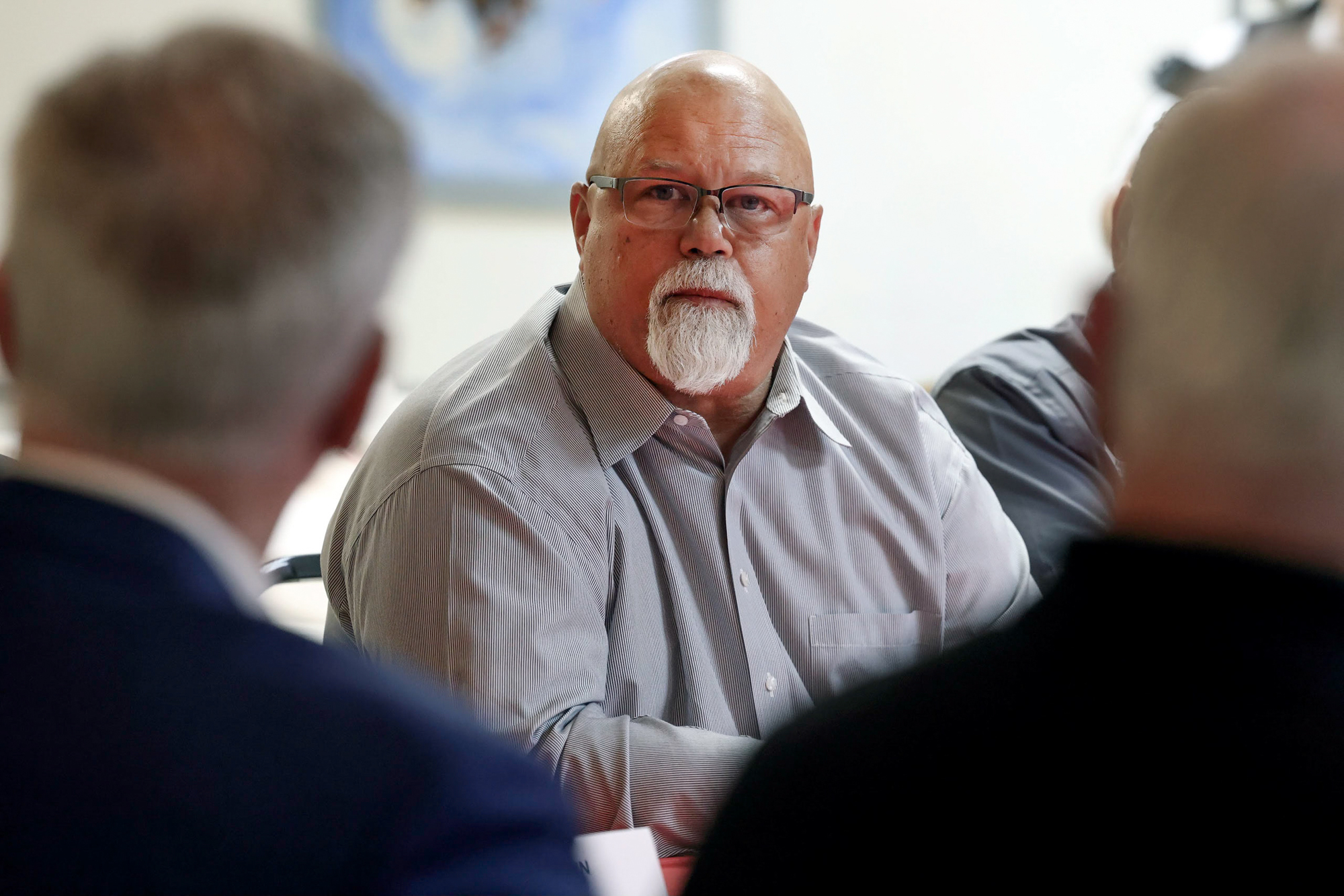
For most of his life, Air Force veteran David Crete, 61, didn't know why he and his family had so many medical issues.
His wife had three miscarriages. His daughters have autoimmune issues. His oldest son, now 38, needed a specialized education plan because he has a benign brain tumor, which he still needs to get checked regularly. Crete has had tumors himself. The left side of his brain is shrinking; his neurologist says it's due to radiation exposure.
But he didn't connect the dots until 2015, when he hosted a reunion with some of the vets he'd served with as a young man at the Nevada Test and Training Range (NTTR), where the U.S. military had conducted nuclear tests. They hadn't seen each other since the '80s. When they started talking, they realized something: They were all dealing with the same kinds of health problems.
"At the time, I'm 50 years old. I have never sat around with a bunch of guys drinking and discussed tumors," he said. "Nobody does that, and that's when we all started to chime in that there was something to it, and at that point, I started to investigate."
After eight years of research, he founded a nonprofit called The Invisible Enemy to spread awareness and get compensation for those affected.
Now, Crete is the namesake of a bill that is a top priority for Nevada's congressional delegation. The Sergeant Dave Crete FORGOTTEN Veterans Act of 2026 would ensure veterans like him qualify for benefits after serving at sites contaminated by radiation or toxins. Under a 2000 law, civilian employees of the Department of Energy who worked at those same sites are entitled to cash and medical coverage. But for veterans whose service was classified, the location where they served is hidden on their records, so they don't have the same presumption of exposure and can't get the benefits they should receive under the PACT Act. The FORGOTTEN Veterans Act would fix that.
All of Nevada's members of Congress support the effort. The House version has united Rep. Susie Lee (D-NV), House Democrats' Battleground Leadership Representative, who says it's "very high" on her priorities list, and retiring Rep. Mark Amodei (R-NV), the state's sole Republican in Congress. Sen. Catherine Cortez Masto (D-NV) and Rep. Steven Horsford (D-NV) are cosponsors. In a statement to The Nevada Independent, Rep. Dina Titus (D-NV) wrote that she appreciates "efforts to address exposure at specific contaminated sites," though she said that her PRESUME Act "takes a more comprehensive approach."
In the Senate, Jacky Rosen (D-NV) is leading the push.
"This is a rare opportunity for Congress to solve a black-and-white discrepancy, and fixing this disparity for the veterans who served at the NTTR by passing my bipartisan Sergeant Dave Crete FORGOTTEN Veterans Act is one of my top priorities," Rosen wrote in a statement to The Nevada Independent. "I will pursue every avenue to reach a solution until we get there."
Crete, a Republican, said that the Nevada delegation — even the Democrats — have been great to work with. When he first got in touch with Rosen's office, he was grateful one of her staff members had worked where he did and could confirm his claims. He praised Lee as well.
"Susie Lee is a pit bull on this stuff, going after the secretary and the chairman of the Joint Chiefs, and different people," he said.
Amodei told The Nevada Independent "you don't need to be a Rhodes Scholar" to see how much the issue matters and that it's his team's "number one veterans issue."
"Everybody kind of agrees on the facts, but it'll cost more money," Amodei said. "I'm as sensitive about money as anybody, but before you get to that, it's like, well, you probably should have been doing it from the beginning, since, in this instance, they're doing it for the civilian people. What are the military people, not real people?"
Who killed the effort last year?
The provisions of the bill classifying the training range as a contaminated site nearly became law last year, when advocates tried to include them in the National Defense Authorization Act (NDAA), must-pass legislation to fund the Department of Defense. But the Congressional Budget Office (CBO) determined those provisions would cost $115 million over the next decade.
To put that figure into context, House Republicans recently advanced legislation to give the Pentagon a $1 trillion budget next year alone.
The CBO's estimate stated that classifying the training range "as a location where contamination occurred would result in additional veterans receiving disability compensation and health care from VA."
Amodei said Congress has previously passed more expensive legislation, such as a 2023 law that expanded Social Security and cost billions.
"The price take on that was monstrous, and it's like, 'Well, but we're going to do it because it's the right thing to do, the right political thing to do,'" he said.
But due to procedural requirements, once the CBO "scored" the bill, the congressional leadership needed to agree to waive a budget rule that requires new mandatory spending be offset. As House and Senate Democrats and Republicans privately worked to finalize the NDAA in conference negotiations, the whole Nevada delegation signed a letter disagreeing with the CBO's estimate and urging leadership to waive the rule.
"Were we to let the score get in the way of [the provisions] surviving conference, Congress would be effectively denying veterans the VA benefits they are legally entitled and penalizing them for the U.S. Government's own recordkeeping failures and bureaucratic inequities," they wrote in November.
But the provisions of the bill were ultimately left out. Rosen's office blamed House Speaker Mike Johnson (R-LA). Her team told The Nevada Independent that according to their understanding of conference negotiations, the other three members of leadership had been willing to waive the budget offset rule, but the speaker was not. Another source familiar with the discussions confirmed that claim. Lee and Crete both said that was their understanding as well.
"We didn't get anywhere," Crete said. "We tried with the speaker and the speaker wouldn't give it to us. … I was told that [Senate Majority Leader John Thune (R-SD)] went to him trying to get it. I know many members of the House went to him trying to get it, and the only excuse I heard is, 'Well, he's just not going to give them to anybody.'"
Johnson's office says he was not responsible for the death of the effort last year.
"This claim is false, the amendment never rose to a Leadership decision during the NDAA conference," his office wrote in a statement to The Nevada Independent. "The Speaker's office is continuing to work with stakeholders to resolve this problem for our veterans."
Amodei told The Nevada Independent he hasn't been in touch with congressional leadership on the issue, though he plans to speak to Johnson about it. The Nevada congressman said he's exploring avenues to get it done this year, including through a party-line budget bill.
"Jesus, you want to do reconciliation every month," Amodei said. "I mean, shit."
'Trying to stay the shiny penny'
Crete wasn't able to get a meeting with Johnson's team last year, but finally had one this spring. He said the speaker's national security advisor seemed like she wanted to be helpful, but he's still concerned the bill will be held up again. He added that he thinks that if Johnson gets on board, other House Republicans will follow suit.
"I've talked to most of the veteran lawmakers on Capitol Hill, and they all seem supportive, but it gets killed by the process. And the one in charge of the process is the speaker. It's dumb."
Lee told The Nevada Independent she hopes the bill will be included as an amendment to the 2027 defense spending bill, which the House is expected to vote on soon, but was "skeptical that it will get included because of its cost."
She's open to other paths, too.
"I don't want to jinx it, just because of where we are with Johnson," Lee said. "But we're gonna keep pushing forward. I'm optimistic."
The executive branch could fix the problem unilaterally. Rosen has raised the issue in public hearings with Department of Defense leadership and in the confirmation hearing for now-chairman of the Joint Chiefs of Staff Dan Caine, as well as in a private meeting with him. She's currently working on setting up a meeting with Secretary of the Air Force Troy Meink, who committed to talking to her about the problem. Her office has heard he's been directing staff to work on fixing it.
Lee is trying to move the administration as well. She grilled Defense Secretary Pete Hegseth about the issue at a May hearing.
"I'm just trying to make it as public as possible, and put enough pressure on, obviously, Pete Hegseth," she said.
Crete said he's been to Hegseth's office twice and met with the White House and senior staff for the secretary of the Department of Veterans Affairs (VA), though these meetings haven't yet borne fruit.
"I've literally been on calls with the assistant secretary of this thing or the other, and they've instructed some of the people, going, 'Look, this is what we need you to do, we need you to do A, B, and C,' and then nothing ever comes of it," Crete said. "Truth is, if we could get the secretary of Defense and secretary of VA into a room together for 30 minutes with their action officers, the problem would be fixed. We wouldn't even need legislation."
Spokespeople for the Department of Defense and the VA told The Nevada Independent that standard policy prevents them from commenting on pending legislation. The VA's website outlines who qualifies for disability benefits due to hazardous exposures, though it does not provide specific information about veterans who completed classified service. The Defense Health Agency, which is in charge of military healthcare, did not respond to a request for comment.
For now, advocates are working to grow support in Congress. Rosen's latest version of the bill expands it beyond the Nevada site to locations in other states that the Department of Energy considers contaminated. Her team is hopeful this change will help get more cosponsors on board, as it did with Sen. Marsha Blackburn (R-TN), whose state has several such sites.
Crete said he's spent a cumulative seven weeks in Washington this year lobbying government leaders. His next trip to D.C. will be focused on House Armed Services Committee members.
Most of his work centers on teaching lawmakers, who often have never heard about the problem, about the harsh realities affected vets face, then making sure the lesson sticks.
"They kind of get that, but then they're focused on whatever the next shiny penny is," Crete said. "Which is why I go back to D.C. all the time, because for three years, I've been trying to stay the shiny penny."
He's also working to make the public more aware of the issue.
"We know that public pressure is a very effective tool," Crete said.
He made a short documentary on the issue and is working on a full-length one with executive producer Matthew Modine. He hopes it will be available on streaming services by the beginning of next year, after he has a chance to show it at film festivals.
Through it all, he tries to teach others who may be affected about what he's learned. He said that one woman he knew was married to a man who worked at the same place he did, and Crete suggested he get some health screenings.
"I said, 'Everything is fine until it isn't,'" Crete recalled. "'And then one day your life is going to change.'"
The next time he saw her, she was crying. Her husband had prostate cancer.
Every two or three days, Crete adds a name to the memorial list of those who were exposed, which is approaching 600. He said the average age on the list is 63 — younger than the average age of a U.S. senator. Crete said lawmakers just don't grasp the human costs.
"They don't understand that there's really good people out there," he said. "One day they're fine, the next day they got a diagnosis, three months later they're dead. And that's our reality. And that's what's so frustrating. I would love to stand in front of the entire Congress and say, 'Look, our lives have been shortened by 10 or 15 years. Explain to me the value of 10 or 15 years of your life. What would you trade for that?'"
This story was updated on June 30th at 9:06 a.m. to include information about disability compensation outlined on the VA's website.
Support Independent Elections Coverage and Journalism in Nevada
You’ve enjoyed unlimited access to our reporting because we’re committed to providing independent, accessible journalism for all Nevadans.
But sustaining this work — informing communities, holding leaders accountable, and strengthening civic life — depends on readers like you.
Nevada needs strong, independent journalism. Will you join us?
A gift of any amount helps keep our reporting free and accessible to everyone across our state and funds our elections coverage.
Choose an amount or learn more about membership