
Can Reno be a soccer town? A stadium fundraising project puts the question to the test

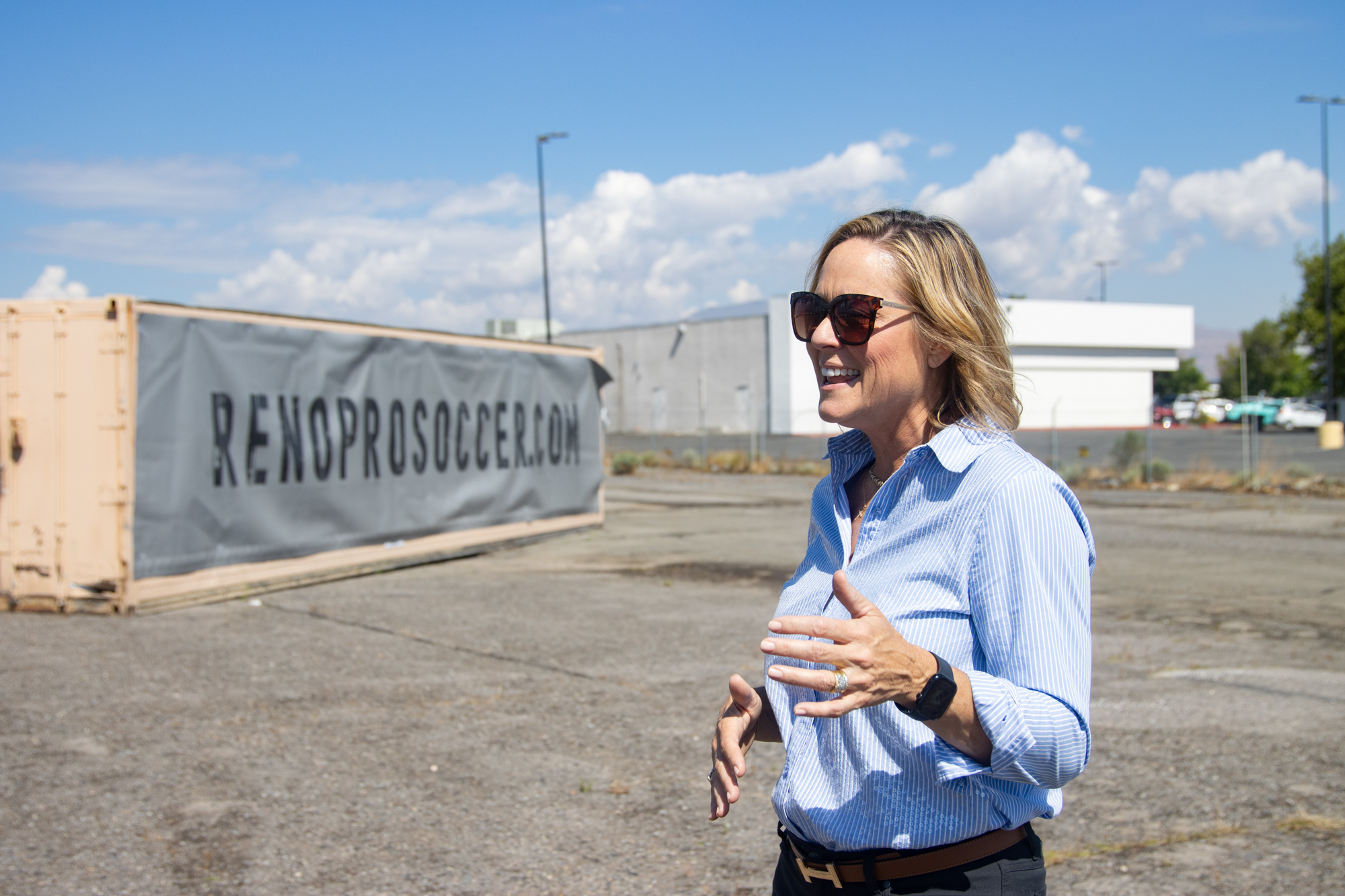
Two large shipping containers covered with hand-painted tarps have replaced a demolished auto dealership that took up land off the main freeway artery through Reno.
The messages are the same and simple: RenoProSoccer.com.
Wendy Damonte, who is leading the effort to land a professional soccer team in Reno, said she can visualize a day when the containers seen from Interstate 580 are gone, replaced by a 6,000-seat soccer stadium and an entertainment district with restaurants, bars, a 300-room hotel and a small casino.
For more than a year, she has been drumming up support for the $327 million venture — $40 million of which is designated for a stadium that could help bring a mini Vegas-style sports renaissance to the state's second-largest city. Based on experience from the Reno 1868 FC — a team whose run was cut short by the pandemic — proponents think there's enough fan energy to support a soccer team if only it can land its own venue.
Damonte, CEO of Reno Pro Soccer, is undaunted by the challenge of finding funds to build the project. The longtime Reno newscaster and television personality has helped raise funds for Northern Nevada charities and community organizations for years.
The website has an animated artist rendering of the stadium, but Damonte said the design has changed slightly. The team has not publicly released renderings of how the stadium and other aspects would fit on the site. Her group controls the site, including two adjacent parcels, that create a nearly 30-acre roadmap for the project.
Obtaining financing and government approvals are the initial steps and could drag into 2027. The stadium is expected to be the initial construction, which could take 12 to 18 months.
"Reno has been promised a lot of projects, primarily from outside developers and outside money," Damonte told The Nevada Independent last month. "We all live here. We're locals doing this for locals. So the fact that our entire Northern Nevada community will be able to see it come up out of the ground from the freeway and from Kietzke Lane makes it real."
Northern Nevada entrepreneur Todd Davis is listed as principal owner of Reno Soccer, which is seeking a USL Championship soccer team — a division just below Major League Soccer (MLS) — which has 25 teams including the Las Vegas Lights. The venue could also host concerts and other events.
Another TIF development in Reno?
Damonte said the group has raised $50 million in equity from "accredited investors." The initial goal is $150 million. There is also a plan to raise funds through tax-increment financing (TIF) — a public funding mechanism that freezes property taxes in a given area, and then diverts property tax revenue generated from a project back to the developer to pay for the construction costs.
But that effort would require approval from the Reno City Council. Damonte also suggested $177 million could be raised through debt financing.
"Those numbers will change slightly as the project becomes more finalized," Damonte said, adding that three votes would be needed from different government agencies before a formal groundbreaking could take place.
Also, Damonte said the stadium's financial backers may not know about the availability of TIF until the Reno City Council decides if it wants to extend the program, which is due to expire in the next few years. An extension would require legislative approval.
The two candidates seeking to be Reno's next mayor are supportive of the soccer stadium project, but want additional details on financial backing and how it would attract soccer fans to the city.
Reno Councilwoman Kathleen Taylor, one of two council members who opposed TIF last year for the Grand Sierra Resort's $450 million arena project, said the proposed soccer stadium site "is ideal for redevelopment." But, she remains concerned about awarding TIF money.
"There has to be a public benefit, and the applicant has to go through our process and undergo a third-party financial review," said Taylor, who is seeking the open mayor's seat in the middle of her four-year term. "We can determine if it makes sense for public funds. But I support private investment and redevelopment."
Her opponent, former State Treasurer Kate Marshall, said Reno residents "love soccer" and a "dedicated stadium for soccer would be a great draw." However, she isn't ready to say yes or no to TIF financing for the project.
"I haven't seen a proof of concept. I haven't seen the financials or received enough information to know if the proposal is ready to move forward and it's financially viable," Marshall said. "The private entity needs to make sure they are financially viable and have a plan. Then we can look at the partnership that a city might play a role in."
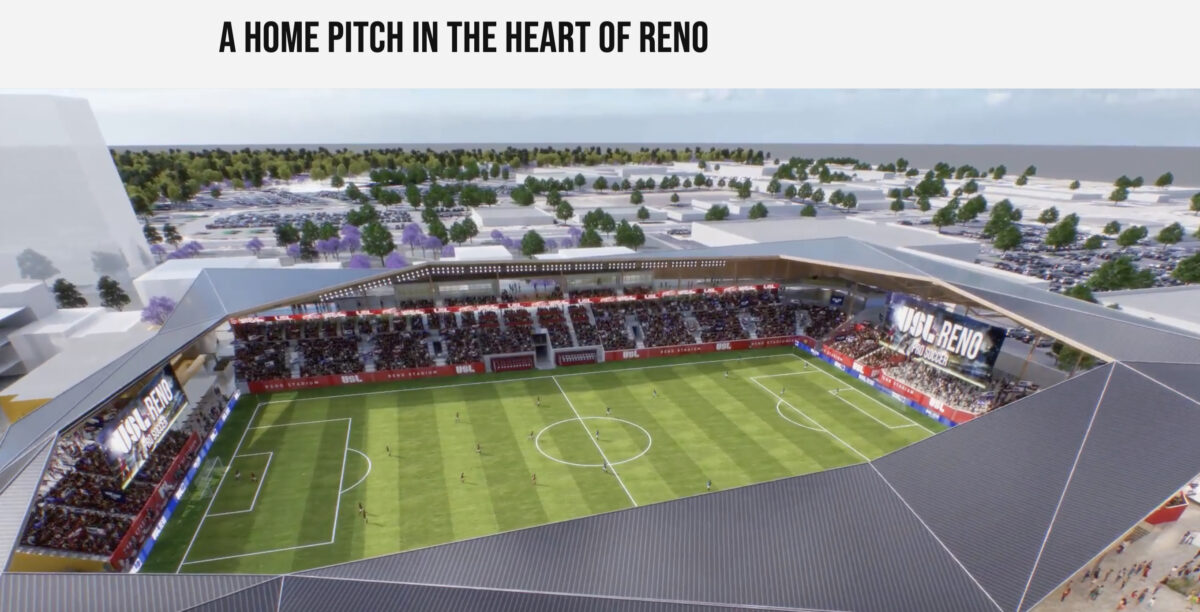

A soccer-only stadium
Damonte is encouraged by recent soccer history in Reno. The city had a USL team — Reno 1868 — from 2017-2020 and made the USL playoffs every year. When the pandemic halted all professional sporting events with fan attendance, the team couldn't recover and ceased operations.
Reno 1868's home stadium, Greater Nevada Field, is no longer an option for a soccer team.
The Triple-A Reno Aces are the primary tenant and Minor League Baseball's maintenance standards have risen, making it less feasible for regular soccer games.
Aces President Eric Edelstein said he doesn't view a soccer team as competition for Northern Nevada sports. He said the teams could easily coexist. However, sharing the 9,100-fan capacity ballpark is impossible given the changes in seating areas and other modifications made to the stadium since 2020.
"We're working on some bigger developments on some adjacent land and we have plans to activate that front lawn area, adding some food service and fencing that in," Edelstein said.
The Aces, the top farm team of Major League Baseball's Arizona Diamondbacks, moved to Reno in 2009 from Tucson. The Aces have a lease with the city through 2049.
"We learned during our soccer experience the games are the easy part. Coexisting on a full-time basis was just a burden too large," Edelstein said. "There are teams that are doing it. El Paso is still playing baseball and soccer in their stadium. But, most of them have gone away."
Damonte said the plan from the beginning is to build its own venue and be the primary tenant. She and team President John Doyle, a former American soccer player, MLS executive and club builder who will oversee the team's on-field operations, are spending time in the community raising awareness and growing fan support.


Building a fan base
During the World Cup soccer tournament in June and July, Reno Pro Soccer hosted more than a half-dozen watch parties at Reno Public Market to start building a fan base and drive awareness of the prospective franchise.
A Tuesday afternoon semifinal game between France and Spain drew a crowd mixed with supporters from both countries. Many said they were hopeful Reno could bring back professional soccer.
Seven-year Reno resident David Parre, who is originally from Toulouse, France, was a ticket holder for Reno 1868 and said he plans to buy season tickets for the new team. Meanwhile, Spain expats Teresa and Glicerio Mara, three-year residents of Reno, said they will join Parre to cheer on a Reno-based soccer team.
"We're excited to get pro soccer in Reno. There are a lot of soccer fans here," Glicerio Mara said.
Doyle, who played for the U.S. team in the 1990 World Cup and the 1988 Olympic Games, said he believes Northern Nevada would support professional soccer. In its final season, Reno 1868 averaged 4,300 fans per game, which was down from just under 5,100 fans the year before.
"There are 12,000 kids playing youth soccer in the Great Basin area. People here are excited about soccer," said Doyle, who spent nine years as general manager of Major League Soccer's San Jose Earthquakes, which is owned by John Fisher, who also owns Major League Baseball's Las Vegas-bound Athletics.
Doyle also cited Northern Nevada's large Hispanic population, which was similar to what he saw in San Jose, as a reason for the team's potential success.
"Soccer is part of their culture and their passion. They would go and support the team," said Doyle, who has since moved with his wife to Reno from Northern California to show his commitment to the franchise.
"There are all kinds of different models on building a team," Doyle said, adding that the Earthquakes relied on younger players rather than veterans. "They got a great opportunity to play and the community embraced it."


Development of Grand Sierra arena progressing
The proposed soccer stadium is one of two sports-related projects in Reno.
The Grand Sierra broke ground nearly a year ago on its 10,000-seat multiuse arena on the north end of the resort's 145-acre site. The venue, which will become the home court for the Nevada Wolf Pack men's basketball team, serves as the anchor for a broader $1 billion in non-gaming redevelopment for the property.
Although smaller than the 12,000-seat Lawlor Events Center on the Nevada campus, the venue will have state-of-art technology, modern acoustics and luxury suites that would help to draw headline entertainers and other sporting events that have normally bypassed Reno.
While the development is primarily being financed by Grand Sierra owner Alex Meruelo, the Reno City Council took more than six hours and voted 5-2 to approve an estimated $68.1 million through a TIF plan in May 2025.
Since the groundbreaking, Grand Sierra has spent much of the past year on foundation work for the arena, which will have a connection to the northern end of the resort. Adjacent sites are being prepared for a parking garage, a new entertainment lounge and a public ice skating venue.
The Reno sports community and hockey fans have speculated on the potential relocation of the ECHL's Tucson Roadrunners, which is owned by Meruelo, to play in the new arena. The team is the minor league affiliate of the NHL's Utah Mammoth. Grand Sierra President Shannon Keel, however, was noncommittal on potential for a professional hockey team to be part of the arena's roster of tenants.
Keel, who is overseeing the development, said the resort will provide an update on construction progress in the fall and offer a view of the arena layout. A grand opening timeline might also be revealed at that time.
"There are a lot of things that we are planning right now. But it's not like we're booking acts," Keel said. "That part will happen about a year out. We are doing things that go along with an arena project, like choosing seating and designing the public and private areas."
Reno Sparks Convention and Visitors Authority (RSCVA) CEO Mike Larragueta said the Grand Sierra arena opens up Northern Nevada to host NCAA basketball tournaments and top tier entertainment, given the venue is attached to a 2,000-room hotel.
Keel said Grand Sierra will open an experience center for the arena, where potential ticket buyers can "see all the renderings and get an idea about the different amenities." Grand Sierra also launched renohockey.com, to promote the ice skating venue as a hub for youth and adult recreational teams.

Reno mimics Vegas on a smaller scale
Reno's sports and venue efforts are small compared to what's happened in Las Vegas over the past 10 years and what's in the future. The city could eventually have teams in the five major professional sports leagues — NFL, NHL, Major League Baseball, WNBA and NBA — with at least three recently built venues — Allegiant Stadium, T-Mobile Arena and the under-construction $2 billion baseball stadium for the Athletics.
"The whole reason we started this project was because of Vegas," Damonte said. "Vegas is crushing it and they have turned themselves into a sports and entertainment capital. I love sports and I love what sports do for a community."
Larragueta said he's met several times with Damonte to discuss the soccer stadium and other events the facility could host. He also had her meet with members of the authority's staff to discuss concert bookings and other forms of entertainment.
Larragueta said he encouraged Damonte to explore other sports, including rugby and lacrosse, given the potential of attracting additional visitation to Reno.
"I think if Wendy and her team can pull this off, it would be a huge coup for Northern Nevada," he said. "The area they've identified is a little bit blighted, so it's really going to help us from a business development standpoint."
Support Independent Elections Coverage and Journalism in Nevada
You’ve enjoyed unlimited access to our reporting because we’re committed to providing independent, accessible journalism for all Nevadans.
But sustaining this work — informing communities, holding leaders accountable, and strengthening civic life — depends on readers like you.
Nevada needs strong, independent journalism. Will you join us?
A gift of any amount helps keep our reporting free and accessible to everyone across our state and funds our elections coverage.
Choose an amount or learn more about membership