
Can the high-profile reentry program Hope for Prisoners survive its founder's fall from grace?



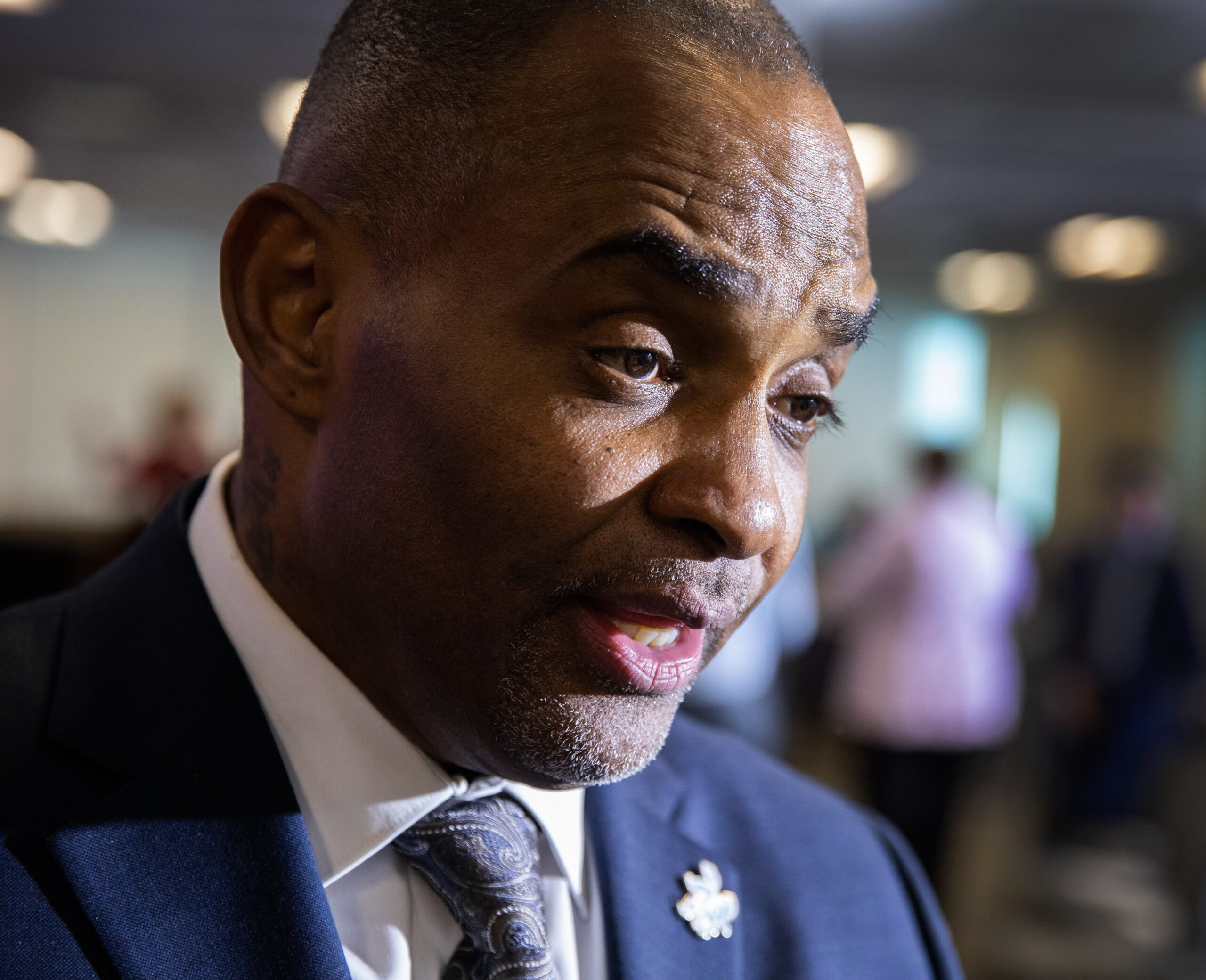
After Hope for Prisoners founder Jon Ponder was arrested last month on more than 20 charges related to sexual misconduct, including sexual assault, a community that had once rallied behind the convicted bank robber-turned-advocate was rattled.
"I just couldn't believe it," Sonya Williams, the executive director of the Christian Walker Re-Entry and Justice Foundation, said. "Like, why would it be investigated? He had the president of the United States backing him," referring to President Donald Trump's 2020 pardon of Ponder for prior convictions related to bank robberies.
Hope for Prisoners was a mammoth presence in the prison reentry community, with Ponder at the helm of a politically connected nonprofit devoted to equipping individuals leaving incarceration with skills and resources — from job training to financial management classes — they could use to succeed outside prison.
Trump was just one of the high-profile political figures — from both major parties and across the state and the country — who have praised the group's work over the years. Ponder allied with state and local authorities from the beginning, partnering with the Las Vegas Metropolitan Police Department (LVMPD), launching programs in Nevada's prisons and attracting prominent community members to its board.
Ponder's arrest raises questions about the future of Hope for Prisoners and perhaps threatens to eclipse the organization's impact. Since its establishment in 2009, it has helped thousands of people transition out of prison by connecting them with jobs and mentoring opportunities. A 2016 study from UNLV found that nearly two-thirds of participants found full-time employment and only 6 percent were reincarcerated over an 18-month period, well below national and state recidivism rates.
After the news broke, the Hope for Prisoners' Facebook page was flooded with comments from people saying the program had transformed their lives. But those familiar with the prison advocacy system in Nevada and with Hope for Prisoners said the group has a long way to go to move beyond the shadow of the scandal.
A source from within Nevada's prison reform community said Hope for Prisoners was at serious risk due to the reputational harm from Ponder's allegations and that the group could fall apart unless it enacts structural changes, including revamping its board and updating its procedures guiding interactions with inmates.
Hope for Prisoners graduates say they are grateful to the organization. David Saine, a former inmate in the Nevada Department of Corrections (NDOC) for a felony conviction, went through the organization's six-week commercial driver's license program at Three Lakes Valley Conservation Camp, hoping to become a truck driver after leaving prison.
"It was great," Saine said, though he said he has struggled to find a truck driving job due to his record. "All the other people there, they're like eager to help you not for any other reason than to see you succeed."
Hope for Prisoners did not return a request for comment from The Nevada Independent.
Rise to prominence
Following his release from a federal prison in Pennsylvania in 2009, Ponder moved back to Las Vegas and launched Hope for Prisoners in 2010. The program relied on private donations at first, including from an array of prominent local church leaders, but soon picked up steam.
According to former prisoners and people working in the prison justice field, Hope for Prisoners was the first organization of its kind in Clark County.
"They were kind of the first ones to do reentry work with former prisoners and families," Saine, a Las Vegas native, said. "They saw a market and then capitalized on it."
In Hope for Prisoners' signature program, inmates enroll in an 18-month course featuring intensive classes and mentorships providing career counseling and emotional support. The organization started with just 12 participants in 2010 but grew quickly, adding new programs and services. Last year, more than 600 people graduated from its various programs.
After its launch, Hope for Prisoners and Ponder himself soon began to garner frequent media coverage, with positive profiles written in 2012 in the Las Vegas Review-Journal and the Las Vegas Sun.
By 2016, the group was being cited frequently as an example of criminal justice reform that both parties could get behind. The next year, Ponder was appointed to the Nevada Sentencing Commission by then-Gov. Brian Sandoval (R).
Videos and recollections from those who met or knew Ponder at the time paint the picture of a charismatic, confident man, comfortable in front of influential politicians, academics, prisoners and police officers alike.
As Hope for Prisoners' profile grew, Ponder began to rub elbows with some of Las Vegas' most influential politicians, particularly in law enforcement. In a 2016 video featuring then-Assistant Sheriff Todd Fasulo, who is now vice president of security for the Wynn hotel, Fasulo pointed to a reason that law enforcement and Hope for Prisoners worked well together.
"The police don't have to become the bad guys anymore, we actually become part of that solution," he said in the video. "We actually help someone stay out of jail."
Clark County District Attorney Steve Wolfson (D) partnered with Ponder in 2019 to launch a diversion program called Hope for Second Chances, although it is unclear for how long the program operated.
Hope for Prisoners also ran programs out of some state prisons by 2019, including Florence McClure, an all-female facility, and High Desert, the state's largest and highest-security facility. Within five years, those prison partnerships would expand to include Southern Desert Correctional Center, Casa Grande Correctional Center and Jean Conservation Camp.
Many of the group's programs were run in partnership with Las Vegas' police department, which from 2015 to 2023 was helmed by then-Clark County Sheriff Joe Lombardo (R), who was soon to become governor.

"Politicians loved the point of it"
Attorneys and sources familiar with the group said it had more conservative values than some other prison-related groups, with a deep connection to law enforcement and Christianity.
Graduations for the Hope for Prisoners program were routinely hosted at the Las Vegas police department headquarters, and police officers would teach classes to program participants. At the mention of police, participants in graduation ceremonies would call back in unison, "Our friends."
The source from Nevada's criminal justice reform space told The Indy that Ponder's group was distinct in that it forged partnerships with law enforcement almost immediately.
Most groups that work with inmates in Nevada feel a sense of friction with law enforcement, the source said, which made Ponder's explicit embrace of and direct partnerships with law enforcement seem even more unusual.
This approach gave the group much of its political purchase, sources told The Indy. Trump embraced it as proof that "this is the country where anyone can make a comeback," as he said during a 2020 graduation ceremony for the group, hosted by the LVMPD and attended by the billionaire casino magnate Miriam Adelson, former Las Vegas Mayor Carolyn Goodman and a variety of religious leaders.
A prominent Nevada lawyer, who spoke to The Indy on the condition of anonymity, called the organization "incestuous in terms of the politics" and "cultish."
"He had some big names on his board," Williams said, describing Ponder as someone she previously admired. "He didn't have to answer to many people because he had the names on there."
At various points in its history, the group's board included Wolfson, current Clark County Sheriff Kevin McMahill, former Gov. Robert List (R) and Paula White-Cain, a senior adviser to the White House Faith Office during the first Trump administration.
The organization, which has reported millions in revenue over the past five years, also collectively received millions in donations from prominent local residents and groups, including millionaire gambler and fellow Trump pardonee Billy Walters, tech entrepreneur Ben Horowitz and the Engelstad Foundation, originally founded by Vegas casino magnate Ralph Engelstad.
Wolfson touted his past work with Hope for Prisoners as proof of his support for "smart reform" in his 2022 reelection campaign, when he faced a primary challenge from a more progressive opponent, defense lawyer and former Assm. Ozzie Fumo (D-Las Vegas).
"Politicians loved the point of it … 'Here's something that we're doing to help reintegrate prisoners or ex-prisoners back into society,'" said the lawyer.
Allegations
Despite the group's outward success, Ponder's conduct came under scrutiny in 2020 after the board of directors hired an outside investigator to look into allegations of sexual impropriety. The investigation came just months after his pardon by Trump and his partial pardon from then-Gov. Steve Sisolak (D).
After the investigation, the group's legal counsel advised the board to fire Ponder, the Nevada Current reported first, but the board did not heed the recommendation.
At the time, the board was composed of a range of influential Nevadans — McMahill, Wolfson, Fasulo, Latin Chamber of Commerce President Peter Guzman, List, attorney Jeff Cooper, Republican political figure and businessman Donnie Gibson, former North Las Vegas Economic Development Director Gina Gavan, Sheri Sani, finance executive Richard Worthington, as well as attorney Kristina Wildeveld.
Lombardo did not directly respond to a question asking whether he knew about the allegations against Ponder while he was Clark County sheriff.
Wolfson did not respond to comment in time for publication.
In September 2020, Wildeveld, formerly a staunch advocate for Ponder, resigned over the allegations against him, writing in a letter obtained by the Current that the board had gotten "lost in the fame and fundraising" that accompanied the organization's growing national prominence. Wildeveld wrote that the allegations against Ponder were numerous and credible and claimed the board's integrity had been compromised, writing that "notoriety and fundraising appears to be the only concern."
Ponder's August arrest report sketched the image of a man who was willing to flout rules to pursue relationships with women. The alleged abuse, which took place in part at several women's facilities for inmates or recently released inmates within Nevada, was somewhat of an open secret, with Ponder allegedly giving special attention to incarcerated women he found attractive and sometimes disappearing with them behind closed doors.
In the arrest report, in which victims' names are redacted, one woman describes being told by Ponder that she would be offered employment at Station Casino, only to be told that residents of Casa Grande, the reentry center where she lived, were not eligible for employment there. Another woman describes staff members turning a blind eye when she was singled out by Ponder.
"I can remember walking by staff members and them directly looking at me knowing I'm going back into (sic) office," the woman told police officers, according to the report. "Nobody ever said anything, nobody ever stopped us."
Ponder also allegedly touted his connections while skirting rules in NDOC prisons. One correctional officer said he "bragged about his political connections and trips to Washington, D.C," according to the report.
The arrest report mentions that Ponder would show up in the prison in inappropriate clothing, bypassing security checks, bringing in banned objects, such as cellphones and securing special permissions for his employees.
"Ponder runs this place," a Jean Conservation Camp staff member allegedly told a Hope for Prisoners staff member.
Ponder was prohibited from entering any state prison facility starting April 23, after NDOC conducted an initial investigation which was subsequently referred to Metro.
In a statement, NDOC spokesperson Teri Vance wrote that the agency "prioritizes the safety and security of all offenders while also preparing them for safe reentry back into society."
Future
Some criminal justice reform advocates say that the organization has taken a devastating hit to its reputation, one it's not yet clear it can recover from. Williams, as well as her colleague Amy Estrada-Ortiz, said parolees and newly released inmates might get spooked by Ponder's criminal record.
Estrada-Ortiz said the whole situation was "so sad," especially given the women's position. "I'm sure they feel helpless … they don't want to get in trouble," she said of Ponder's victims.
"It sucks," Williams said, of how the situation affects their own reentry work. "We're trying to convince people that these guys need a second chance."
Others, however, predicted the organization will ultimately be able to weather the storm.
The prison reform advocate said that the group's programs themselves were widely respected, even if people disagreed at an individual level with Ponder's more conservative, less reform-minded view of the prison system.
The advocate added that they hope the group's offerings to current and former inmates remain operative. These programs include a 10-week course in Southern Desert Correctional Center where inmates can earn their commercial driver's licenses.
Lombardo and NDOC confirmed to The Indy that the state does not expect any disruptions to the jobs training program at Southern Desert.
The group's future is likely going to involve a number of changes, although it's unclear what steps, if any, Hope for Prisoners has taken so far. Ponder has been placed on administrative leave, but the group has not publicly commented on his arrest. Comments are turned off on its Instagram and Facebook pages.
The advocate said that more oversight would give the group its best chance at future success, such as having female employees work exclusively with female inmates.
Support Independent Elections Coverage and Journalism in Nevada
You’ve enjoyed unlimited access to our reporting because we’re committed to providing independent, accessible journalism for all Nevadans.
But sustaining this work — informing communities, holding leaders accountable, and strengthening civic life — depends on readers like you.
Nevada needs strong, independent journalism. Will you join us?
A gift of any amount helps keep our reporting free and accessible to everyone across our state and funds our elections coverage.
Choose an amount or learn more about membership