
Nevada's district attorney races are often uncontested. Here's why experts say it's a problem.

Elected prosecutors are some of Nevada's most influential local officials — responsible not just for bringing criminal charges, reaching plea deals and proposing prison sentences but also for determining a county's overall approach toward criminal justice issues.
A progressive prosecutor might decline to pursue low-level marijuana possession cases they feel are unjust. A conservative one might frequently request the death penalty.
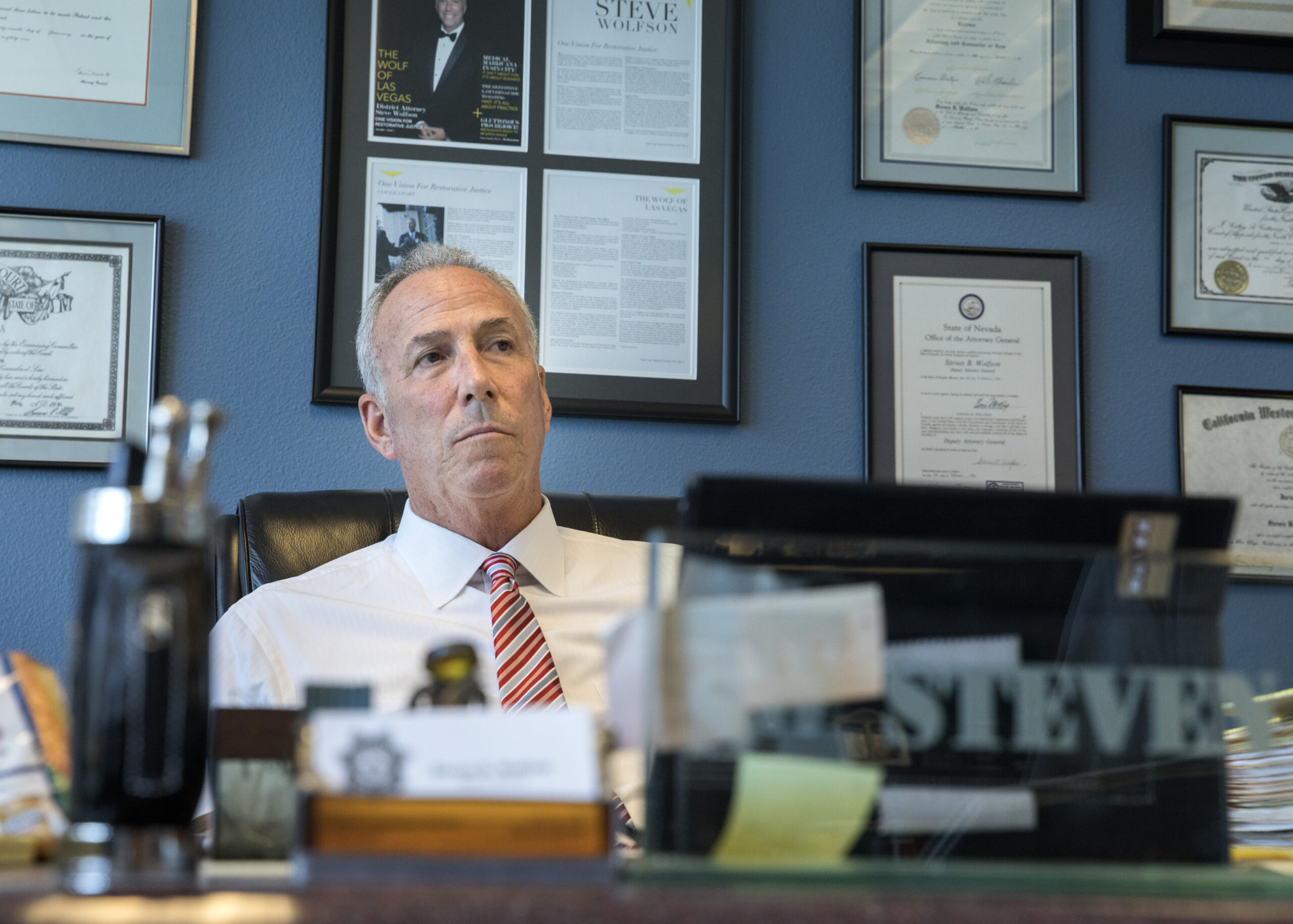
But despite the importance of these positions, Nevada's district attorneys are rarely challenged in their re-election bids — and are even more rarely defeated. Some of the state's incumbent district attorneys have been in office for more than two decades without ever facing an opponent. In Nevada's most populous county, Clark, Democratic District Attorney Steve Wolfson has easily won re-election in his three races since his 2012 appointment and is running uncontested for the first time this year.
Criminal justice experts blame the lack of competition in district attorneys' races in part on the small field of contenders qualified to seek the office, especially in rural areas. They warn that having so little competition reduces the transparency of local governments and enables prosecutors with past scandals to be elected or re-elected with little scrutiny.
But this year has seen more political upheaval than usual in prosecutors' offices. Of the three incumbent prosecutors facing primary challengers this year, two were defeated. The third, Nye County District Attorney Brian Kunzi (R), clung on by just 300 votes.
In Washoe County, incumbent Chris Hicks lost in an upset to Sparks City Attorney Wes Duncan in the Republican primary. It was Hicks' first primary challenge since being elected in 2014. Esmeralda County District Attorney Robert Glennen also lost in the Republican primary, facing his first opponent since his 2012 appointment.
These results may indicate a shift in the status quo. But the majority of candidates running for district attorney this year in Nevada face no opponent.
District attorneys are elected every four years in Nevada's 16 counties and single independent city, Carson City. This year, 10 of those 17 races have just one candidate. That's slightly less than in 2022, when 12 in 17 races were uncontested.
In one county — Humboldt — the incumbent prosecutor is not seeking re-election, meaning a new prosecutor will be chosen without opposition. In the nine other uncontested races, incumbents will be automatically re-elected.
Uncontested prosecutor races are neither new nor unique to Nevada. The Prosecutor and Politics Project at the University of North Carolina School of Law wrote in its recent report that from 2014 to 2024 just one-quarter of the races for county prosecutors nationwide were contested.
Professor Carissa Hessick, director of the project, told The Indy that voters might not even know who their county district attorney is, or that it's an elected position, in part because uncontested races often don't appear on primary ballots and because of voters' generally low interest in local offices.
It's particularly common for district attorneys to go unchallenged in rural counties, said Hessick, where attracting high-quality legal talent is difficult.
That's especially true in Nevada, a state with weaker-than-average legal infrastructure. A 2020 report by the American Bar Association found that two-thirds of the state's counties were "legal deserts," or areas with less than one attorney per 40,000 residents.
Legal officials and experts in Nevada lament the difficulties of fielding candidates for the role of elected prosecutor and of finding lawyers to serve as their appointed deputies.
Pershing County spent months last year searching for a new district attorney after Gov. Joe Lombardo (R) appointed longtime prosecutor Bryce Shields to a local judgeship in 2024. The county hasn't had a contested prosecutor election since 1998.
Prior to finding a replacement, interim district attorney Jack Bullock told county commissioners during a March 2025 meeting that he was struggling to find interested candidates.
"People don't want to move to Lovelock. … It's hard to commute, the drive is difficult and gas prices are going up," Bullock told the commissioners. "When you drive down Main Street, it's pretty bleak."
Why are races uncontested?
It's difficult to know why some district attorneys rarely face challengers, said Hessick, especially since one possible answer is that voters are simply satisfied with their performance.
But another explanation for the rarity of competitive races is a small talent pool.
Prosecutors' offices "aren't like a lot of other local races" such as school boards or mayorships, said Hessick. In those positions, residents hailing from a variety of backgrounds can choose to run against a politician they disagree with. But running for prosecutor requires having a law degree and passing the Nevada Bar Exam — a much higher bar.
That threshold is especially hard to meet in rural areas. Prosecutor candidates told The Indy that the sparse populations and long distances in rural Nevada make it a struggle for counties to attract lawyers, prosecutors and public defenders.
Mark Jackson, the long-serving Douglas County district attorney, says the problem has gotten worse ever since the COVID-19 pandemic normalized remote work. It's more difficult to convince attorneys to move to rural areas, he said — and while residency in a county isn't a requirement to serve as county prosecutor, he said it helps do the job.
"Drawing in talent into the rural counties is so much more difficult today," Jackson said.
It's not just in Nevada, he added. Getting candidates interested in rural criminal justice is a problem everywhere, with many future lawyers questioning if rural work is "really what they want to do."
Even when eligible candidates exist, Hessick said recruiting them can be difficult. If a deputy district attorney wants to run, "It can be really uncomfortable to challenge their boss," she said.
The same goes for defense attorneys, who must negotiate with prosecutors on charges and plea deals. For public defenders, said Hessick, "There's a disincentive there to aggravate the sitting prosecutor by saying you're going to run against them."
Some experts have argued that appointing prosecutors or implementing term limits on them could reduce conflicts of interest and encourage qualified candidates to run. Other experts have suggested that term limits could further shrink an already-small talent pool or result in sitting-duck prosecutors with little incentive to care about the public's opinion. Nevada does not impose term limits on judges or justices, either, although they apply to many other elected positions.
Hessick said research on term limits' influence has been generally inconclusive, in part because only one state — Colorado — even imposes them on district attorneys. When incumbent prosecutors run for re-election in Colorado, they are about as likely to face an opponent as incumbents in other states.
Four states — Alaska, Connecticut, Delaware and New Jersey — appoint county prosecutors, while a handful of other states allow individual counties to choose if they'd rather elect or appoint their district attorneys.
Prosecutors' influence
County prosecutors have a wide range of responsibilities, from defending counties in lawsuits to advising their agencies on legal matters and attending public meetings.
They often bear the brunt of criticism over crime trends and legal policy decisions. In Washoe County, incumbent Hicks lost re-election in the Republican primary this year to Duncan, who was Hicks' first-ever challenger since his 2014 election and who won by 16 points.
Duncan ran an aggressive, negative campaign accusing Hicks of ethical violations — including nepotism favoring his wife's career — and claimed publicly that Hicks had enabled "levels of violence that we haven't seen before in this community."
One of Duncan's criticisms concerned a controversial plea bargaining and charging policy introduced by Hicks in 2022.
Police union leaders and other critics had slammed the policy, claiming it made it harder to press charges while also producing more criminal trials rather than plea deals. Duncan told The Indy after his victory that revoking the policy was his top priority.
Prosecutors are also active in state politics. Of the 188 criminal justice bills introduced in the Legislature between 2014 and 2018, Nevada's elected district attorneys lobbied on half of them.
One of the most high-profile political issues involving Nevada's elected prosecutors is the death penalty, which state lawmakers have repeatedly failed at curtailing or ending, despite their efforts. Wolfson, the Clark County district attorney, and other prosecutors have criticized or publicly testified against the push to repeal the death penalty at multiple junctures, making emotional appeals alongside family members of those killed in some of the most heinous crimes committed in their counties.
Wolfson's linkages to the Legislature have come under particular scrutiny. Some critics blamed the death of bills in 2019 and 2021 that would have outlawed the death penalty on Sens. Melanie Scheible (D-Las Vegas) and Nicole Cannizzaro (D-Las Vegas), the latter of whom was also Senate majority leader. Both senators worked in Wolfson's office at the time.
The issue arose in primary challenges to Wolfson from the left in 2018 and 2022. His opponent in 2022 was Assm. Ozzie Fumo (D-Las Vegas), one of the lawmakers most involved in the 2019 effort to repeal the death penalty. Fumo lost to Wolfson by 12 points in the Democratic primary, the same victory margin Wolfson had in 2018 over progressive attorney Robert Langford.
This year, Wolfson is running for re-election uncontested.
There is mixed research on how contested elections might affect prosecutors' behavior. Some studies have found that defendants are more likely to be charged or convicted in years where district attorneys face electoral opponents — suggesting prosecutors more aggressively pursue cases in years of heightened scrutiny. But research is limited, and other studies have been inconclusive.
Why advocates worry
Criminal justice expert Ronald Wright told The Indy that contested elections can help boost Americans' trust in political institutions, citing research showing that the public generally trusts legal decisions reached by juries more than judges.
"Generally, it's better for democracy if people feel like they have a choice," Wright said. "They feel more invested in it, like the criminal courts are our criminal courts, rather than something imposed from the outside."
This year, Nye County Manager Tim Sutton ran for district attorney in Esmeralda County, the first person to challenge Robert Glennen, the incumbent, since his 2012 appointment.
Speaking to The Indy before the primary election, Sutton said he ran in part because "it's good for the people of Esmeralda County to have a choice, whether I get elected or not."
Sutton beat Glennen in a landslide in the primary.
Glennen, who was publicly reprimanded in 2013 and 2019 for prosecutorial misconduct, was one of multiple prosecutor candidates in Nevada this year with past disciplinary issues.
Lander County District Attorney William Schaeffer formerly served as district attorney in Esmeralda County, where the county sheriff unsuccessfully pushed for his removal, and in Eureka County, where he faced a recall effort. He's running unopposed this year.
In Pershing County, voters just elected a new district attorney, lawyer Steve Evenson, who was publicly reprimanded in 2022 for conducting himself inappropriately in court and submitting documents late.
Evenson beat lawyer Steve Girardot in the primary. In the general election he will face the county's current district attorney, Derrick Penney, who is running as a Democrat. Penney was formerly suspended from practicing law because of ethical and professional violations, including concealing information from the Bar and using $150,000 of a client's money for personal use. (Penney later repaid the money.)
Hessick said she believes it's important for elections to be contested, but that it's even more important for citizens to be aware of and engaged with local prosecutors.
"Elections serve as a 'pull this in case of emergency' lever," she said, but added there's more to holding prosecutors accountable than voting. "In my ideal world, the public would be more aware of the really important decisions that their local prosecutor is making."
Support Independent Elections Coverage and Journalism in Nevada
You’ve enjoyed unlimited access to our reporting because we’re committed to providing independent, accessible journalism for all Nevadans.
But sustaining this work — informing communities, holding leaders accountable, and strengthening civic life — depends on readers like you.
Nevada needs strong, independent journalism. Will you join us?
A gift of any amount helps keep our reporting free and accessible to everyone across our state and funds our elections coverage.
Choose an amount or learn more about membership